- Disclosure & Barring Service (DBS)
-

 11 min read





On 1 September 2026, one of the most significant changes to the DBS checking regime in over a decade came into force. The Crime and Policing Act 2026 removes the supervision exemption from the definition of regulated activity with children. From that date, a large group of volunteers who had never needed an enhanced DBS check now need one, complete with a check of the children’s barred list.
Most of the coverage so far has been written for schools, charities and HR teams. This guide is written for the people actually being checked. It explains who comes into scope, who stays out, and, most importantly, what to do if you have a caution, an old arrest or anything else on your record that a check might now surface.
What Has Changed and Why
Regulated activity is the legal category that determines who must have the highest level of DBS check. A person working in regulated activity with children needs an enhanced DBS check with children’s barred list information, and a person on the barred list cannot lawfully do the work at all.
Since 2012, the definition has contained a carve-out known as the supervision exemption. Under it, unpaid activities such as teaching, training, instructing, caring for or supervising children did not count as regulated activity if the person was supervised by someone who was themselves in regulated activity, for example a class teacher. A parent hearing children read in a classroom, or an assistant coach working under a head coach, sat outside the definition however often they attended.
The Crime and Policing Act 2026 removed that exemption with effect from 1 September 2026. The reasoning is straightforward: a person who poses a risk to children should not be able to work regularly with them in any role, supervised or not. The change applies in England.
Who Is Now in Scope
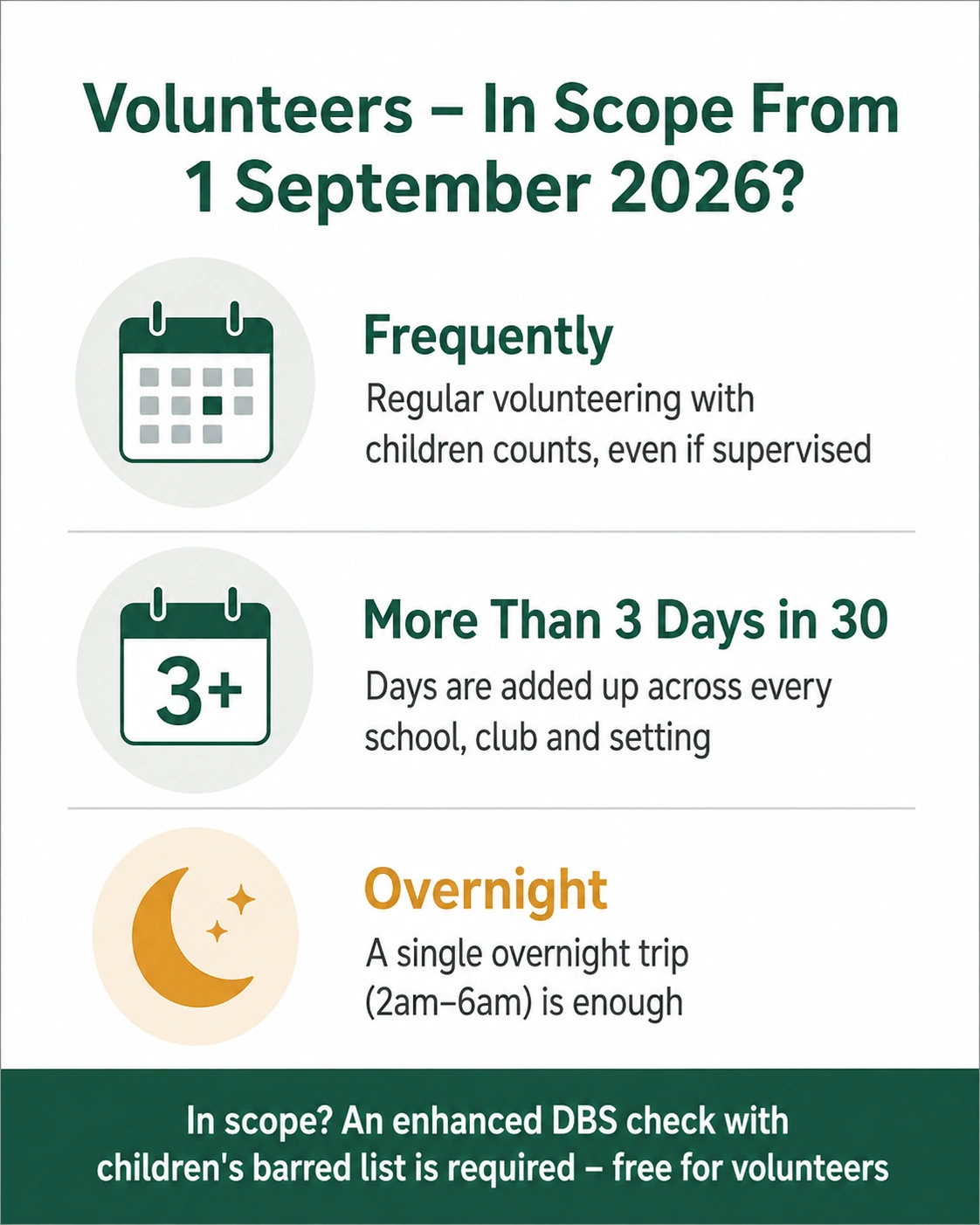
From 1 September, anyone who teaches, trains, instructs, cares for or supervises children is in regulated activity, whether supervised or not, if they do it:
- frequently, or
- on more than 3 days in any 30-day period, or
- overnight, between 2am and 6am.
Before the change, the exemption was capable of applying to paid and unpaid supervised roles alike, although in practice it was volunteers who most often relied on it, which is why the official guidance and most commentary focus on them. The main group affected is volunteers and other unpaid helpers in supervised roles, but anyone whose role sat outside regulated activity because it was supervised should look at the position again now. Typical examples include parents who help with reading in class every week, assistant coaches at junior sports clubs, regular helpers at youth groups, cadet and uniformed organisations, and volunteers in faith settings.
Two details in the official guidance deserve more attention than they have had. The first is that days are counted across every setting, not per organisation. A person who volunteers one day a month at four different schools or clubs meets the more-than-3-days threshold, even though no single organisation sees them more than once. Anyone who spreads their volunteering across several settings needs to add it all up.
The second is the overnight rule. A single overnight trip is enough. Every volunteer who helps on an overnight school or club trip is in regulated activity from 1 September, regardless of how rarely they otherwise volunteer. Anyone helping with a residential trip needs the new level of check.
All volunteers in regulated activity now need an enhanced DBS check with children’s barred list information. The check is free for volunteers, and the DBS Update Service, which keeps a certificate current and portable between organisations, is also free for volunteers.
Who Is Not Affected
The change does not sweep in every parent who ever sets foot in a school. Parents and carers who help out occasionally are outside the new requirement. Helping at an occasional PTA event or accompanying a daytime school trip does not bring a person into regulated activity, and the guidance says so in terms.
Occasional helpers can still be asked for an enhanced or basic DBS check without barred list information if the school or club wants one, but there is no legal requirement, and no barred list check is involved.
Self-employed people who work with children for payment, such as private tutors and coaches, are a separate strand of this year’s changes. Since January 2026 they have been able to apply for their own enhanced checks through a DBS umbrella body. Our guide on self-employed Enhanced DBS checks and disputes covers that route and what to do if a certificate discloses something unexpected.
The Barred List – The Serious End of the Change
The new checks are not just enhanced checks. They include the children’s barred list, and that is where the change has real teeth.
A person on the children’s barred list cannot engage in regulated activity with children. From 1 September, that prohibition reaches supervised volunteer roles it never reached before. It is a criminal offence for a barred person to engage in regulated activity, and a criminal offence for an organisation knowingly to permit it. The guidance is blunt about the consequence: a barred person volunteering in a supervised role affected by the change must inform their school, club or setting and stop immediately.
Two things about barring are widely misunderstood. The first is that a person can be barred without ever having been convicted of anything. Barring decisions can follow referrals from employers and regulators, and an allegation that never reached court, or a case that ended in acquittal, does not prevent one. The second is that barring decisions can be challenged. Representations can be made before the DBS reaches a final decision, and a concluded decision can be appealed to the Upper Tribunal. Our note on barred list appeals after SA v DBS explains how those appeals work and what a successful appeal achieves. Our DBS barring appeals service covers the full process.
What If You Have a Caution, an Arrest or a Record?
A large group of adults is now being checked at the enhanced level for the first time in their lives. Some of them have history: a caution from decades ago, an arrest that went nowhere, an investigation that ended without charge. Many have no idea whether it will appear on a certificate.
An enhanced DBS check can disclose two broad categories of information. The first is convictions and cautions, unless they are removed by the filtering rules. Those rules take some older and less serious matters off certificates after set periods. Filtering does not cover everything. Offences on the specified list are never filtered, and many cautions and convictions continue to be disclosed for life. The second category is non-conviction information: matters the police hold on their records which they consider relevant to the role and proportionate to disclose. That can include arrests, closed investigations and allegations that never reached court. Our guide on what can show on an Enhanced DBS check explains both categories in detail.
If any of that applies to you, the order in which you do things matters. The records that feed a DBS check can, in some circumstances, be addressed before a check is ever made. A caution can sometimes be deleted from the Police National Computer. Records of arrests and investigations that ended without action can be the subject of deletion applications. The local records held by police forces, which are the main source of non-conviction disclosure, can be challenged through a separate route. Our guide to the Record Deletion Process explains how the national applications work. A record that has been deleted before you apply is never assessed and never disclosed.
If a certificate has already been issued and discloses something you believe is wrong, irrelevant or disproportionate, the certificate itself can be challenged. The time limits are short, and our Enhanced DBS certificate appeals service deals with exactly this.
What Schools, Clubs and Charities Need to Do
For organisations, the task is to identify everyone whose role involves teaching, training, instructing, caring for or supervising children and was treated as outside regulated activity because it was supervised. Volunteers are the largest group. The next step is to work out who meets the thresholds once their time across all settings is counted. Volunteers who meet them need an enhanced check with children’s barred list information, and an existing enhanced check without barred list information does not satisfy the new requirement.
Schools and colleges that need to cover the gap while a check is processed can use the Department for Education’s check a teacher’s record service to run a standalone barred list check in limited circumstances. The checks themselves are free for volunteers, and encouraging volunteers onto the Update Service means one check can serve several organisations.
The obligation has a hard edge. Knowingly permitting a barred person to engage in regulated activity is a criminal offence, which is why the identification exercise needs to be done properly rather than left to chance.
How Legisia Can Help
We advise volunteers and workers on what an enhanced check with barred list information is likely to disclose in their case. We prepare applications to delete cautions, arrest records and local police records before a check is made. We also challenge certificates that disclose information unfairly, and represent people facing barring decisions at every stage.
If you are one of the many volunteers now in scope, and you are worried about what a check will show, the most useful step is to find out where you stand before you apply.
We offer a fixed-fee initial consultation where we will assess your position in detail and provide clear written advice on your options.
To discuss your situation, contact us or call 020 8099 9051.
Frequently Asked Questions
Do volunteers need a DBS check from September 2026?
Many will. From 1 September 2026, the supervision exemption is removed from the definition of regulated activity with children in England. Volunteers who teach, train, instruct, care for or supervise children are in regulated activity if they do so frequently, on more than 3 days in a 30-day period, or overnight between 2am and 6am, even if a member of staff supervises them. Volunteers in regulated activity need an enhanced DBS check with children’s barred list information. Checks are free for volunteers.
I only help at my child’s school occasionally. Do I need an enhanced DBS check?
No. Parents and carers who help out occasionally are not affected by the change. Helping at an occasional PTA event or on a daytime school trip does not bring you into regulated activity. The change applies to those who volunteer with children frequently, on more than 3 days in a 30-day period, or overnight. A school can still request an enhanced or basic check without barred list information for occasional helpers if it wishes.
Will an old caution show on a volunteer’s enhanced DBS check?
It can. An enhanced DBS check discloses convictions and cautions unless they are filtered under the filtering rules, which remove some older and less serious matters after set periods. Many cautions do still appear, particularly for offences on the specified list, which are never filtered. If a caution is likely to be disclosed, it is sometimes possible to apply to have it deleted from the Police National Computer before a check is made.
I was arrested or investigated but never convicted. Can that appear on an enhanced check?
It can. On an enhanced check, the police can disclose non-conviction information where they consider it relevant to the role and proportionate to disclose. That can include arrests, investigations that ended without charge and allegations that never reached court. The records behind these matters can sometimes be deleted through applications to the police, which removes them from the material available to a future check.
What happens if a volunteer is on the barred list?
A person on the children’s barred list cannot engage in regulated activity with children, and it is a criminal offence to do so. It is also an offence for an organisation knowingly to permit it. A barred person volunteering in a supervised role affected by the change must tell the school, club or setting and stop immediately. Barring decisions can be challenged, through representations before a final decision is made and through an appeal to the Upper Tribunal afterwards.
Share this Post, Choose your platform!

Matt is a Solicitor Advocate and Director of Legisia Legal Services. He specialises exclusively in police record deletion, DBS appeals, and regulatory defence. With over 20 years of experience, he has advised hundreds of professionals and individuals on high-stakes matters affecting careers, reputations, and legal standing. His work focuses on challenging unlawful data retention, safeguarding thresholds, and procedural breaches across UK policing and disclosure systems.
Matt is a Solicitor Advocate and Director of Legisia Legal Services. He specialises exclusively in police record deletion, DBS appeals, and regulatory defence. With over 20 years of experience, he has advised hundreds of professionals and individuals on high-stakes matters affecting careers, reputations, and legal standing. His work focuses on challenging unlawful data retention, safeguarding thresholds, and procedural breaches across UK policing and disclosure systems.
Disclosure & DBS: the complete CPD course for professionals
Written by a solicitor who handles these cases every day. For HR, compliance, safeguarding and legal professionals who make decisions about police records and DBS disclosures.
- Eleven modules covering disclosure, DBS checks, barring, regulatory interface and employment decisions
- The only UK course that also covers how UK records affect work, travel and employment abroad
- CPD-accredited, with written feedback on a final applied-scenario exercise
- Waitlist members get 20% off and a sample module ahead of launch
We'll only email you about the course launch – nothing else. See the full course →