- Enhanced DBS Disclosure
-

 16 min read





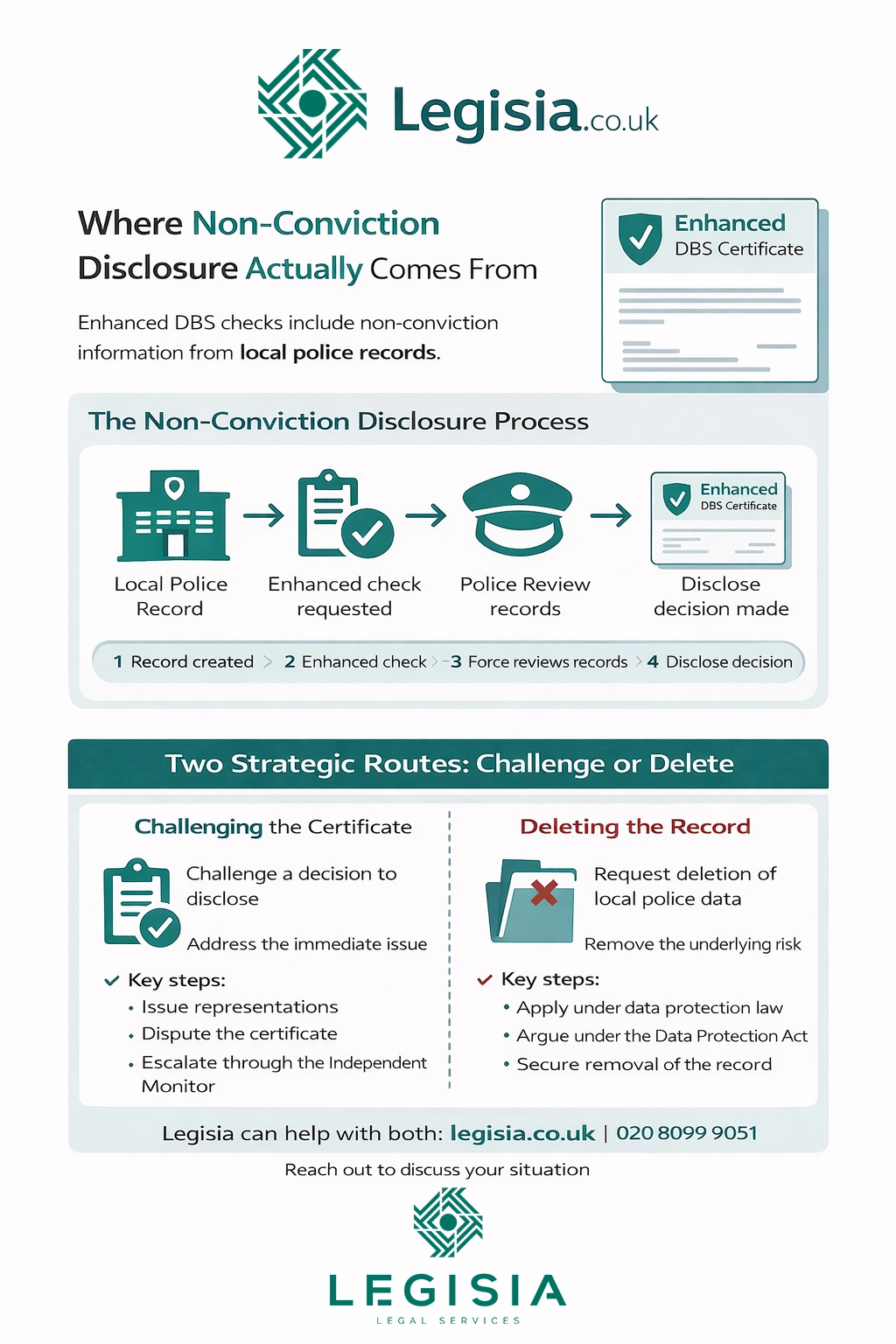
The non-conviction information that appears on an Enhanced DBS certificate almost always comes from one place: the local records held by an individual police force. This is where allegations, arrests without charge, no further action matters, community resolutions and police intelligence all live. It is also where disclosure decisions start.
Understanding the link between local police records and Enhanced DBS disclosure matters for one simple reason. If you know where the information comes from, you can address the problem at its source — not just its symptom. This guide explains the mechanism and the two strategic routes available to deal with it.
For background on what an Enhanced DBS check can show, see our complete guide to what can show on an Enhanced DBS check. For an explainer on local records themselves, see what are local police records.
Where Non-Conviction Disclosure Actually Comes From
An Enhanced DBS certificate draws on two very different sources of information. Understanding the distinction is essential to understanding how disclosure actually works.
Convictions and cautions come from the Police National Computer. The PNC is a central national database that holds formal entries linked to identifiable individuals. Disclosure of PNC data on an Enhanced DBS certificate follows fixed statutory rules on filtering and protection. The same rules apply regardless of which force originally recorded the matter.
Non-conviction information comes from a different place altogether. It comes from the local police records held by the force that dealt with the underlying matter. These records sit on the force’s own systems. They include crime reports, investigation files, custody records, intelligence entries and other operational data. Disclosure from local records is not automatic — it is a discretionary decision made by the chief officer of the force.
This distinction matters because the strategies for addressing the two types of disclosure are completely different. PNC disclosure is addressed through filtering rules and PNC deletion. Local records disclosure is addressed through the disclosure decision itself and through deletion of the underlying data. The routes do not overlap, and they require different legal arguments.
The Mechanism — From Local Record to Certificate
The journey from a local police record to a disclosure on an Enhanced DBS certificate follows a predictable path. Breaking it down helps explain where a person can intervene.
Step 1 — The record is created. At some earlier point, the police have recorded information about the person on the force’s local systems. This may have been a report made by a third party, an investigation that went nowhere, an arrest that did not lead to a charge, or an intelligence entry logged by an officer. The record exists. It may have existed for years.
Step 2 — An Enhanced DBS check is requested. The person applies for a role that requires an Enhanced DBS check. The application goes to the Disclosure and Barring Service, which processes it and triggers a check against police records.
Step 3 — The force is asked to review its records. The relevant police force is asked to check whether it holds any information that it considers should be disclosed for the role. The force searches its local systems to see what comes up.
Step 4 — The chief officer makes a disclosure decision. If the force finds a record, it has to decide whether to disclose it. The decision is made by or on behalf of the chief officer, applying a quality assurance framework. The officer must consider whether the information is relevant to the role and whether disclosure is proportionate in all the circumstances.
Step 5 — The applicant may be notified. Where the force is proposing to disclose non-conviction information, the statutory framework requires it to notify the applicant and give them an opportunity to make representations before the certificate is issued. This is the pre-issue stage, and it is often the best opportunity to prevent disclosure.
Step 6 — The certificate is issued. If the decision is to disclose, the information appears on the certificate as relevant police information. The certificate then goes to the applicant and, usually, to the employer who requested the check.
Step 7 — The applicant can raise a dispute. If the certificate has been issued with information the applicant believes should not be there, the formal route is the DBS certificate disputes process. The dispute form goes to the DBS, which forwards it to the relevant police force to reconsider its decision.
Step 8 — The police force reviews the dispute. The force itself — not the DBS — reviews the challenge and decides at first instance whether to amend or withdraw the disclosure. If the force agrees, a corrected certificate is issued. If not, the process moves to the next stage.
Step 9 — The dispute is referred to the Independent Monitor. If the police refuse to change their decision, the dispute is referred to the Independent Monitor as the built-in escalation stage of the disputes process. The Independent Monitor reviews the decision on both relevance and proportionality grounds, and on accuracy grounds where that is in issue.
Step 10 — Judicial review is available in appropriate cases. Where the police decision-making was fundamentally flawed, or where the Independent Monitor process has not resolved the matter, the decision can be challenged in the High Court. Judicial review is the most formal route and is not appropriate in every case, but it remains available as a final option.
Understanding this sequence is important because each step creates an opportunity — or closes one. Pre-issue representations work at Step 5. The disputes process, the Independent Monitor and judicial review work at Steps 7 to 10. Deletion of the underlying record works against Step 1 — and is the only route that prevents the same information from coming back on a future check.
What the Police Look At When They Review
When a force is asked to review its records for an Enhanced DBS check, it does not simply pull the most recent item and pass it over. It looks across the full scope of what it holds.
The force will typically check the crime reporting system, the intelligence database, the custody records and any linked operational data. It will look at whether the person has been arrested, whether they have been investigated, whether any intelligence entries exist about them, and whether any complaints have been recorded. The search is broad.
Once a match is found, the force then has to decide what to do with it. This is where the disclosure test applies. The chief officer has to be satisfied that the information is relevant to the role the person is applying for, and that disclosure is proportionate in all the circumstances. Both tests have to be met. If either fails, the information should not be disclosed.
In practice, this is where decisions go wrong. Some forces take a broad-brush approach that treats anything safeguarding-related as automatically disclosable. That is not what the law requires. The proportionality test demands a genuine balancing exercise in every case — not a default in favour of disclosure. Where that balancing exercise has not been done, or has been done badly, the decision is vulnerable to challenge.
Why the Same Record Can Be Disclosed Again and Again
If you successfully challenge a disclosure on one Enhanced DBS certificate, the challenge deals with that specific certificate. The information is removed. The certificate is clean. Job done — for now.
But the underlying local police record does not disappear. It is still there, sitting on the force’s systems. The next time you apply for a role that requires an Enhanced DBS check, the force will look at its records again. It will find the same information. And it will have to decide all over again whether to disclose.
The previous challenge does not bind the force in a future decision. It may carry some weight — particularly if the earlier challenge was substantive and the circumstances have not changed — but it is not a guarantee. A force that has agreed to withdraw a disclosure once can still decide to make the same disclosure on a future check. The statutory test applies each time.
For a person applying for a single job, this may not matter. The challenge does its work and the problem goes away. For a person in a profession that requires repeated Enhanced DBS checks throughout their career — doctors, nurses, teachers, social workers, care workers — it matters enormously. Each new check is another exposure to the same risk.
Two Strategic Routes — Challenge and Delete
The point above explains why the cluster of services at Legisia is designed around two routes rather than one. Both exist to address the same underlying problem. They do it in different ways, and they produce different results.
Challenging the certificate addresses the immediate disclosure. It targets the decision to include the information on this particular Enhanced DBS certificate. A successful challenge results in the information being removed from the certificate. It does not touch the underlying record.
Deleting the underlying record addresses the source of the problem. It targets the data held on the force’s local systems. A successful deletion application results in the record being removed from the force’s databases altogether. If the record no longer exists, the force cannot disclose it on a future certificate.
The two routes are not alternatives. They are complementary, and they operate under different legal frameworks. Challenging the certificate works under the Police Act 1997 and the statutory disclosure guidance. Deleting the record works under the UK GDPR and Part 3 of the Data Protection Act 2018. The arguments are different, the decision-makers are different, and the timescales are different.
Challenging the Certificate
A challenge to the certificate targets the disclosure decision, not the underlying record. The strongest stage is usually before the certificate is issued — making representations to the police force while they are still deciding whether to include the information. Representations at this stage can persuade the force not to disclose at all.
If the certificate has already been issued, the formal route is the DBS certificate disputes process. The DBS forwards the dispute to the relevant police force to reconsider. If the police refuse to change their decision, the dispute is referred to the Independent Monitor as the built-in escalation stage. In appropriate cases, judicial review is also available.
A challenge is the right route when the urgent issue is a specific disclosure on a specific certificate — usually because a job, a training place or a professional registration is on the line. It produces a result that addresses the immediate problem. But it does not prevent the same information from coming up again on a future check.
For the full process, see our guide on how to challenge information on an Enhanced DBS certificate.
Deleting the Underlying Record
A deletion application targets the local police record itself. It asks the force to remove the underlying data from its systems — the crime report, the investigation file, the intelligence entry, or whatever combination of records is in play. If the application succeeds, the data is gone.
Deletion applications are made under data protection law. The legal basis is the UK GDPR and Part 3 of the Data Protection Act 2018, which give individuals rights to the erasure of personal data held by law enforcement authorities. The police are not entitled to retain data indefinitely simply because they hold it. Where the continued retention is no longer necessary, the data should be deleted.
A successful deletion is the most thorough remedy. It removes the source of any future disclosure risk. A record that no longer exists cannot be disclosed on an Enhanced DBS certificate, cannot surface in security vetting, and cannot be obtained by a regulator investigating fitness to practise. Deletion addresses the underlying problem.
The trade-off is that deletion applications take time, and the bar for success depends on the facts of the case. Where the allegation was weak, the matter was closed without action, and the person has worked without incident since, the argument for deletion can be strong. Where the matter is more serious or more recent, deletion may be harder to secure.
For the process, see our guide on how to apply for deletion of local police records.
When to Pursue Both Routes
In many cases, the right approach is to pursue both routes in parallel. The challenge addresses the urgent disclosure and produces a clean certificate for the role in front of the client. The deletion application addresses the underlying record and prevents the same issue from recurring on future checks.
This dual-route approach is particularly important for professionals who face repeated Enhanced DBS checks. A doctor moving between trusts, a teacher changing schools, a care worker applying for a new role — each faces a new check, and each new check is an opportunity for the same information to surface again. A one-off challenge is not enough. The only durable solution is to remove the record itself.
It is also the right approach where the immediate disclosure has already caused damage that cannot be fully undone. Even if a specific certificate is corrected after a challenge, the employer may already have seen the disclosure, the job offer may already have been withdrawn, or the regulator may already have been notified. Deleting the underlying record at least ensures that no further damage is done through future disclosures.
Where time allows, we usually recommend starting both routes at the same time. Where the urgent deadline is the imminent issue of a certificate, the challenge takes priority and the deletion application follows. The order matters — but the strategy of pursuing both is, in most cases, the one that gives the strongest long-term result.
Real Case — Local Records Deleted to Protect Future DBS Checks
We acted for a healthcare applicant who had been the subject of an ABH allegation involving a family member. The matter had never led to any criminal outcome. But the local police records remained on the force’s systems, and our client was about to enter a profession that would require repeated Enhanced DBS checks throughout his career.
The immediate concern was not a specific certificate. It was the long-term exposure. Every future Enhanced DBS check would trigger a review of the same local records. Every review would be a fresh opportunity for the force to decide to disclose. Even a successful challenge on one certificate would not close the door on future disclosures.
We prepared an application for deletion of the local records, setting out why the continued retention of the data was no longer justified. The application addressed the weakness of the underlying allegation, the absence of any criminal outcome, the passage of time without repetition, and the professional consequences that ongoing retention would cause. The force agreed to delete the records.
The effect of the deletion was to remove the risk at source. Future Enhanced DBS checks would find nothing to disclose, because the records no longer existed.
How Legisia Can Help
If your career is being affected by the disclosure of non-conviction information on an Enhanced DBS certificate — or if you are worried that local police records may cause future problems — we can help on both fronts.
We act for professionals and private individuals across healthcare, education, social work, childcare and care settings. Depending on the facts, we can advise on challenging the disclosure on the certificate, seeking deletion of the underlying local police records, or — in most cases — both. The right combination depends on the urgency of the immediate issue and the long-term exposure you face.
We offer a fixed-fee initial consultation where we will assess your case in detail and provide clear written advice on your prospects of success on each route.
To discuss your case, contact us or call 020 8099 9051.
Frequently Asked Questions
How does a local police record end up on an Enhanced DBS certificate?
When an Enhanced DBS check is processed, the relevant police force reviews its own local records to see whether it holds anything that should be disclosed. If the chief officer decides that information on the force’s local systems is relevant to the role and proportionate to disclose, it appears on the certificate as relevant police information. The information does not come from the Police National Computer — it comes directly from the force’s own local data.
If I win a challenge on one certificate, will the information be disclosed again on the next one?
It can be. A successful challenge to a specific certificate prevents the disclosure on that occasion. But if the underlying local police record remains on the force’s systems, the same information can be considered again the next time an Enhanced DBS check is processed. The force is not required to reach the same decision again, but the record is still there to draw on. This is why deleting the underlying record can be important for people who face repeated checks.
Is it better to challenge the certificate or delete the local record?
It depends on the facts. Challenging the certificate is the right route when you need to address a specific disclosure quickly — typically because a job or a professional registration is at risk. Deleting the local record is the right route when you want to remove the underlying source of the problem so that it cannot be disclosed in future. In many cases, the best approach is both — a challenge to address the immediate disclosure and a deletion application to address the long-term risk.
Do all Enhanced DBS disclosures come from local police records?
No. Convictions and cautions on an Enhanced DBS certificate come from the Police National Computer, not from local records. But the non-conviction information — allegations, arrests that did not lead to a charge, no further action matters, community resolutions and intelligence entries — almost always comes from local police records. This is the category of disclosure that causes the most difficulty for people who have never been convicted of anything.
Can I address both the certificate and the underlying record at the same time?
Yes. The two routes are not alternatives — they are complementary. A challenge to the certificate addresses the immediate disclosure. A deletion application addresses the underlying record. The two can run in parallel, and in many cases pursuing both gives the strongest overall result. The right combination depends on the facts of the case and the urgency of the immediate issue.
Share this Post, Choose your platform!

Matt is a Solicitor Advocate and Director of Legisia Legal Services. He specialises exclusively in police record deletion, DBS appeals, and regulatory defence. With over 20 years of experience, he has advised hundreds of professionals and individuals on high-stakes matters affecting careers, reputations, and legal standing. His work focuses on challenging unlawful data retention, safeguarding thresholds, and procedural breaches across UK policing and disclosure systems.
Matt is a Solicitor Advocate and Director of Legisia Legal Services. He specialises exclusively in police record deletion, DBS appeals, and regulatory defence. With over 20 years of experience, he has advised hundreds of professionals and individuals on high-stakes matters affecting careers, reputations, and legal standing. His work focuses on challenging unlawful data retention, safeguarding thresholds, and procedural breaches across UK policing and disclosure systems.
Disclosure & DBS: the complete CPD course for professionals
Written by a solicitor who handles these cases every day. For HR, compliance, safeguarding and legal professionals who make decisions about police records and DBS disclosures.
- Eleven modules covering disclosure, DBS checks, barring, regulatory interface and employment decisions
- The only UK course that also covers how UK records affect work, travel and employment abroad
- CPD-accredited, with written feedback on a final applied-scenario exercise
- Waitlist members get 20% off and a sample module ahead of launch
We'll email you the checklist and news about the course launch – nothing else. See the full course →