- Enhanced DBS Disclosure
-

 18 min read





Most people think of police records as a list of convictions and cautions on a central national database. That is part of the picture — but only part. Every police force in England and Wales also holds its own records on its own local systems. These local police records are a much broader category of data than the national database. They can have a serious effect on a person’s career even where there has never been a conviction or a charge.
For most people, local police records only become relevant when something goes wrong. A job offer is withdrawn after an Enhanced DBS check. A security clearance is refused. A professional registration is questioned. By the time the problem surfaces, the records have often sat on the force’s systems for years.
This guide explains what local police records are, how they differ from PNC records, what types of information they contain, and why they matter. For a broader overview of how this kind of information can appear on an Enhanced DBS certificate, see our complete guide to what can show on an Enhanced DBS check.
What Are Local Police Records?
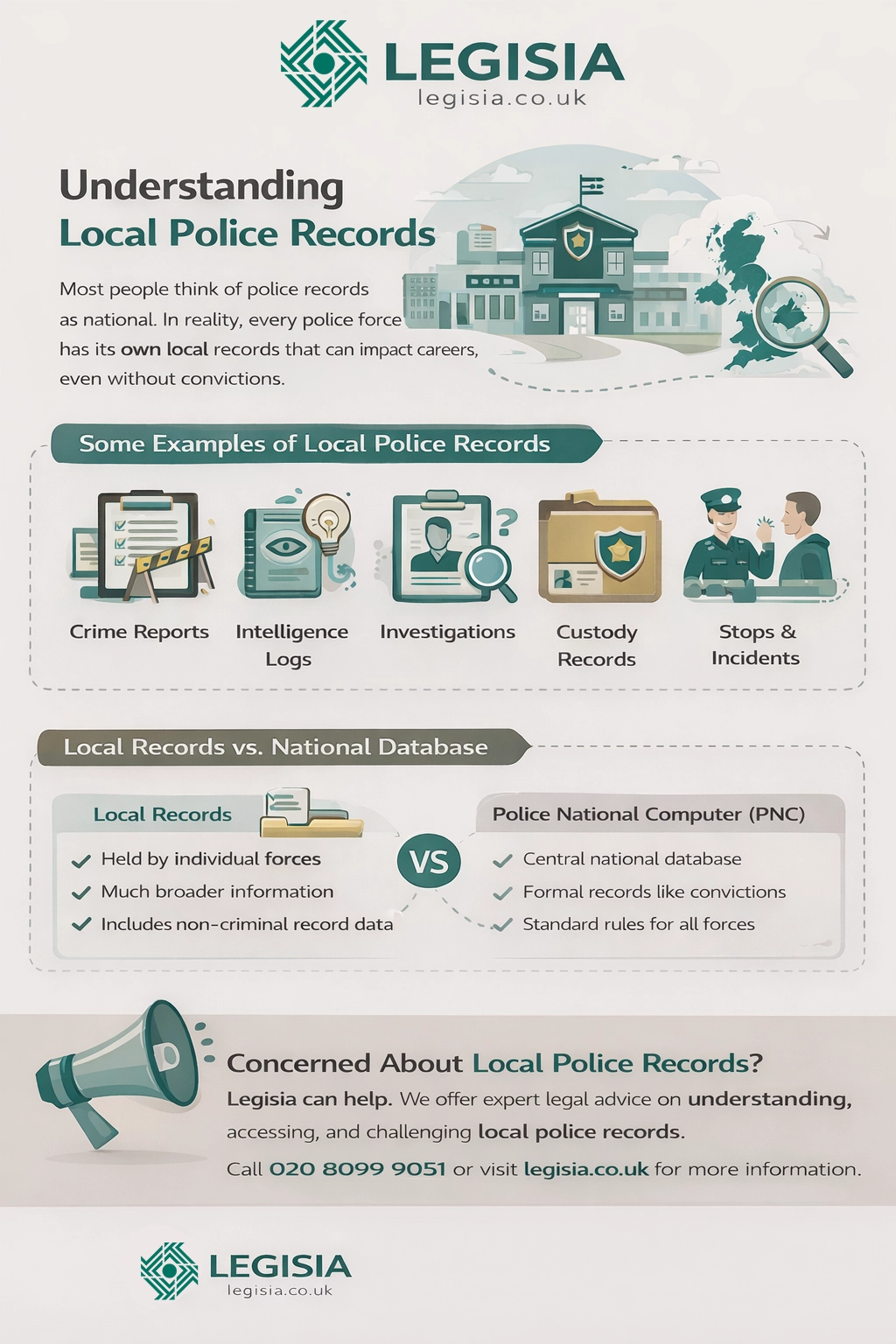
Local police records are records that an individual police force holds on its own systems. They are separate from the Police National Computer, which is a central national database used by all UK forces. Each force runs its own crime recording systems, intelligence databases, custody systems and operational records. The data on those systems belongs to the force itself.
The category is much broader than people expect. Local police records can include details of any contact a person has had with the force — as a suspect, a witness, a complainant, someone reported by a third party, or someone whose name has come up in an intelligence context. The force can create a record without the person knowing, and without any criminal investigation taking place. Once the record exists, it stays on the force’s systems under that force’s own retention policy.
The recording threshold is low. Local records can include information about people who have never been convicted of anything, never been charged with anything, and in many cases never been arrested. The consequences of being recorded can persist for many years.
Local Records vs the Police National Computer
The difference between local police records and PNC records is fundamental. It explains why this area of law matters and why a person facing a problem often has to address two parallel systems at once.
The Police National Computer is a national database. All UK forces can access it. It mainly holds formal entries linked to identifiable individuals — convictions, cautions, arrests, summonses and warnings. National rules govern disclosure of PNC data, and those rules apply in much the same way regardless of which force created the entry.
Local police records sit on each force’s own systems. They are not centralised. They are not standardised across forces. They capture a much wider range of information than the PNC. Where the PNC records the formal outcome — “arrested for X on this date, no further action” — the local records may contain the entire investigation file. That can include the original allegation, the witness statements, the interview notes, the investigating officer’s observations, and any intelligence entries created during or after the investigation.
The same incident can generate records on both systems. If the police arrest a person, the arrest will typically appear on the PNC. The underlying investigation file and any associated intelligence will sit on the local force’s records. The two records have different lifespans. They are governed by different rules. They require different routes to challenge. A person facing a problem with their criminal record information often has to address both.
The Types of Information Held Locally
Police forces hold a wide range of information on their local systems. The main categories include:
Crime reports and occurrence logs. These record every incident reported to the police, including the original allegation, the names of those involved, and the action taken. A single phone call can create an occurrence log, even where no investigation follows.
Investigation files. These record the full course of any investigation. They include witness statements, interview transcripts, forensic results, and the reasons for any decision not to charge.
Custody records. The force creates a custody record whenever it detains someone at a police station. It records the reason for arrest, the time of detention, and the outcome.
Intelligence entries. These are records on local intelligence systems. They capture information that the police consider relevant to law enforcement but which has not necessarily led to any formal action. Intelligence entries can include observations from officers, information from informants, and reports from third parties. They are not always evidenced and they are not always accurate.
Police National Database (PND) entries. The PND is a separate national system. It aggregates intelligence and operational information from across forces. Although the PND is national, individual forces create and own the underlying entries.
Stop and search records. These record every stop and search the force carries out, including the reason for the stop and the outcome.
Domestic incident logs. These record every domestic incident reported to the force. They include incidents where the police establish no offence and take no further action.
The breadth of this category is what makes local police records so important. Even a single phone call from a third party can create a record that follows a person for many years.
How Local Records Are Created
Local police records can come into existence in several ways. Many of them do not require the person to know that anything is happening at all.
The most common route is a report to the police. Anyone can report a matter — a member of the public, a colleague, an employer, a family member, an estranged partner, a neighbour. Once the report is made, the force will record it. Even if the force decides that no offence has been committed and takes no further action, the report itself becomes a record on the force’s systems.
The police also create records whenever they carry out an investigation, however brief. An investigation file may include the original report, statements from anyone interviewed, the officer’s observations, and the reasons for any decision. None of this depends on a charge. None of it deletes automatically when the investigation ends.
Intelligence records can come into existence even more easily. An officer can create an intelligence entry based on something said in an interview, an observation made during a stop, or information passed on by a third party. People sometimes call these entries “soft intelligence” because they are not based on hard evidence. But once recorded, they sit on the system in the same way as any other entry.
How Long the Police Keep Local Records
There is no single rule on how long the police keep local records. Each force operates its own retention schedule. National guidance shapes those schedules, but in practice forces interpret and apply the rules differently.
The national framework that governs how forces retain crime-related information is called the Management of Police Information (MoPI). Under MoPI, records are classified into one of three groups based on the seriousness of the offence and the risk presented by the matter recorded.
MoPI Group 1 covers the most serious offences and public protection matters — for example, murder, sexual offences, terrorism and serious violence. Records in this group are retained for very long periods, often for the person’s lifetime, and are subject to scheduled manual review.
MoPI Group 2 covers other serious offences that fall short of Group 1 but still carry significant risk. Records in this group are subject to scheduled manual review every ten years and are typically retained for extended periods.
MoPI Group 3 covers less serious matters. Records in this group can be deleted without manual review after a “clear period” of at least six years — meaning a period in which the person has not come to police attention again. If the criteria are met, the deletion happens automatically. If they are not, the records continue to be retained.
The scheduled review intervals are not the only point at which a record can be reviewed. The police can also carry out a review at any earlier stage where the facts or circumstances justify it — for example, where new information comes to light, where a request for deletion is made, or where the original basis for retention no longer applies. A scheduled ten-year review is the longstop, not the only opportunity to revisit a record.
The practical effect of the MoPI framework is that records relating to safeguarding concerns, sexual offences and serious violence are kept for very long periods — sometimes indefinitely. Less serious matters may be removed after the six-year clear period under Group 3. But there is no automatic deletion at the end of an investigation, and the existence of a record does not depend on any formal outcome being reached.
A person who was reported to the police, investigated and cleared can still have a local record sitting on the force’s systems decades later. The same is true of someone who was arrested but not charged, someone whose case ended in no further action, and someone who was never even formally suspected but who appears in an intelligence entry. The records persist regardless of the criminal justice outcome.
This is why local police records can come as such a shock when they surface. The person assumed the matter was closed years ago. The records show otherwise.
Why Local Police Records Matter for Your Career
For most people, the practical question is not whether the police hold a record. It is whether that record is going to affect them. The honest answer is that local police records can affect a person in several significant ways. The impact is often disproportionate to the underlying matter.
The most direct effect is on Enhanced DBS disclosure. Most of the information disclosed on an Enhanced DBS certificate as relevant police information originates from local records. Where the records exist, the police can choose to disclose them on the certificate. A single disclosure can be enough to derail a job application, a training place, a professional registration or a clinical placement.
Local records also matter for security vetting. People applying for SC, DV or other forms of national security clearance can be affected by information held on local police systems, even where there has been no conviction or formal action. The vetting process draws on a range of sources, and locally held police data is one of them.
For people in regulated professions — healthcare, social work, education, financial services — local police records can also surface in regulatory contexts. A regulator investigating a fitness to practise matter may obtain information from the police, and that information may include locally held data. The regulator can treat it as relevant to the person’s suitability even where it never led to a criminal outcome.
Local police records also create an ongoing risk. Even where the records have not yet caused a problem, they remain on the force’s systems and can surface at any future point. People who face repeated background checks throughout their career — particularly in safeguarding-sensitive roles — face an exposure that does not go away on its own.
Local Records and Enhanced DBS Disclosure
The relationship between local police records and Enhanced DBS disclosure is the central issue for most of the people we act for. It is the area where the harm done by local records is most direct and most difficult to manage after the fact.
When an Enhanced DBS check is processed, the relevant police force is asked to review whether it holds any information that should be disclosed on the certificate. The force searches its local records. It then considers whether anything found there is relevant to the role and proportionate to disclose. If the chief officer decides that it is, the information goes onto the certificate as relevant police information. This can happen even where the underlying matter never led to a conviction, a caution or a charge.
This means that the Enhanced DBS disclosure system is, in practice, a system of disclosing local records. Convictions and cautions appear too — they come from the PNC. But the most contentious disclosures, and the ones most likely to cause unfair career consequences, almost always come from local police records.
The implication is important. If the underlying local record did not exist, the police could not make the disclosure. This is why deletion of local police records can be so valuable. It addresses the source of the problem, not just the symptom on a particular certificate. Our guide on how local police records feed into Enhanced DBS disclosure explores this relationship in more detail.
Local Records, Security Vetting and Employment Screening
Enhanced DBS disclosure is the most common route by which local records cause career problems. But it is not the only one. Several other processes draw on locally held police information, and each operates under its own rules.
National security vetting. Clearance processes for SC, DV, CTC and similar roles involve a detailed background investigation. That investigation can include checks against police records. Vetting operates under different legal authority from Enhanced DBS, but it draws on the same underlying records. Information on local police systems can therefore feed into the assessment of a person’s suitability for clearance.
Regulatory investigations. Where a professional body is investigating a registrant’s fitness to practise, it may obtain information from the police. This is most commonly seen in healthcare, education and social work. The regulator can take into account information that has not led to any criminal outcome.
Employer screening. Some employers, particularly in safeguarding-sensitive sectors, will request references from the police as part of their recruitment process. Others may seek further information after an Enhanced DBS check has been returned. The information shared in this context will typically come from the same local records.
In each of these contexts, local police records can have an effect that is disproportionate to the underlying matter. A single intelligence entry, a withdrawn allegation or a closed investigation can be enough to raise a red flag. The person then has to explain something they have often never even seen.
Finding Out What Is Held About You
If you are concerned that local police records may exist about you, the first step is usually to obtain a copy of what the police hold. The mechanism for doing this is a subject access request under Part 3 of the Data Protection Act 2018, which gives individuals the right to ask a competent authority for a copy of the personal data it holds about them. The right exists, and the force must respond.
In practice, the value of a subject access request depends entirely on how it is made. Requests need to be properly framed to capture the right categories of data — local records, intelligence entries, custody records, investigation files — and to draw a clear distinction between locally held information and PNC data, which sits on a separate national system and has to be requested through a different route. A request that asks for the wrong information, or that conflates the two systems, will produce an incomplete picture and can leave a person worse off than before.
For this reason, we usually undertake the subject access stage on behalf of the client. We make sure the request captures the full scope of what is held, identify the right force or forces, and review the response when it arrives. Once we have the records in front of us, we can advise on what they actually mean and on the realistic options for challenge or deletion.
Real Cases — Local Police Records Successfully Removed
We have acted in many cases involving the removal of local police records. Three cases illustrate the range of situations in which local records can become a problem and the kinds of outcomes that can be achieved.
Healthcare applicant — ABH allegation involving a family member. We acted for a healthcare applicant who had been the subject of an ABH allegation involving a family member. The matter never led to any criminal outcome, but the local police records were a clear future risk for Enhanced DBS disclosure. We secured the deletion of the local records, removing the source of any future disclosure on a healthcare certificate.
Professional — repeated harassment arrests without caution or conviction. Our client was a professional who had been arrested several times in connection with harassment allegations. None of the arrests had led to a caution or conviction. The arrests and the related local records were creating an ongoing risk to his career. We obtained the deletion of the local records, removing the underlying basis for any future disclosure or vetting concern.
Finance professional — false rape allegation. A finance professional had been the subject of a false rape allegation. The investigation cleared him and the matter ended without any criminal outcome. But the local police records remained on the force’s systems. We secured the deletion of the records, removing the risk of disclosure in any future check or vetting process.
What these cases share is that each client had a clean criminal record. Each was being held back by information sitting on local police systems. In each case, that information could be properly challenged and removed.
How Legisia Can Help
If you are concerned about local police records, we can help. That includes situations where the records have already caused a problem on an Enhanced DBS certificate, where you are facing a vetting or regulatory issue, or where you want to address them before they cause future damage.
We act for professionals and other private individuals across a range of sectors who are affected by locally held police data. We can advise on the position, obtain the underlying records, and where appropriate make applications for deletion of the records. Where there is also an issue with disclosure on an Enhanced DBS certificate, we can advise on challenging the disclosure in parallel.
We offer a fixed-fee initial consultation where we will assess your case in detail and provide clear written advice on your prospects of success.
To discuss your case, contact us or call 020 8099 9051.
Frequently Asked Questions
What are local police records?
Local police records are records that an individual police force holds on its own systems, separate from the Police National Computer. They include crime reports, occurrence logs, custody records, intelligence entries and other data created during the course of policing. Local records can include information about people who have never been convicted, charged or even formally suspected of any offence — including witnesses, complainants and people about whom intelligence has been recorded.
How are local police records different from PNC records?
The Police National Computer is a national database. It mainly contains formal entries linked to identifiable individuals, such as convictions, cautions and arrests. Local police records sit on each force’s own systems and capture a much wider range of data. They include intelligence and unverified information that has not led to any criminal outcome. The two systems serve different purposes, and the same incident can generate records on both.
Can I find out what local police records are held about me?
Yes. Data protection law gives you the right to make a subject access request to a police force for a copy of the personal data it holds about you. The force must respond within one month, although in practice it often takes longer. The force may withhold some information where disclosure would prejudice an investigation or law enforcement function, but it must still tell you that it has withheld information.
How long do the police keep local records?
Retention is governed by the national framework known as the Management of Police Information (MoPI). Records are classified into one of three groups based on the seriousness of the offence. Group 1 covers the most serious matters — including sexual offences, serious violence and public protection cases — and records in this group are often retained for very long periods, in many cases for the person’s lifetime. Group 2 covers other serious offences and records are subject to scheduled review every ten years. Group 3 covers less serious matters, and records can be deleted after a clear period of at least six years. The police can also review a record earlier where the circumstances justify it. Records do not delete automatically when a case ends without a conviction.
Can local police records affect a job application even if I have no convictions?
Yes. Local police records are the source of most non-conviction disclosure on Enhanced DBS certificates. They can also feed into security vetting, professional regulatory investigations and other forms of background screening. Because the records can include allegations, intelligence and information about matters that never led to any formal action, they can affect a job application even where the person has a clean criminal record.
Share this Post, Choose your platform!

Matt is a Solicitor Advocate and Director of Legisia Legal Services. He specialises exclusively in police record deletion, DBS appeals, and regulatory defence. With over 20 years of experience, he has advised hundreds of professionals and individuals on high-stakes matters affecting careers, reputations, and legal standing. His work focuses on challenging unlawful data retention, safeguarding thresholds, and procedural breaches across UK policing and disclosure systems.
Matt is a Solicitor Advocate and Director of Legisia Legal Services. He specialises exclusively in police record deletion, DBS appeals, and regulatory defence. With over 20 years of experience, he has advised hundreds of professionals and individuals on high-stakes matters affecting careers, reputations, and legal standing. His work focuses on challenging unlawful data retention, safeguarding thresholds, and procedural breaches across UK policing and disclosure systems.
Disclosure & DBS: the complete CPD course for professionals
Written by a solicitor who handles these cases every day. For HR, compliance, safeguarding and legal professionals who make decisions about police records and DBS disclosures.
- Eleven modules covering disclosure, DBS checks, barring, regulatory interface and employment decisions
- The only UK course that also covers how UK records affect work, travel and employment abroad
- CPD-accredited, with written feedback on a final applied-scenario exercise
- Waitlist members get 20% off and a sample module ahead of launch
We'll email you the checklist and news about the course launch – nothing else. See the full course →