- Enhanced DBS Disclosure
-

 17 min read





When people think of a DBS check, they think of convictions and cautions. But on an Enhanced DBS certificate, there is a third category that sits alongside the criminal record section — and it is the category that can cause the most unfair disclosure. It is the category that captures allegations, arrests that never led to a charge, investigations that were closed without action, intelligence records, and other non-conviction information held on local police systems.
In the statutory framework, this category is called relevant police information. In practice, it is also referred to as approved information or other relevant information. These terms all describe the same thing: non-conviction information that a chief officer of police has decided should be disclosed on an Enhanced DBS certificate because the chief officer considers it relevant to the role the applicant is seeking.
This guide explains what relevant police information is, the statutory basis for it, the legal tests the police must apply before disclosing it, and where disclosure decisions go wrong. For a broader overview of everything that can appear on an Enhanced DBS certificate, see our complete guide to what can show on an Enhanced DBS check.
What Is Relevant Police Information?
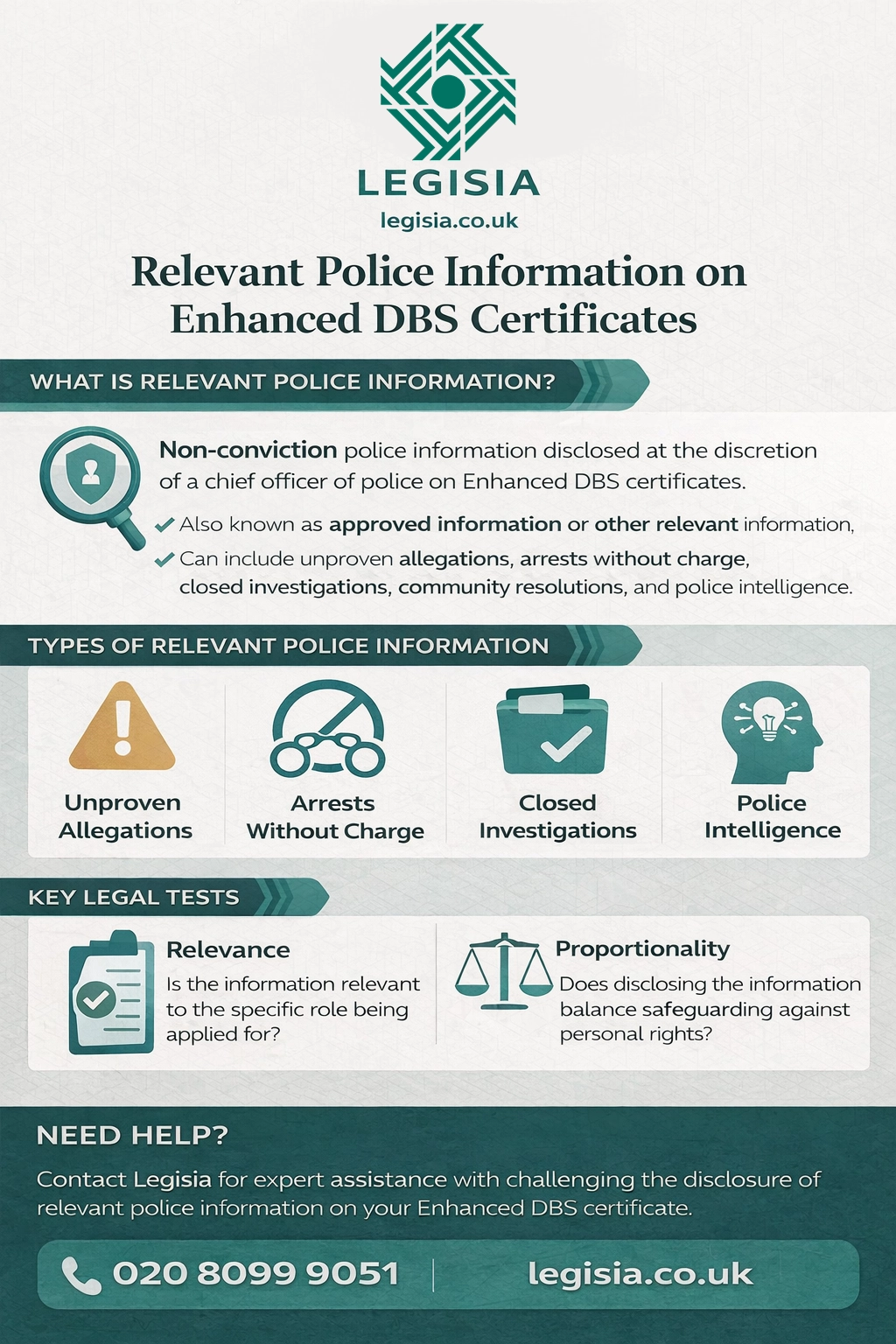
Relevant police information is the formal name given to the category of non-conviction information that can be disclosed on an Enhanced DBS certificate at the discretion of the chief officer of police. Unlike convictions and cautions — which come from the Police National Computer and are disclosed according to fixed rules on filtering and protection — relevant police information is discretionary. The chief officer decides what to include, applying a legal test laid down by statute.
The category is sometimes also called approved information or other relevant information. “Relevant police information” is the language used in the statutory framework. “Other relevant information” is the heading commonly used on the certificate itself. “Approved information” is a term that has grown up in practice and reflects the fact that disclosure has to be signed off by a senior officer through a formal quality assurance process before it is released. All three terms describe the same thing — non-conviction information that the police have decided is relevant enough to the role to justify disclosure.
This is the category that carries the greatest risk of unfair disclosure. It is where allegations that were never proven, arrests that never led to charges, and investigations that were closed without action can still appear on a certificate years after the event. It is also the category that has generated the most litigation, because the decision to disclose is a judgment call made by a police officer — and discretionary judgment calls can be challenged.
The Statutory Framework
The legal basis for the disclosure of relevant police information is set out in section 113B of the Police Act 1997. That section sets out the regime for Enhanced criminal record certificates and, in subsection (4), gives the chief officer of police the power to include on the certificate any information which the chief officer “reasonably believes to be relevant” for the purpose stated in the application and “ought to be included in the certificate”.
The statutory language is deceptively simple. Two tests have to be satisfied before information can be disclosed. The chief officer must reasonably believe that the information is relevant, and must also decide that it ought to be included. Both tests carry significant legal weight, and both are subject to challenge.
Alongside the statute, chief officers are required to follow the statutory disclosure guidance — often referred to as the quality assurance framework or QAF — issued by the Secretary of State. The guidance structures how forces are expected to apply the statutory tests in practice, including the factors they must weigh, the process by which decisions are made, and the obligation to notify the applicant and invite representations before disclosing relevant police information.
The courts have also played an important role. A succession of cases, culminating in the Supreme Court decision in R (L) v Commissioner of Police of the Metropolis [2009], has clarified how the statutory tests interact with the right to respect for private life under Article 8 of the European Convention on Human Rights. The legal framework today is a combination of the statutory scheme, the guidance, and the case law — all of which have to be applied together.
What Types of Information Can Be Disclosed
The category of relevant police information is broad. It captures any non-conviction information held by the police that the chief officer considers relevant to the applicant’s suitability for the role.
In practice, the most common types of relevant police information that appear on Enhanced DBS certificates are:
Allegations. Reports made to the police that did not result in a charge or conviction. These may be workplace complaints, domestic allegations, or reports made by third parties. Our guide on allegations on Enhanced DBS certificates covers this type of disclosure in detail.
Arrests that did not lead to a charge. The fact of an arrest, the circumstances of it, and any information gathered during the subsequent investigation can be disclosed even where no charge was brought. See our guide on arrest records and Enhanced DBS disclosure.
No further action matters. Cases that were investigated and closed without action — whether by the police or the CPS — can still be disclosed. Our NFA guide explains why.
Community resolutions. Out-of-court disposals involving an acceptance of responsibility but no caution or conviction. See our guide on community resolutions on Enhanced DBS checks.
Police intelligence. Entries on local police intelligence systems or the Police National Database recording concerns about a person or incidents in which they were involved, even where no formal police action was taken.
Information about third parties. In limited circumstances, information about a family member or other person connected to the applicant can be disclosed where the chief officer considers it relevant to the safeguarding purpose of the check. This kind of disclosure is often particularly unfair because the conduct disclosed is not the applicant’s own.
All of these share a common feature: they are held on local police records rather than on the Police National Computer, and they are disclosed at the discretion of the chief officer rather than according to fixed statutory rules.
The Legal Tests — Relevance and Proportionality
Before a chief officer can disclose relevant police information on an Enhanced DBS certificate, two legal tests have to be satisfied. These are the tests that determine whether the disclosure is lawful, and they are the tests on which any challenge to disclosure turns.
The first is relevance. The chief officer must reasonably believe that the information is relevant to the purpose for which the check has been requested. It is not enough that the police hold the information — it must connect to the specific role and to the safeguarding concerns that underpin the Enhanced DBS regime.
The second is proportionality. Even where information is relevant, the chief officer must decide whether it ought to be included. That involves a balancing exercise: weighing the public interest in disclosure — typically the protection of children or vulnerable adults — against the impact on the applicant’s private life, including their career, reputation, and ability to work.
Both tests have to be satisfied. Information that is relevant but disproportionate to disclose should not be disclosed. Information that is proportionate to disclose but not genuinely relevant should not be disclosed either. Where either test fails, the disclosure is unlawful.
What “Relevant” Actually Means
Relevance is not a low bar. The information must bear a meaningful connection to the specific role being applied for. A historic allegation that relates to a domestic matter is not automatically relevant to a clinical role. An arrest for a public order offence twenty years ago is not automatically relevant to a teaching position. An incident involving a family member is not automatically relevant to the applicant’s own suitability.
The chief officer has to apply the relevance test to the particular role identified in the application. That means understanding what the applicant will actually be doing, who they will be working with, and what the safeguarding concerns are. Information that might be relevant to one role may not be relevant to another, and the police are not entitled to disclose everything they hold on the basis that something about it could conceivably be of interest.
In practice, relevance challenges are most commonly made on the basis that the connection between the information and the role is too attenuated — that the chief officer has taken a broad-brush approach rather than a genuine assessment of whether this information matters for this role.
Proportionality and Article 8
The second test — proportionality — is where most of the law on relevant police information has developed. It flows from the applicant’s right to respect for private life under Article 8 of the European Convention on Human Rights, which is incorporated into domestic law through the Human Rights Act 1998.
Disclosure of non-conviction information engages Article 8 because it affects the applicant’s reputation, their employment prospects, and their ability to establish professional and personal relationships. Any interference with Article 8 must be justified: it must be in accordance with the law, in pursuit of a legitimate aim (here, the protection of children or vulnerable adults), and proportionate to that aim.
The leading case is the Supreme Court’s decision in R (L) v Commissioner of Police of the Metropolis [2009] UKSC 3. That case established that there is no presumption in favour of disclosure. Rather, the chief officer must conduct a genuine balancing exercise in every case, weighing the public interest in disclosure against the impact on the applicant. The court made clear that the Article 8 rights of the applicant are not subordinate to the safeguarding purpose of the Enhanced DBS regime — they have to be given real weight in the decision.
The effect of R (L) is that a chief officer who discloses information without properly balancing Article 8 against the safeguarding purpose has not made a lawful decision. That failure is a freestanding ground of challenge, independent of any dispute about the underlying facts.
The Factors the Police Must Weigh
The statutory disclosure guidance sets out the factors a chief officer must weigh when deciding whether disclosure is proportionate. How well those factors are applied is usually what determines whether a disclosure decision holds up — or whether it can be challenged.
The main factors the police are required to consider include the gravity of the matter, the reliability of the underlying information, how long ago the events occurred, whether there is any pattern of repetition or escalation, whether the applicant has had the opportunity to respond to the allegation, and the likely impact of disclosure on the applicant. The weight to be given to each factor depends on the circumstances of the case.
Where the allegation is serious, the information reliable, and the conduct recent, the balance is likely to favour disclosure. Where the allegation is old, the evidence weak, the person has worked without incident for years, and the impact on their career would be severe, the balance shifts the other way. Most real cases fall somewhere in between, which is why properly reasoned representations make such a difference.
A chief officer who disclosed information without genuinely weighing these factors — or who applied a risk-averse default in favour of disclosure rather than conducting a real balancing exercise — has failed to apply the statutory test. That kind of failure is routinely the basis for successful challenges.
Where the Police Go Wrong
In our experience, there are recurring patterns in how chief officers reach disclosure decisions that do not hold up to legal scrutiny.
The most common problem is a failure to properly balance Article 8. Some forces take an approach that treats safeguarding as an almost automatic trump card — disclosing because the information touches on a safeguarding theme, without asking whether the specific information, in the specific circumstances, actually warrants the intrusion into the applicant’s private life. That is not the balancing exercise required by R (L).
A second problem is failure to take account of the outcome of the underlying matter. Where an investigation ended in no further action, where a prosecution was dropped, where the applicant was acquitted, or where a complainant withdrew — these outcomes go directly to the reliability and gravity of the information. Disclosure decisions that disregard them, or treat them as neutral, do not properly engage with the factors the guidance requires.
A third problem is treating repeated disclosure as automatic. If information has been disclosed on a previous certificate, some forces will disclose it again on the next check without revisiting the balancing exercise. But proportionality is dynamic. The passage of further time, the absence of any repetition, and the applicant’s continued professional conduct are all factors that should be reassessed at each check — not simply assumed to produce the same answer as last time.
A fourth problem is inadequate reasoning. Where the decision letter does not explain how the factors were weighed, or refers to them only in generic terms, the force is vulnerable to challenge on the basis that the balancing exercise cannot be shown to have happened at all.
Challenging a Disclosure of Relevant Police Information
A disclosure of relevant police information can be challenged at several stages — before the certificate is issued, through the formal DBS certificate disputes process after issue, and by referral to the Independent Monitor if the police refuse to change their decision.
The strongest stage is usually pre-issue. Under the statutory quality assurance framework, the police are required to notify the applicant when they are proposing to disclose relevant police information and to give an opportunity to make representations before the certificate is issued. Representations at this stage can persuade the force not to disclose at all, meaning the information never appears on the certificate.
Where information has already been disclosed, the formal route is the DBS certificate disputes process. The DBS forwards the dispute to the relevant police force to reconsider, and if the police refuse to amend or withdraw the disclosure, the dispute is referred to the Independent Monitor as the built-in escalation stage of the same process. In appropriate cases, judicial review is also available.
Our guide on how to challenge information on an Enhanced DBS certificate sets out the process in full.
Real Cases — Relevant Police Information Removed From Certificates
We have acted in many cases where a challenge to the disclosure of relevant police information has succeeded. A few examples illustrate how the legal tests bite in practice across different types of information and different professional contexts.
Care worker — colleague allegation. A care worker faced disclosure of an allegation made by colleagues that she had viewed inappropriate material. We challenged the disclosure on both reliability and proportionality grounds and the information was removed.
Nurse — workplace intoxication allegation. A nurse had been reported as intoxicated at work, the investigation had ended without formal action, but the allegation had been disclosed. The disclosure was removed following representations addressing the context of the allegation and the impact on the nurse’s career.
Medical student — community resolution. A medical student had accepted a community resolution following a family incident, and the resolution had been disclosed on a certificate needed for clinical placement. We appealed the disclosure on proportionality grounds and it was removed.
Doctor — false sexual allegation. A doctor had been the subject of a false allegation of sexual assault involving a neighbour’s child. The investigation had cleared him, but the police proposed to disclose the allegation. Representations at the pre-issue stage prevented the information from being included.
Teacher — family-linked disclosure. A teacher faced disclosure of information relating to an acquitted relative living at the same address. The disclosure was challenged on relevance and proportionality grounds and removed from the certificate.
What these cases have in common is that the police had not properly applied the statutory tests to the specific facts. Once the tests were argued head-on — grounded in the statute, the guidance, and R (L) — the disclosure was removed.
How Legisia Can Help
If relevant police information has been disclosed on your Enhanced DBS certificate, or if you have been notified that the police are proposing to disclose information, we can help.
We act for professionals and private individuals across healthcare, education, social work, childcare, and care settings who face disclosure of non-conviction information. Depending on the circumstances, we can advise on challenging the disclosure on the certificate, seeking deletion of the underlying local police records, or both.
We offer a fixed-fee initial consultation where we will assess your case in detail and provide clear written advice on your prospects of success.
To discuss your case, contact us or call 020 8099 9051.
Frequently Asked Questions
What is the difference between relevant police information and approved information?
In practice, the two terms are used more or less interchangeably. Both refer to non-conviction information that a chief officer has decided should be disclosed on an Enhanced DBS certificate under section 113B of the Police Act 1997. “Approved information” reflects the fact that the information has been approved for disclosure by a senior officer through a formal quality assurance process. “Relevant police information” reflects the statutory test — that the chief officer reasonably believes the information to be relevant to the purpose of the check. The substance of what is being described is the same.
Who decides what is disclosed as relevant police information?
The decision is made by or on behalf of the chief officer of the relevant police force. In practice, the decision is taken by a police disclosure unit applying a quality assurance framework agreed across forces. The Disclosure and Barring Service does not make the decision itself — the DBS receives the information from the force and includes it on the certificate in the form the chief officer has approved.
What legal tests must the police apply before disclosing relevant police information?
The chief officer must be satisfied that the information is relevant to the purpose for which the check was requested, and that disclosure is proportionate in all the circumstances. The proportionality assessment involves weighing the public interest in safeguarding against the individual’s right to respect for private life under Article 8 of the European Convention on Human Rights. The Supreme Court set out the balancing framework in R (L) v Commissioner of Police of the Metropolis [2009].
What types of information can be disclosed as relevant police information?
The category is broad. It can include allegations that were never prosecuted, arrests that did not lead to a charge, investigations that ended in no further action, community resolutions, police intelligence reports, and in some cases information about third parties where it is considered relevant to the applicant’s suitability. The common feature is that the information did not result in a conviction or caution but is nevertheless held on police records and considered by the chief officer to be relevant.
Does the police force have to tell me before disclosing relevant police information?
Under the statutory quality assurance framework, the force is required to notify the applicant where it is proposing to disclose relevant police information and to give the applicant an opportunity to make representations before the certificate is issued. There are some limited exceptions — for example where the information is simply a repeat of information previously disclosed — but as a general rule the applicant should be given the chance to respond before disclosure takes place.
Share this Post, Choose your platform!

Matt is a Solicitor Advocate and Director of Legisia Legal Services. He specialises exclusively in police record deletion, DBS appeals, and regulatory defence. With over 20 years of experience, he has advised hundreds of professionals and individuals on high-stakes matters affecting careers, reputations, and legal standing. His work focuses on challenging unlawful data retention, safeguarding thresholds, and procedural breaches across UK policing and disclosure systems.
Matt is a Solicitor Advocate and Director of Legisia Legal Services. He specialises exclusively in police record deletion, DBS appeals, and regulatory defence. With over 20 years of experience, he has advised hundreds of professionals and individuals on high-stakes matters affecting careers, reputations, and legal standing. His work focuses on challenging unlawful data retention, safeguarding thresholds, and procedural breaches across UK policing and disclosure systems.
Disclosure & DBS: the complete CPD course for professionals
Written by a solicitor who handles these cases every day. For HR, compliance, safeguarding and legal professionals who make decisions about police records and DBS disclosures.
- Eleven modules covering disclosure, DBS checks, barring, regulatory interface and employment decisions
- The only UK course that also covers how UK records affect work, travel and employment abroad
- CPD-accredited, with written feedback on a final applied-scenario exercise
- Waitlist members get 20% off and a sample module ahead of launch
We'll email you the checklist and news about the course launch – nothing else. See the full course →