


Disclosure & DBS: The Complete CPD Course for Professionals
Early-access pricing and a sample module ahead of launch.
What this course is for
If you work in HR, compliance, safeguarding or employment law, you probably deal with disclosure issues more often than you’d like. A candidate discloses a caution at interview and you’re not sure what you can lawfully do with that information. A safeguarding concern has been flagged and you need to decide whether a DBS referral is required. A longstanding employee turns out to have a spent record that’s now causing visa problems for an overseas posting. These matters rarely arrive in a neat form, and they rarely match the framing of the generic training most organisations use to cover this area.
The law here is genuinely complicated, and most professionals only encounter it intermittently. You don’t need to become a specialist lawyer, but you do need to know enough to make good decisions, recognise when a case is heading somewhere difficult, and document your reasoning in a way that holds up later.
That’s what this course is for.
Who it’s for
This course has been written for people who handle disclosure, safeguarding and DBS issues as part of their broader role, rather than as a full-time specialism.
That includes HR directors and senior managers in regulated sectors – healthcare, education, financial services, charities – who have to make defensible decisions about recruitment, retention and dismissal when disclosure issues arise.
It also includes safeguarding leads in schools, care providers, NHS trusts and faith-based organisations, where DBS disputes, barring referrals and safer-recruitment questions come up on a recurring basis.
Employment lawyers and solicitors advising clients through DBS-related dismissals or regulatory fitness-to-practise matters will find the course useful – particularly where the criminal records dimension sits awkwardly alongside ordinary employment advice.
Compliance officers in financial services and public sector contexts who run fit-and-proper assessments under the Senior Managers and Certification Regime (SMCR) – the regime governing accountability for senior staff in UK financial services – will recognise most of the scenarios covered, as will those running internal disclosure processes.
And for regulatory and tribunal panel advisers, assessing fitness to practise, barring appeals or professional misconduct, the course provides a working knowledge of the disclosure side that often sits behind these cases.
If any of that sounds like you, the course is built for your work.
What it covers
The course is built around the decisions people actually have to make at work – in recruitment, safer recruitment checks, safeguarding referrals and dismissal. Each module pulls in the law and policy as needed, with real working situations at the centre of the teaching.
Module 1 – The disclosure landscape
A proper working understanding of how the UK system fits together. ACRO, the Police National Computer, local police records, Standard and Enhanced DBS checks. What “relevant information” means in practice. The difference between what an individual sees on their own certificate, what an employer sees through a regulated check, and what other gatekeepers – visa authorities, regulators, foreign police – may end up seeing. The difference between convictions, cautions, arrests, NFAs, and why each is treated differently.
Module 2 – Asking about criminal records lawfully
What an employer is actually entitled to ask at each stage of recruitment, and what they aren’t. The distinction between filterable and non-filterable records, and what candidates are legally required to disclose versus what they can keep to themselves. The Rehabilitation of Offenders Act 1974 in practice: spent convictions, when they must be disclosed, and the limited situations in which they can lawfully be asked about. The impact of getting this wrong, both on the individual and on the employer’s Equality Act exposure. Drafting application forms, interview questions and self-declaration forms that are legally sound.
Module 3 – Regulated activity, eligibility and the right level of check
The single question that trips up more HR teams than any other: what level of DBS check is this role actually eligible for? The statutory definition of regulated activity with children and adults, and how it maps onto real job descriptions. Which roles are eligible for Standard checks, which for Enhanced, which for Enhanced with barred-list checks, and the common errors that create real legal risk. Working out the right answer for ambiguous roles, and what to do when a check has been run at the wrong level.
Module 4 – Enhanced DBS disclosures in practice
How to read an Enhanced DBS certificate properly, and how to tell when a disclosure looks defensible and when it looks challengeable. What the police can lawfully include, and what they often get wrong. The dispute and Independent Monitor process from the outside. What to say when an employee or candidate comes to you with a difficult disclosure – and when the right answer is specialist legal advice.
Module 5 – Employing people with criminal records
How to make lawful, defensible hiring decisions when a check returns a record. Risk assessment frameworks that actually work. The relevance of the offence to the role, the time elapsed, the candidate’s explanation, and the available mitigation. When a record should rule a candidate out, and when it genuinely shouldn’t. Documenting the reasoning properly. Ban the Box, blanket exclusions and indirect discrimination risk. Drafting clear, fair, organisation-wide policies that line managers can actually apply.
Module 6 – Spent, protected and filtered records
How the rehabilitation periods work, when records become spent, and the practical consequences for employment and disclosure. The separate DBS filtering regime for Standard and Enhanced checks – which offences are filtered, which aren’t, and the recent case law driving change in this area. Why “spent” and “filtered” are not the same thing and why the distinction matters. What to do when a record that should be filtered appears on a certificate.
Module 7 – DBS barring and referral duties
Referrals to the DBS, the barred lists, representations and appeals. The duty to refer: when a referral must be made, when discretion exists, who has the duty, and what happens if an organisation fails to refer when required. The criminal offence of failing to refer. How to make a referral properly, what the DBS does with it, and what the referred person’s rights are. Proportionality, rehabilitation and the interaction with professional regulators.
Module 8 – The regulatory interface
How the GMC, NMC, SRA, HCPC, TRA and GDC treat cautions, arrests, convictions and disclosures. Self-referral obligations to regulators and the risks of getting them wrong. Managing dual-track processes – criminal alongside regulatory – without letting one prejudice the other. Fit-and-proper assessments under SMCR in financial services. How a regulatory finding on disclosure can flow back into DBS and employment consequences.
Module 9 – Employment decisions, dismissal and the Equality Act
The employer’s position when a disclosure issue arises after someone is already in post. Fairness, proportionality, and where the Equality Act 2010 bites. The specific risks of dismissal based on spent records or disclosed non-conviction information. Constructive dismissal, unfair dismissal and discrimination claims arising from disclosure-based decisions. The recent case law and what it has changed about what employers can lawfully do.
Module 10 – The international dimension
The part that tends to get overlooked by UK-focused training, and often the most commercially useful module for HR teams with any international footprint. How UK records affect travel and work abroad, and how overseas matters affect UK disclosure. The ACRO Police Certificate process and when it’s required for visas. How the US, Canada, Australia, New Zealand, UAE, Singapore and Schengen states treat UK criminal records – and the very different approaches each takes to spent convictions, cautions, and non-conviction disposals. Visa refusals driven by old UK records. Overseas convictions and how they end up on the PNC via ACRO. What happens when a UK employee is posted abroad and needs to satisfy foreign background-check requirements. The practical problem most HR teams don’t spot until it bites: a UK caution that is spent at home may still block an employee’s posting to Dubai, Washington or Sydney.
Module 11 – Scenarios
Worked scenarios drawn from live practice. Each one is taken through as a professional would have to handle it: spotting the issues, identifying the decision points, deciding when to seek specialist advice, and documenting a position that holds up if the matter escalates.
Interested? Join the waitlist.
DBS, disclosure and safer recruitment training, written from live casework. Waitlist members get 20% off at launch and a sample module ahead of release.
We’ll email you the checklist and news about the course launch – nothing else.
What this course doesn’t do
A straight answer on something that matters: this course doesn’t teach you to handle PNC deletion applications or bring Enhanced DBS challenges on your own certificate. Those are specialist legal matters and they stay with specialist lawyers. Legisia conducts that work as a dedicated litigation service, and the honest answer for anyone whose own record is on the line is to instruct someone who does this full-time.
Who’s teaching
The course is written and led by Matt Elkins, Solicitor Advocate and Director of Legisia Legal Services.
Matt has worked in criminal records and disclosure for over seventeen years. Legisia is the UK’s leading business dedicated exclusively to police record deletion, DBS appeals and security vetting – he was a criminal defence partner at a City of London firm before focusing his practice on this area. His recent work includes the Foulkes case, in which he secured the deletion of a caution issued to a retired special constable for a tweet, a case that drew national attention and press coverage in the Telegraph, Metro and GB News.
He holds Higher Rights of Audience in civil and criminal matters. Before qualifying as a solicitor, he taught international human rights and public law at the Graduate Institute in Geneva.
The teaching draws directly on his casework. Every scenario in the course is modelled on something that has come across his desk, usually more than once.
Format and CPD
Format. On-demand video with written materials, downloadable resources and worked examples. Designed for self-paced study over four to six weeks, or compressed into a week if needed.
Length. Roughly eight to ten hours of core content, with further reading and optional depth for anyone who wants it.
Assessment. Short multiple-choice questions at the end of each module, and a final applied-scenario exercise returned with written feedback from Matt.
CPD accreditation. The course is being developed to meet recognised CPD standards for the professional regulators whose members it serves. Specific accreditations will be confirmed before launch.
Certificate. Successful completion carries a dated certificate recording the hours completed.
Pricing
Individual seat
From £300. Waitlist members get early-access pricing at a 20% discount.
Team licences
For HR teams, safeguarding networks and in-house legal functions of 5-25 people. Priced per organisation rather than per seat, which usually works out significantly cheaper than buying individual access.
Institutional licences
Annual organisation-wide access for NHS trusts, local authorities, large employers, regulators and law firms. Includes tailored onboarding. Quote on enquiry.
Frequently asked questions
When does it launch?
Development is underway. A firm date will be confirmed and shared with the waitlist first – waitlist members will also have early access to book before general availability opens.
Will it count toward my CPD hours?
Yes. CPD accreditation is being pursued with relevant professional bodies. The course is built to meet CPD quality standards even where a given body doesn’t operate a formal accreditation scheme.
Can my organisation buy in bulk?
Yes. If disclosure and DBS issues come up at scale in your organisation – and in most regulated-sector employers they do – bulk access usually makes more financial sense than individual seats. Team and institutional pricing is available.
Does the course cover security vetting (SC, DV, etc.)?
No. Security vetting is being developed as a separate course because it’s a different subject with a different audience. If that’s what you need, join the waitlist and mention vetting as your area of interest – you’ll be the first to know when the vetting course is released.
How is this different from the DBS training my organisation already runs?
Most generic training covers the mechanics: how to request a check, what a certificate looks like, how the barred lists work. This course goes further. It covers how to make lawful, defensible employment decisions when records are disclosed, where the law is genuinely contested, and the parts that generic training simply doesn’t touch – including the international dimension. It’s written by a solicitor who takes on the contested cases, not a training provider producing compliance content.
Is there a preview?
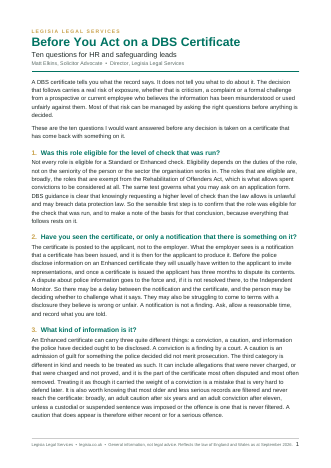
A sample module will be made available to waitlist members ahead of launch. Waitlist members also receive our free checklist, Before You Act on a DBS Certificate, by email.
Will this qualify me to advise on record deletion or DBS challenges?
No. Those remain specialist legal matters. What the course will do is help you recognise when a case has moved into specialist territory, handle the referral properly, and document the position without prejudicing it.
I’m not based in the UK – is this still relevant?
The course is built around UK law and policy. If you handle UK-related matters from overseas – in-house counsel for UK-regulated entities, immigration advisers dealing with UK records – the content is directly applicable. Module 10 in particular covers the interaction between UK records and overseas work, visas and travel. If your work is in a wholly non-UK system, the material will be informative but not operational.
Ready to join?
Early-access pricing. Sample module before launch. First in line when seats open.
We’ll email you the checklist and news about the course launch – nothing else.