- Security Vetting
-

 10 min read





On 13 July 2026, the rules governing police vetting changed. The amended Police (Vetting) Regulations 2025 came into force, and with them a fully statutory regime. Every police officer must now hold and maintain vetting clearance. Forces have a defined procedure for withdrawing it, and an officer whose clearance is withdrawn faces dismissal. Alongside those duties sit new appeal rights, and they are the subject of this guide.
For a serving officer, vetting clearance is now the legal foundation of the job itself. For candidates and transferring officers, a vetting decision determines whether a policing career starts, continues or ends. This guide explains who can appeal, through which route, and how your police record feeds into the decision.
What Changed on 13 July 2026
Police vetting used to rest on guidance rather than law. Forces vetted officers under the College of Policing’s code and guidance, but there was no statutory duty to hold clearance, and no statutory process for taking it away. That gap produced a striking result in early 2025. The High Court held that a force had no power to dismiss an officer simply because his vetting clearance had been withdrawn. An officer could fail vetting and yet be legally undismissable.
The Police (Vetting) Regulations 2025 were the answer. As amended with effect from 13 July 2026, they put the whole structure on a statutory footing:
- A duty to hold clearance. Every police officer, including special constables, must hold and maintain vetting clearance.
- A withdrawal procedure. Where evidence suggests an officer may no longer be suitable, the force must follow a defined assessment process, with rights for the officer at each stage.
- Dismissal for withdrawn clearance. An officer whose clearance is withdrawn is dismissed. The 2025 gap has been closed.
- Reviews, renewals and transfers. The amended regulations add machinery for reviewing and renewing a serving officer’s clearance, vetting on transfer between forces, and mandatory criminal history checks in some circumstances.
- Presumptive unsuitability. A new schedule prescribes circumstances, including some categories of criminal history, in which a person is not suitable to hold clearance save in exceptional circumstances.
- Appeal rights. Withdrawal decisions carry their own appeal route, and separate appeal rights cover decisions about conditions on clearance and decisions affecting transferring officers.
The regime is only weeks old, and forces are operating it for the first time. The early decisions will shape how it works in practice, which makes well-prepared representations especially important.
Police Vetting Is Not National Security Vetting
A quick distinction, because the word “vetting” covers two different legal worlds. This guide is about police vetting: the clearance regime run by police forces for their own officers, staff and candidates under the Police (Vetting) Regulations 2025.
National security vetting – CTC, SC and DV clearances administered through UKSV for government and sensitive roles – is a separate regime with its own rules and its own appeal routes. Our guide to the legal framework of UK security vetting covers that system. If your issue is an SC or DV clearance rather than police vetting, start there.
The two regimes do share one thing: both draw heavily on police records, which is why record deletion features later in this guide.
The Duty to Hold Clearance – and What Withdrawal Now Means
The core of the new regime is simple. Clearance is now a continuing condition of being a police officer. It is granted at recruitment, maintained through service, reviewed and renewed under the new machinery, and reassessed when concerns arise, including after misconduct proceedings.
Withdrawal is the most serious outcome under the regime, because dismissal follows it. Under the old arrangements, an officer whose clearance was withdrawn was left in an uncertain position. Under the regulations, withdrawal leads to dismissal, which means the withdrawal assessment itself is the point at which an officer’s position has to be defended. Representation during that assessment, rather than after it, is where the most can be achieved.
If Your Clearance Is Being Withdrawn – the Process and the Appeals
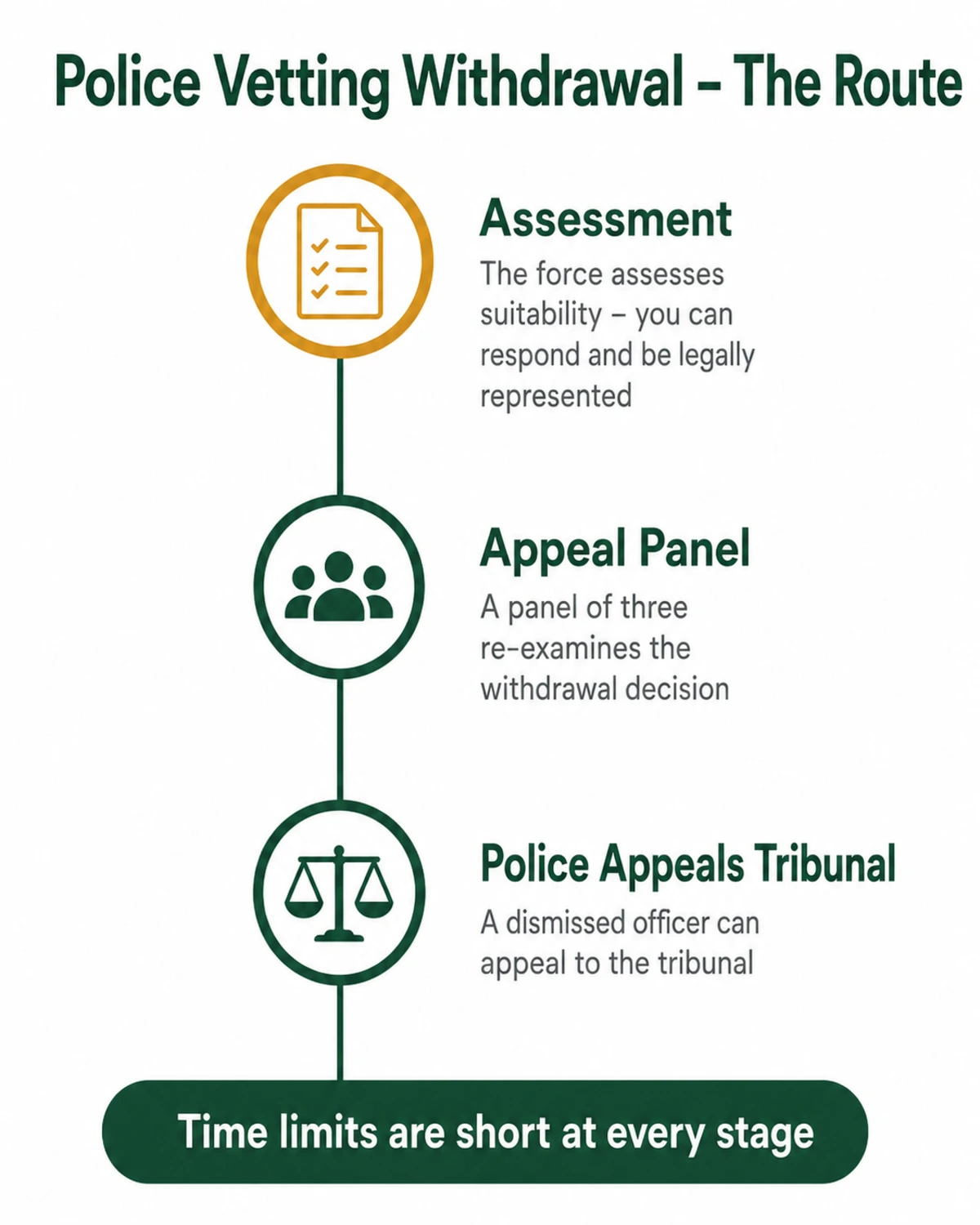
Where a force considers that an officer may no longer be suitable to hold clearance, the regulations set out an assessment process that the force must follow. The officer is informed of the matters under consideration and given the opportunity to respond, and the regulations allow the officer to be represented by a lawyer of their choice at an interview or an appeal meeting.
If the decision is to withdraw clearance, the officer can appeal to a panel of three people, and can again be represented at that stage. The regulations require detailed reasons to be given for key vetting decisions, which is significant for any appeal, because the reasoning behind the original decision can be examined and challenged.
An officer who is dismissed following the withdrawal of clearance can then appeal to the Police Appeals Tribunal, under amendments made to the tribunal’s rules. The process as a whole involves an initial assessment followed by two potential levels of appeal, each with its own deadlines.
The time limits are short at every stage, and it is a mistake to hold back preparation for the appeal. The strongest cases are usually built during the initial assessment. It is also worth bearing in mind that the regime is new. Forces will inevitably make procedural errors while they get used to it, and identifying those errors requires familiarity with the regulations.
Refused Clearance – Recruits, Transferees and Conditions
The position on refusal depends on who you are, and the honest answer is that the new appeal rights do not reach everyone.
Transferring officers. An officer seeking to transfer to another force now has a statutory right of appeal. It covers that force’s decision to refuse clearance, to grant it subject to conditions, or to vary those conditions. The appeal goes to a nominated decision maker who was not involved in the original decision.
Conditions on clearance. A serving officer can likewise appeal against a decision to attach or vary conditions on their clearance, through the same route.
New recruits. A candidate refused vetting clearance at recruitment has no statutory appeal. The routes that exist are practical rather than statutory. A refused candidate can ask the force to review the decision and make representations that address the concerns directly. Where a refusal is legally flawed, it may be open to challenge by judicial review. Refusals at this stage often turn on old cautions, arrests and police records. Representations that deal properly with that history can and do change outcomes.
Police staff. Vetting for police staff sits outside the statutory scheme for officers, and staff withdrawals are handled through employment procedures. The underlying vetting assessment can still be challenged through representations, and the same record issues arise.
How Your Police Record Feeds Into Vetting
Every police vetting decision is built on records: the Police National Computer, the force’s own local systems, and intelligence holdings. Cautions, arrests that went nowhere, closed investigations and non-conviction records are all visible to a vetting unit. Any of them can drive a refusal or a withdrawal. Our guide on what local police records are explains what these systems hold.
The amended regulations sharpen this further. Some categories of criminal history now make a person unsuitable to hold clearance save in exceptional circumstances. Outside those categories, history is assessed on the facts, and the age, seriousness and context of a record all matter.
The point most people miss is that the records themselves can sometimes be addressed before they are ever assessed. A caution can in some circumstances be removed from the PNC. Arrest records and local records from matters that ended without action can be the subject of deletion applications. Our police caution removal, arrest record deletion and local police record deletion services deal with exactly this. For anyone contemplating a policing career, or facing a vetting review, with an old record in the background, the order of events matters. A record that has been deleted before vetting takes place is never assessed at all.
How Legisia Can Help
We act across the whole of this landscape. We prepare representations during vetting withdrawal assessments and appeals against withdrawal and refusal decisions. We also carry out the record deletion work that changes what a vetting unit sees in the first place. Our police vetting appeals service covers officers, candidates and staff. We advise on the interaction between vetting and police records every day.
If your clearance is under threat, the best time to act is before the decision is made. If the decision has already gone against you, the appeal stages give you a route to challenge it, but the deadlines are short and it is important to act quickly.
We offer a fixed-fee initial consultation where we will assess your case in detail and provide clear written advice on your options.
To discuss your case, contact us or call 020 8099 9051.
Frequently Asked Questions
Can I appeal if my police vetting clearance is withdrawn?
Yes. Under the Police (Vetting) Regulations 2025, a serving officer whose vetting clearance is withdrawn can appeal to a panel of three people. If the withdrawal is upheld and the officer is dismissed, a further right of appeal lies to the Police Appeals Tribunal. Time limits are short at each stage, so early advice matters.
Can I appeal if I fail police vetting as a new recruit?
There is no statutory appeal for candidates refused vetting clearance at recruitment. The statutory appeal routes in the Police (Vetting) Regulations 2025 apply to serving officers. A refused candidate can usually ask the force to review the decision, and a decision that is legally flawed may be open to challenge by judicial review. Well-prepared representations at the review stage are often the most effective route.
Will I be dismissed if my police vetting is withdrawn?
Under the regulations, an officer cannot serve without vetting clearance, and withdrawal of clearance leads to dismissal. That is what makes the withdrawal process and the appeal stages so important. The decision to withdraw is where the case is won or lost, and the regulations give the officer the right to make representations and to be legally represented.
Can I be legally represented in the police vetting withdrawal process?
Yes. The regulations allow the officer to be accompanied and represented by a lawyer of their choice at an interview or an appeal meeting in the withdrawal process. Given that the officer’s career depends on the outcome, representation at these stages is strongly advisable.
Does an old caution or arrest automatically fail police vetting?
Not automatically, although the amended regulations now treat some categories of criminal history as making a person unsuitable to hold clearance, save in exceptional circumstances. Outside those categories, cautions, old arrests and non-conviction records are assessed on the facts. Because vetting draws on the Police National Computer and local police records, it is sometimes possible to apply to delete records before they are assessed, which can change the vetting picture entirely.
Share this Post, Choose your platform!

Matt is a Solicitor Advocate and Director of Legisia Legal Services. He specialises exclusively in police record deletion, DBS appeals, and regulatory defence. With over 20 years of experience, he has advised hundreds of professionals and individuals on high-stakes matters affecting careers, reputations, and legal standing. His work focuses on challenging unlawful data retention, safeguarding thresholds, and procedural breaches across UK policing and disclosure systems.
Matt is a Solicitor Advocate and Director of Legisia Legal Services. He specialises exclusively in police record deletion, DBS appeals, and regulatory defence. With over 20 years of experience, he has advised hundreds of professionals and individuals on high-stakes matters affecting careers, reputations, and legal standing. His work focuses on challenging unlawful data retention, safeguarding thresholds, and procedural breaches across UK policing and disclosure systems.
Disclosure & DBS: the complete CPD course for professionals
Written by a solicitor who handles these cases every day. For HR, compliance, safeguarding and legal professionals who make decisions about police records and DBS disclosures.
- Eleven modules covering disclosure, DBS checks, barring, regulatory interface and employment decisions
- The only UK course that also covers how UK records affect work, travel and employment abroad
- CPD-accredited, with written feedback on a final applied-scenario exercise
- Waitlist members get 20% off and a sample module ahead of launch
We'll only email you about the course launch – nothing else. See the full course →