Wrongful Police Caution Removed After Tweet Investigation

Wrongful Police Caution Removed After Tweet Investigation

The Situation:

What Our Client Was Facing

Our client was investigated after a short social media post was interpreted in a way he strongly disputed. He maintained that the post had been misunderstood and that the police had read hostility into wording that was never intended that way.

What followed was serious and immediate. He was arrested, taken into custody and kept in detention for hours before being offered a police caution. The matter may have been presented as a quick way to bring events to an end, but the caution created a formal police record capable of remaining on the Police National Computer unless it was successfully challenged.

Like many people in shock after arrest, our client later said he accepted the caution while still unsettled and not thinking clearly. That is exactly why cautions accepted in pressured circumstances can require careful scrutiny. As our guide on when a police caution can be deleted explains, the key issue is not simply whether the caution is causing harm now, but whether it was properly issued, fairly administered and lawfully retained in the first place.

The caution also carried wider consequences. A police caution is not a harmless warning. It is a recorded disposal that can affect checks, travel, reputation and future opportunities if left in place.

NEED HELP WITH A POLICE CAUTION ISSUED AFTER A SOCIAL MEDIA OR SPEECH INVESTIGATION?

Our Approach:

How We Challenged the Caution

We approached the case on the basis that the police response had been fundamentally flawed and that the caution should never have been accepted or retained on the PNC in the first place.

We examined both the context of the post and the way the police had handled the matter, including the circumstances in which our client ultimately came to accept the caution.

  • We reconstructed the wider context: We reviewed the wording of the post, the surrounding exchange and the broader background to show that the police had dealt with the matter on an incomplete and unfair understanding of what had happened.
  • We traced how the caution came to be accepted: The sequence of arrest, prolonged detention and eventual acceptance mattered. It showed that the caution was not the product of a calm and properly considered decision.
  • We challenged the lawfulness of keeping the record: We argued that once the disposal itself was shown to be unsafe, it should not continue to remain on the PNC as if it were a sound and reliable outcome.
  • We prepared formal deletion submissions: We brought the evidence together in structured representations under the Record Deletion Process, explaining why the caution had been wrongly issued and why deletion was the proper remedy.

This was not simply a case about disagreement over a social media post. It was a case about a wrongful police disposal that should not have remained on record once the full context and the unfairness of the process were properly exposed.

The Outcome:

How Legisia Protected & Reinstated Client's Life

The caution was deleted from the Police National Computer. That removed the formal police record and corrected an outcome that should not have remained in place.

The matter also went on to attract national attention, with the wider events later becoming the subject of public reporting and apology. You can read the public-interest account in our related news piece on Kent Police’s admitted error after the wrongful caution.

For our client, the important point was simpler. A caution accepted under pressure after a misread online post no longer remained on police systems to damage his reputation, travel or future opportunities.

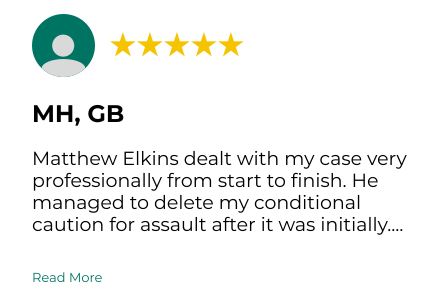
Don't just take our word for it– check out our 5-star reviews on Google and Trustpilot!
Words From Those We’ve Helped.

Discover why clients in the UK and around the world continue to place their trust in us.

Why This Case Mattered — and What Others Can Learn

This case shows why a police caution should never be dismissed as minor just because it avoids a prosecution. Where a caution follows a disputed interpretation of an online post, message or comment, and is then accepted while the individual is still under the pressure of arrest and custody, the outcome may require close legal review.

It also shows that online-speech cases are not just about headlines or public controversy. They can leave people with lasting police records if the caution is not challenged properly. Where there is a real problem with how the disposal was reached or retained, formal deletion may be possible.

If you have accepted a caution after a social media or speech-related investigation, Legisia’s Police Caution Removal service can assess whether there is a realistic basis to act.

Q&A

Can a police caution issued after a social media post be removed?

Potentially, yes. If the caution was wrongly issued, accepted under pressure, based on a misread context, or otherwise open to challenge, there may be grounds to seek deletion under the Record Deletion Process.

Does accepting a caution in shock or under pressure matter later?

It can. A caution should be a properly informed decision. Where someone accepts one while distressed, confused or under significant pressure, that may become an important part of a later challenge.

Share this Post, Choose your platform!
FacebookTwitterLinkedInReddit
Leave Your Message
See How Our Legal Intervention Has Restored Futures

Explore real stories of individuals just like you who turned to us at pivotal moments and how our timely legal intervention helped protect their future, dignity, and livelihood.

FacebookTwitterLinkedInReddit
Loading...