-

 13 min read





Police Cautions and the NMC or GMC: What Nurses and Doctors Need to Know
A police caution is often accepted under pressure at a police station, sometimes within minutes of an interview ending. For most people the immediate concern is getting out of custody. The longer-term implications — particularly for those registered with the Nursing and Midwifery Council (NMC) or the General Medical Council (GMC) — only become apparent later.
This guide explains what the NMC and the GMC each require following a police caution, how their fitness to practise processes work, and what you can do — including applying for caution removal — to protect your registration.
Note: if you are regulated by the Health and Care Professions Council (HCPC) rather than the NMC or GMC, please see our separate guide: The HCPC and Police Cautions.
Spent, protected, and specified — three concepts you must understand
Before getting into what the NMC and GMC specifically require, it is worth being clear about three terms that are frequently confused — and where that confusion causes real problems.
A simple caution is spent immediately under the Rehabilitation of Offenders Act 1974. Spent status is largely relevant to basic DBS checks and general employment questions. It does not, on its own, tell you whether you need to disclose to a regulator.
A caution becomes protected — and is therefore exempt from disclosure — only when all of the following apply: the caution was given to someone aged 18 or over; it was not given for a specified (listed) offence; and six or more years have passed since the date the caution was given. A protected caution does not need to be disclosed to the NMC or the GMC. A caution can be spent without being protected — for example, a caution issued two years ago is spent immediately but is not yet protected, and must still be disclosed.
Specified offences are those on a list maintained by the DBS, covering serious violent, sexual, and safeguarding-related offences. A caution for a specified offence is never protected, regardless of how long ago it was given. It will always require disclosure to the NMC and GMC, and will always appear on a Standard or Enhanced DBS certificate.
The practical effect for healthcare professionals is this: if your caution was for a non-specified offence and was given more than six years ago, it is likely to be protected and you will not normally need to disclose it to your regulator. If your caution was given within the last six years, or was for a specified offence at any point, disclosure is required regardless of how minor the matter seemed at the time.
The NMC and police cautions
Who must disclose, and when?
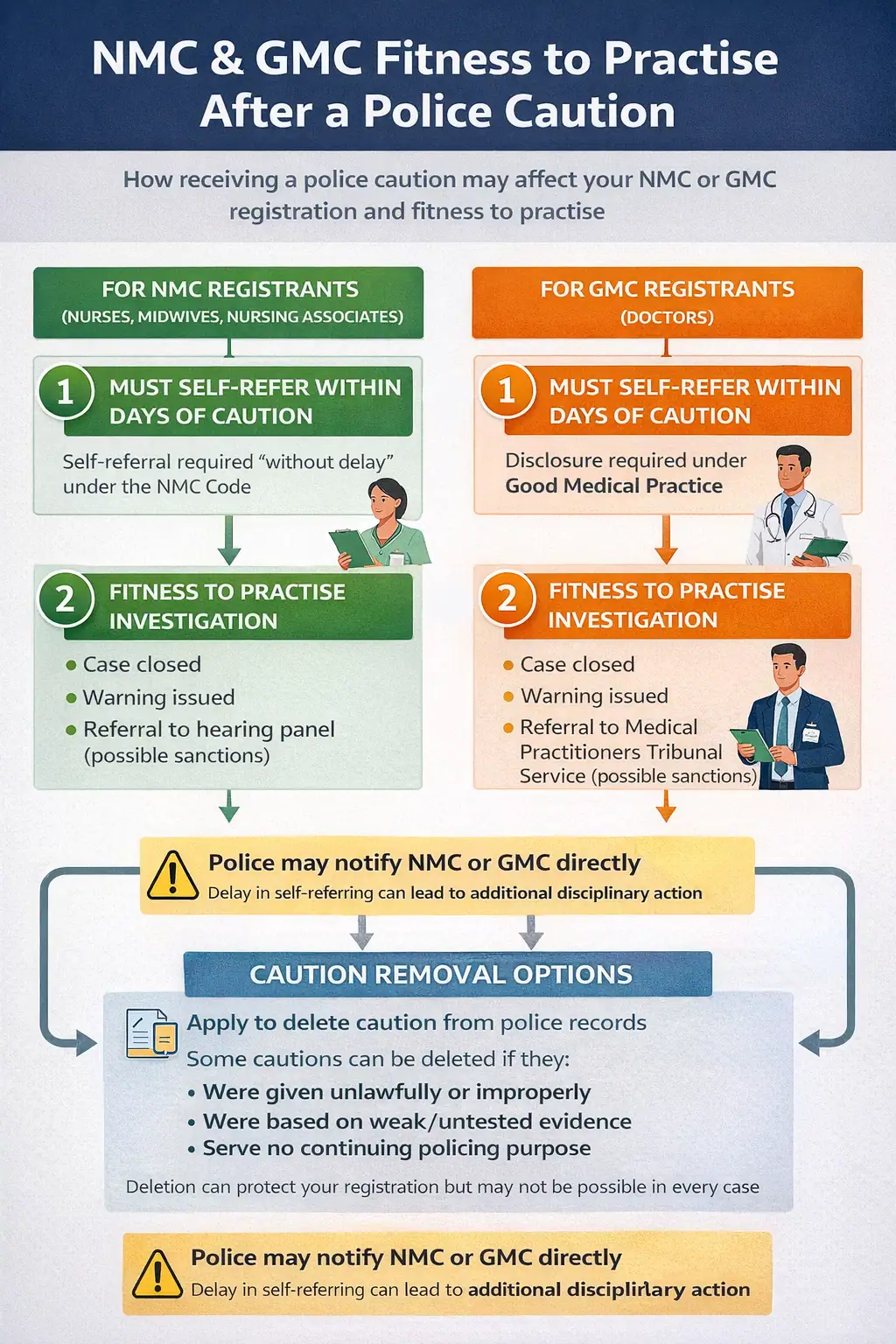
The NMC Code (rule 23.2) requires nurses, midwives, and nursing associates to tell the NMC as soon as possible about any caution — unless that caution is protected. The NMC’s own guidance confirms this: registrants must disclose cautions that are not protected, and do not need to disclose those that are.
In practice this means: if your caution is recent (within six years), you must disclose it to the NMC without delay. If your caution was given more than six years ago and was not for a specified offence, it is likely protected and disclosure is not required. If you are in any doubt about which category your caution falls into — particularly if the offence could be characterised as a specified one — you should take legal advice before deciding whether to disclose.
If you are applying to register with the NMC for the first time, the same protection rules apply: you must declare non-protected cautions as part of your application, but protected cautions do not need to be declared.
The NMC views late or non-disclosure of a disclosable caution seriously. In some cases, the regulator has found a registrant’s conduct in failing to disclose to be of more concern than the underlying caution itself. Where a caution must be disclosed, prompt action is essential.
What happens after you disclose to the NMC?
The NMC will assess whether your fitness to practise is impaired. Not every caution results in a full hearing. The NMC operates a case-examiners process where many matters are resolved at an early stage, without referral to a fitness to practise panel.
The NMC will consider the nature and circumstances of the offence, whether there is any pattern of behaviour, and what remediation — if any — you have undertaken. A single minor caution, promptly disclosed, with appropriate reflection and context, is often resolved at the initial screening stage. However, cautions involving dishonesty, violence, sexual behaviour, or conduct closely linked to your professional role are treated with considerably more seriousness.
Can the police notify the NMC directly?
Yes. The police have a common law power to disclose information to regulatory bodies where they consider it is in the public interest to do so. If the police choose to exercise this power, the NMC will receive notification independently of any self-referral you have made. The police will usually inform you before making such a disclosure, but not always.
This is an important reason not to delay where disclosure is required. If the NMC receives notification from the police before you have self-referred, this will be treated as a failure to disclose — which is a separate and serious finding in its own right. Your employer may also refer information to the NMC if a caution comes to light through an Enhanced DBS check. For more on when cautions appear on DBS checks, see our guide: Do Police Cautions Show on an Enhanced DBS Check?
The GMC and police cautions
Who must disclose, and when?
Paragraph 75 of Good Medical Practice requires doctors to tell the GMC without delay if they have accepted a caution from the police anywhere in the world. The same protected caution framework applies to doctors as to nurses: a caution that is protected — given more than six years ago, for a non-specified offence, to someone aged 18 or over at the time — does not need to be disclosed to the GMC.
Where a caution is not protected, the obligation to disclose is immediate. The GMC’s guidance uses the phrase “without delay” — not “when convenient” or “at revalidation”. A caution received last month must be reported now, not at your next appraisal.
The GMC’s reporting obligations also extend to community resolution orders. The GMC’s own guidance on reporting criminal and regulatory proceedings explicitly includes formally admitting to committing a criminal offence — including by accepting a community resolution order — as a matter that must be reported. This is a point many doctors are unaware of. A community resolution is not a formal caution and does not appear on the PNC in the same way, but the GMC’s reporting duty attaches to it nonetheless.
How does the GMC investigate?
Once the GMC receives notification of a police caution — whether by self-referral or via an external source — it will carry out an initial triage to assess whether an investigation is warranted. There is a general presumption in the GMC’s framework that matters involving a conviction or caution will proceed directly to a hearing before a Medical Practitioners Tribunal (MPT). In practice, many cases are resolved at an earlier stage where the circumstances support it.
At an early stage, the GMC may write to you seeking further information and your own account of the circumstances. The content and tone of that response matters considerably. Importantly, a doctor cannot seek to go behind the caution to argue innocence — the admission in the caution is treated as conclusive. Attempting to do so is likely to be read as a lack of insight, which makes matters worse rather than better. Any response to the GMC should be carefully prepared with legal advice.
What types of caution does the GMC treat most seriously?
The GMC applies particular scrutiny to cautions involving dishonesty or fraud (including matters entirely unrelated to medicine), violence, sexual offences, drug-related offences, and conduct involving patients or vulnerable people. Cautions in any of these categories are more likely to result in referral to the MPT.
Cautions arising from minor, isolated matters entirely unrelated to a doctor’s medical practice are more commonly resolved at the initial triage stage. The GMC has published a list of matters it will not normally investigate, which includes minor road traffic offences. However, the GMC retains full discretion in all cases, and the specific circumstances of each matter — including the doctor’s conduct since — will be assessed individually.
Can the police notify the GMC directly?
Yes. Police forces routinely inform the GMC when a doctor is charged with, cautioned for, or convicted of a criminal offence. The police’s common law disclosure power operates independently of any self-referral you have made. Waiting to see whether the police will notify the GMC before deciding whether to self-refer is not a position we would recommend. If the GMC receives notification before you have reported the matter, the failure to self-refer becomes an additional concern in its own right.
Can you get your caution deleted to protect your registration?
This is one of the most important — and most misunderstood — points for registered healthcare professionals.
If your caution was issued unlawfully, procedurally incorrectly, or on the basis of weak or untested evidence, it may be possible to apply for the caution to be deleted from the Police National Computer (PNC) under the Record Deletion Process. If your caution is deleted, the record ceases to exist — and with it, the basis on which disclosure to your regulator was required in the first place.
This matters in two distinct ways. First, if your caution has not yet been disclosed to the NMC or GMC and is successfully deleted before any obligation to disclose has crystallised, there may be no remaining obligation to report it at all. Second, if your caution has already been disclosed and a fitness to practise investigation is underway, deletion of the underlying record removes the factual foundation of the regulatory concern. In some cases, deletion has caused a fitness to practise investigation to be closed entirely.
Deletion is not automatic and is not available in every case. The police assess deletion applications against specific grounds — including whether the caution was properly administered, whether the admission was freely given, and whether there is a continuing policing purpose for retaining the record. For a full explanation of how the process works, see our guide: Deletion of Records from National Police Systems.
Should you pursue deletion before or after disclosing to your regulator?
This question arises frequently and the answer depends on the specific timeline of your case. The critical point is that pursuing deletion does not automatically suspend your disclosure obligation in the meantime. Where the caution is not yet protected and has not yet been disclosed, the disclosure obligation exists from the moment the caution was received — not from the moment you decide to deal with it.
However, there is a meaningful difference between an unexplained failure to disclose and a properly drafted disclosure that explains deletion proceedings are already underway and sets out the grounds on which the caution is being challenged. We regularly advise on how to manage both proceedings simultaneously and on how to frame the regulatory disclosure in the most effective way. If you are in this position, early legal advice is essential.
What if you accepted a caution under pressure?
Many healthcare professionals who contact us accepted a caution at the police station under conditions that, in retrospect, were not fair. They were told the caution was a minor matter with no real consequences. They were not given adequate time to take legal advice. They were not told they did not have to accept it. In some cases, they did not fully understand what they were being asked to sign.
If this applies to you, the circumstances in which the caution was administered are highly relevant to a deletion application. The police should not issue a caution unless certain conditions are met, including a clear and freely given admission of guilt and confirmation that the person understands the significance of the caution. Where those conditions were not properly satisfied, the caution is vulnerable to challenge — and deletion may be available even for a caution that has already been disclosed to your regulator.
For more background on the caution process and your rights at the police station, see: Should I Accept a Police Caution?
What Legisia can do for you
We work with nurses, midwives, and doctors who are dealing with the consequences of a police caution. Our work typically covers one or more of the following:
- Assessing whether your caution is protected, and whether any disclosure obligation currently exists
- Assessing whether your caution can be deleted from the PNC and running the deletion application on your behalf
- Advising on your disclosure obligations to the NMC or GMC and how to present your position to the regulator in the strongest terms
- Drafting written representations to the NMC or GMC to prevent a matter from escalating to a formal hearing
- Representing you in fitness to practise proceedings before the NMC or GMC
- Challenging unfair information on an Enhanced DBS certificate that is contributing to a regulatory referral
- Resisting police common law disclosure to your regulator where there are grounds to do so
The two strands — deletion and regulatory defence — are closely connected. In many cases, success on one directly influences the outcome of the other. We are one of the few practices in the country with deep expertise in both.
Act quickly — timing matters
The most important thing we can say to any nurse or doctor who has received a police caution is this: do not wait. The longer you delay in taking legal advice, the more options close.
Deletion applications have the best prospects when made promptly, before positions become entrenched. Disclosure obligations arise from the moment the caution is received, not from the moment you decide to act on them. And if your employer or the police notify your regulator before you have self-referred, you face a disclosure failure on top of the original matter.
We offer a fixed-fee initial consultation in which we will assess whether your caution is protected, advise on your disclosure position, and assess your deletion prospects. If your case can proceed, we will tell you clearly what your options are and what a realistic outcome looks like.
Speak to a specialist
If you are registered with the NMC or the GMC and have received a police caution, contact Legisia today for a fixed-fee initial consultation. We will assess whether your caution is protected, advise on your disclosure position, and give you a clear picture of your options.
Related guides
- The HCPC and Police Cautions — for those regulated by the HCPC rather than the NMC or GMC
- Deletion of Records from National Police Systems — how the Record Deletion Process works
- Do Police Cautions Show on an Enhanced DBS Check? — DBS disclosure rules explained
- Should I Accept a Police Caution? — your rights at the police station
- Police Caution Removal — our services

Matt is a Solicitor Advocate and Director of Legisia Legal Services. He specialises exclusively in police record deletion, DBS appeals, and regulatory defence. With over 20 years of experience, he has advised hundreds of professionals and individuals on high-stakes matters affecting careers, reputations, and legal standing. His work focuses on challenging unlawful data retention, safeguarding thresholds, and procedural breaches across UK policing and disclosure systems.
Matt is a Solicitor Advocate and Director of Legisia Legal Services. He specialises exclusively in police record deletion, DBS appeals, and regulatory defence. With over 20 years of experience, he has advised hundreds of professionals and individuals on high-stakes matters affecting careers, reputations, and legal standing. His work focuses on challenging unlawful data retention, safeguarding thresholds, and procedural breaches across UK policing and disclosure systems.





When Can a Police Caution Be Deleted?
Mar 9, 2026