- Enhanced DBS Disclosure
-

 16 min read





Local police records can be deleted. That fact alone surprises many people. Most assume that once the police have recorded something, it is there for good. But the law does not work that way. Data protection law gives individuals the right to seek deletion of personal data held by the police.
For people whose careers are being affected by a local police record, deletion is often the most effective remedy. It removes the problem at source. If the record no longer exists, it cannot be disclosed in future. This matters whether the record has already caused a problem on an Enhanced DBS certificate, or whether it represents a risk that has not yet surfaced.
This guide explains how the deletion process works in practice. For background on what local records are and why they matter, see our guides on what local police records are and how local police records feed into Enhanced DBS disclosure.
What Deletion Actually Means
Deletion means exactly what it says. The force removes the record from its systems so that it no longer exists as retrievable data. Once deleted, the record cannot be surfaced in a future Enhanced DBS check. It cannot be passed to a regulator. It cannot be drawn on during security vetting. The source of the problem is gone.
It is important to distinguish deletion from other things that sound similar but are not the same. Filtering is a statutory mechanism that controls what appears on a DBS certificate. It does not remove the underlying record. A successful challenge to a certificate removes the information from that particular certificate. It does not touch the underlying data on the force’s systems. A refusal to disclose on a specific check is not deletion either. Only deletion removes the record itself.
This distinction matters. It explains why deletion is often the most valuable remedy for people who face repeated background checks. A one-off challenge resolves a one-off problem. Deletion closes the source.
The Legal Basis for Deletion
The legal framework that applies to local police records is Part 3 of the Data Protection Act 2018. Part 3 governs the processing of personal data by competent authorities for law enforcement purposes. Police forces are competent authorities, and the records they hold about individuals are personal data within the framework.
Part 3 imposes a set of data protection principles that competent authorities must follow. Personal data must be processed lawfully and fairly. It must be collected for specified purposes. It must be adequate, relevant and not excessive. It must be accurate. And critically, it must not be kept for longer than is necessary for the law enforcement purpose for which it was collected. This last principle — the storage limitation principle in section 39 — is the one that most deletion applications turn on.
The right to erasure itself is in section 47 of Part 3. It gives the data subject the right to require the controller to erase personal data where the processing of the data would infringe one of the data protection principles. In a deletion application, the typical argument is that continued retention infringes the storage limitation principle: the data is no longer necessary for any law enforcement purpose, so it should be erased.
Where the police originally had a legitimate purpose for holding the data, the question is whether that purpose still applies. If it does not, the continued retention is no longer lawful. The data should be deleted.
When Is Deletion Possible?
Deletion is not available in every case. The strength of an application depends on the facts. Some cases are much more likely to succeed than others.
Cases with the strongest prospects typically share several features. The underlying matter is weak — for example, the allegation was not corroborated, the complainant withdrew, or the investigation found no basis to proceed. There is no ongoing law enforcement purpose in retaining the data. No active investigation, no similar concerns, no intelligence value. The person has worked without incident for a significant period since the matter arose. And the continued retention is causing real and identifiable harm to the person, typically through its effect on their career.
Cases where deletion is harder to secure include those where the matter was serious, where the investigation produced findings that were never formally resolved, or where the police can point to a continuing law enforcement interest. Deletion may still be possible in these cases. But the arguments are more demanding and the outcome less certain.
Every case turns on its facts. The right question at the outset is not “can this record be deleted?” It is “what are the realistic prospects on these facts, and what would the application need to address?”
The Deletion Process Step by Step
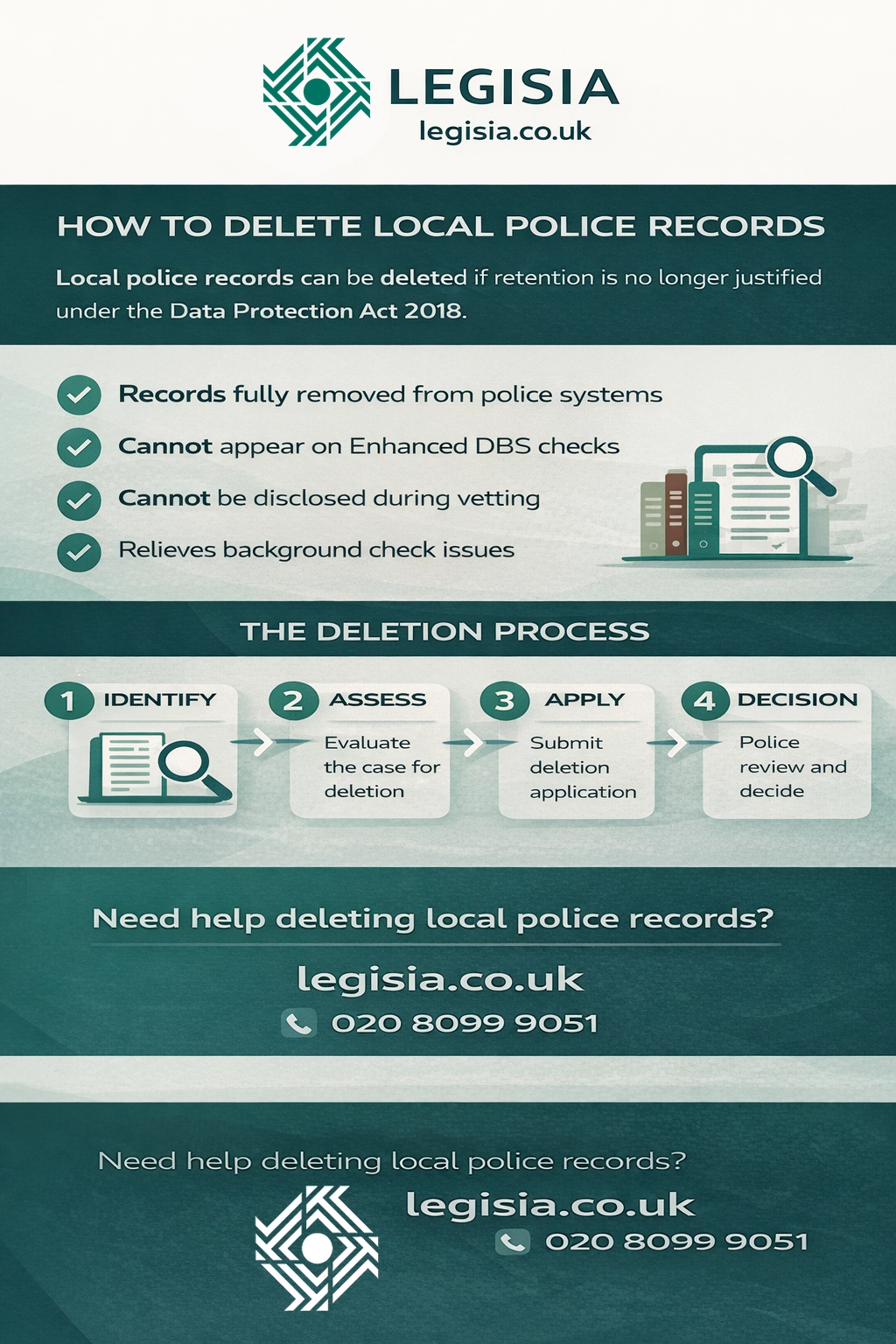
A deletion application is not a single letter. It is a structured process that moves through several stages. The main steps are:
Step 1 — Identifying what is held. The starting point is usually a request to the relevant force, to obtain a copy of the records that exist. Without knowing what the force holds, it is impossible to frame a proper application. We undertake this stage on behalf of clients. The value of a request depends on how it is made, and on the ability to draw a clear distinction between local records and PNC data.
Step 2 — Assessing the prospects. Once the records are in, the next step is a proper assessment. What is there? What does the legal framework require? What are the realistic arguments for deletion on the facts? This is where the strength of the case is properly tested. Not every matter is a candidate for deletion, and it is better to know that at the outset than after months of effort.
Step 3 — Drafting the application. If the prospects justify it, the next step is the application itself. This is a detailed written submission to the force. It sets out the legal basis for deletion under Part 3 of the Data Protection Act 2018, the factors that support deletion on the facts, and the specific records the applicant is asking to be removed. The application should engage directly with the retention principle and address each factor the force will weigh.
Step 4 — The force’s review. The force is then required to review the application and decide whether to delete the records. This is an internal process, typically handled by a records management or data protection team. It can take some time. The force may ask for additional information or clarification during the review.
Step 5 — The decision. The force communicates its decision in writing. Where it agrees to delete, the records are removed and the applicant is notified. Where it refuses, it should give reasons. The reasons given are important, because they shape the next steps.
Step 6 — Further routes if refused. If the application is refused and the refusal is not well founded, there are further routes available. These are described below.
What the Police Will Weigh
When a force considers a deletion application, it weighs a number of factors. Together these determine whether the continued retention of the record is still justified. A well-drafted application addresses each of them directly.
The factors that typically carry the most weight include:
The seriousness of the matter originally recorded. More serious matters attract stronger retention arguments. A minor allegation is more vulnerable to deletion than a serious one.
The reliability of the underlying information. An allegation that was never corroborated, was withdrawn, or was contradicted by other evidence is weaker in retention terms than a well-evidenced one.
The outcome of any investigation. Where the police or CPS decided not to proceed, where a prosecution was dropped, or where the person was acquitted, these outcomes go directly to the continuing justification for retention.
The passage of time. The older the matter, the weaker the retention argument — particularly where there has been no further contact with the police in the intervening period.
Any repetition or similar concern. Where the person has had no further contact with the police since the matter arose, that supports deletion. Where there is a pattern of repetition, retention is easier to justify.
The continuing law enforcement purpose. This is the core question under Part 3 DPA 2018. If the force cannot identify a current, specific law enforcement reason for retaining the data, the retention is not justified and the data should be deleted.
The impact on the individual. Where the continued retention is causing identifiable harm — typically through its effect on the person’s career, professional registration or ability to work — that is a relevant factor in the proportionality assessment.
The retention framework also plays a role. The Management of Police Information (MoPI) is the national framework that governs how police forces retain crime-related records. Under MoPI, records are classified into one of three groups based on the seriousness of the matter, and each Group has its own scheduled retention and review periods (our guide on what local police records are explains the MoPI Groups in more detail). Where a record falls into a Group that would normally attract a long retention period, the force may be more resistant to deletion. But MoPI is not the whole answer. The statutory retention principle in Part 3 DPA 2018 takes precedence. A record held under MoPI can still be deleted where the continued retention is no longer justified on the specific facts.
Timescales
There is no fixed statutory timescale for a deletion application. Different forces respond at different speeds. The complexity of the records can also affect how long the review takes.
As a general guide, a deletion application typically takes several months to resolve. Some forces respond more quickly, particularly where the records are straightforward and the legal basis for deletion is clear. Others take longer. This is especially true where the records span multiple systems or involve multiple record types. Applications that require further engagement — for example where the force asks for clarification or raises counter-arguments — take longer still.
Where the matter is urgent — for example, because an Enhanced DBS check is imminent — the timescale has to feed into the overall strategy. In some cases it is sensible to run a challenge to the certificate in parallel with the deletion application. That way the immediate issue is addressed while the longer-term deletion process runs its course. Our guide on how to challenge information on an Enhanced DBS certificate covers the challenge process in more detail.
If the Police Refuse
Where a force refuses a deletion application, the process does not necessarily end there. Three further routes are available. The right route depends on the reasons for the refusal and the strategy for the case.
A complaint to the Information Commissioner’s Office. The ICO regulates compliance with data protection law, including Part 3 DPA 2018. If a force has refused a deletion application and the refusal appears inconsistent with the data protection framework, the ICO can consider a complaint. Its powers include enforcement action and directing the force to reconsider. The ICO route is most useful where the refusal is based on a misapplication of the legal framework or a failure to engage with the retention principle.
A claim under the Data Protection Act 2018. Section 167 of the DPA 2018 gives the data subject the right to apply to the court for an order requiring the controller to comply with the data protection rights set out in the Act. This includes the right to erasure under section 47. Where a force has refused a deletion application that should have been granted, a claim under section 167 asks the court to order the force to comply. This is a statutory route under the data protection framework itself, and it is distinct from both the ICO complaint route and judicial review.
Judicial review. In appropriate cases, a refusal can also be challenged in the High Court by judicial review. The court considers the lawfulness of the force’s decision-making. That includes whether the force applied the correct legal tests, whether it considered all relevant factors, and whether the decision was one a reasonable decision-maker could have reached. Judicial review is the most formal route and is not appropriate in every case. But where the force has made a fundamentally flawed decision, it provides a powerful mechanism for overturning the refusal.
The three routes are not mutually exclusive, and the right combination depends on the underlying reasons for the refusal and the overall strategy for the case. An ICO complaint is the most lightweight route but the ICO does not always engage substantively. A section 167 claim is a direct statutory remedy aimed at the right itself. Judicial review is the most formal and the most expensive, but it is the route best suited to fundamentally flawed decision-making.
A Note on PNC Records
This article is about the deletion of local police records. PNC records — the national records held on the Police National Computer — are a separate matter.
PNC records include convictions, cautions and arrest records held on the national database. They are retained until the person reaches 100 years of age unless separately deleted. The route to deletion of PNC data is the Record Deletion Process, operated under different rules from the data protection route for local records. A deletion of local records does not affect PNC entries. A deletion of PNC entries does not affect local records.
Where a client has both types of record — for example, a local investigation file and a PNC arrest record — the two usually have to be addressed through separate applications on separate legal bases. The strategy for the case has to take both into account.
Real Cases — Local Police Records Successfully Deleted
We have acted in many cases involving the deletion of local police records. Three cases illustrate the range of situations where deletion has succeeded.
Healthcare applicant — ABH allegation involving a family member. We acted for a healthcare applicant who had been the subject of an ABH allegation involving a family member. The matter had not resulted in any criminal outcome. The concern was that the local records would cause repeated problems on future Enhanced DBS checks. We prepared a deletion application setting out why the continued retention was no longer justified. The force agreed to remove the records.
Professional — repeated harassment arrests without caution or conviction. Our client was a professional who had been arrested several times in connection with harassment allegations. None of the arrests had led to a caution or conviction. The local records were creating an ongoing risk to his career across employment screening and security vetting. We secured the deletion of the records, removing the underlying basis for any future disclosure.
Finance professional — false rape allegation. A finance professional had been the subject of a false rape allegation. The investigation had cleared him. But the local police records remained on the force’s systems. In a sector where vetting and background checks are a recurring feature, the records represented an ongoing risk. We obtained the deletion of the records, eliminating the future disclosure risk altogether.
Each of these cases turned on its specific facts. But each shared a common theme. The continued retention of the data was no longer justified in legal terms. A properly structured application — grounded in the statutory framework and the factors the force is required to weigh — produced the right result.
How Legisia Can Help
If you are concerned about a local police record — whether it has already caused a problem or represents a future risk — we can help. Deletion is one of our core services. We act for professionals and private individuals across a range of sectors.
We handle each stage of the process. That includes obtaining the underlying records, assessing the prospects, drafting the deletion application, engaging with the force, and — where necessary — pursuing further routes through the ICO or advising on judicial review. Where there is also an issue with an Enhanced DBS certificate, we can advise on challenging the disclosure in parallel. For full details of our local police record deletion service, see our service page.
We offer a fixed-fee initial consultation where we will assess your case in detail and provide clear written advice on your prospects of success.
To discuss your case, contact us or call
020 8099 9051
Frequently Asked Questions
On what legal basis can local police records be deleted?
The legal basis is data protection law. Under the UK GDPR and Part 3 of the Data Protection Act 2018, personal data held by a law enforcement authority must only be retained where it is necessary for a law enforcement purpose and proportionate to that purpose. A deletion application argues that the continued retention of the record no longer meets those requirements. The framework applies across the full range of records that a police force may hold, including crime reports, investigation files and intelligence entries.
What factors will the police consider when deciding whether to delete a record?
The force will weigh a number of factors. These include the seriousness of the matter originally recorded, the reliability of the underlying information, the outcome of any investigation, the passage of time, whether there has been any repetition since, and whether there is any continuing law enforcement purpose for holding the data. The MoPI retention framework also plays a role, because the Group the record falls into shapes how long it would normally be retained. The police are not bound to delete in every case. But where the continued retention is no longer justified, the data should be removed.
How long does a deletion application take?
There is no fixed statutory timescale. In practice, a deletion application can take several months to resolve, depending on the force involved and the complexity of the records. Some forces respond relatively quickly, while others take longer to carry out the review and provide a decision. Applications involving multiple record types or multiple forces typically take longer than straightforward single-record cases.
What happens if the police refuse to delete the records?
If the force refuses a deletion application, there are further routes available. A complaint can be made to the Information Commissioner’s Office, which regulates compliance with data protection law. A claim can also be brought in the court under section 167 of the Data Protection Act 2018, asking the court to order the force to comply with its data protection obligations. In appropriate cases, a refusal can also be challenged by judicial review in the High Court. The right route depends on the reasons for the refusal and the strength of the underlying case.
Will deleting local records affect my PNC record?
No. Local police records and Police National Computer records are held on different systems under different rules. Deleting a local record does not affect any PNC entries, such as a conviction, caution or arrest record held nationally. Where a client has both types of record — for example, a local record and a PNC arrest record — the two usually have to be addressed separately, through different routes.
Share this Post, Choose your platform!

Matt is a Solicitor Advocate and Director of Legisia Legal Services. He specialises exclusively in police record deletion, DBS appeals, and regulatory defence. With over 20 years of experience, he has advised hundreds of professionals and individuals on high-stakes matters affecting careers, reputations, and legal standing. His work focuses on challenging unlawful data retention, safeguarding thresholds, and procedural breaches across UK policing and disclosure systems.
Matt is a Solicitor Advocate and Director of Legisia Legal Services. He specialises exclusively in police record deletion, DBS appeals, and regulatory defence. With over 20 years of experience, he has advised hundreds of professionals and individuals on high-stakes matters affecting careers, reputations, and legal standing. His work focuses on challenging unlawful data retention, safeguarding thresholds, and procedural breaches across UK policing and disclosure systems.
Disclosure & DBS: the complete CPD course for professionals
Written by a solicitor who handles these cases every day. For HR, compliance, safeguarding and legal professionals who make decisions about police records and DBS disclosures.
- Eleven modules covering disclosure, DBS checks, barring, regulatory interface and employment decisions
- The only UK course that also covers how UK records affect work, travel and employment abroad
- CPD-accredited, with written feedback on a final applied-scenario exercise
- Waitlist members get 20% off and a sample module ahead of launch
We'll email you the checklist and news about the course launch – nothing else. See the full course →