- Court Record Deletion
-

 12 min read





A not guilty verdict feels like the end. The jury or the magistrates heard the case against you and rejected it. You walked out of court cleared, and you were entitled to believe the matter was finished.
But the record of the case is not finished. The arrest, the charge and the prosecution all remain on police systems after an acquittal. By default, they stay there until your 100th birthday. For most people, that comes as a genuine shock. It is usually discovered years later, when a background check, a vetting process or a visa application drags the case back into the light.
This guide explains what remains on your record after a not guilty verdict. It covers where the records are held, what checks can reveal them, and what can be done about it.
What Remains on Your Record After an Acquittal
When you were arrested and charged, records were created on two separate sets of systems. The acquittal did not remove either of them.
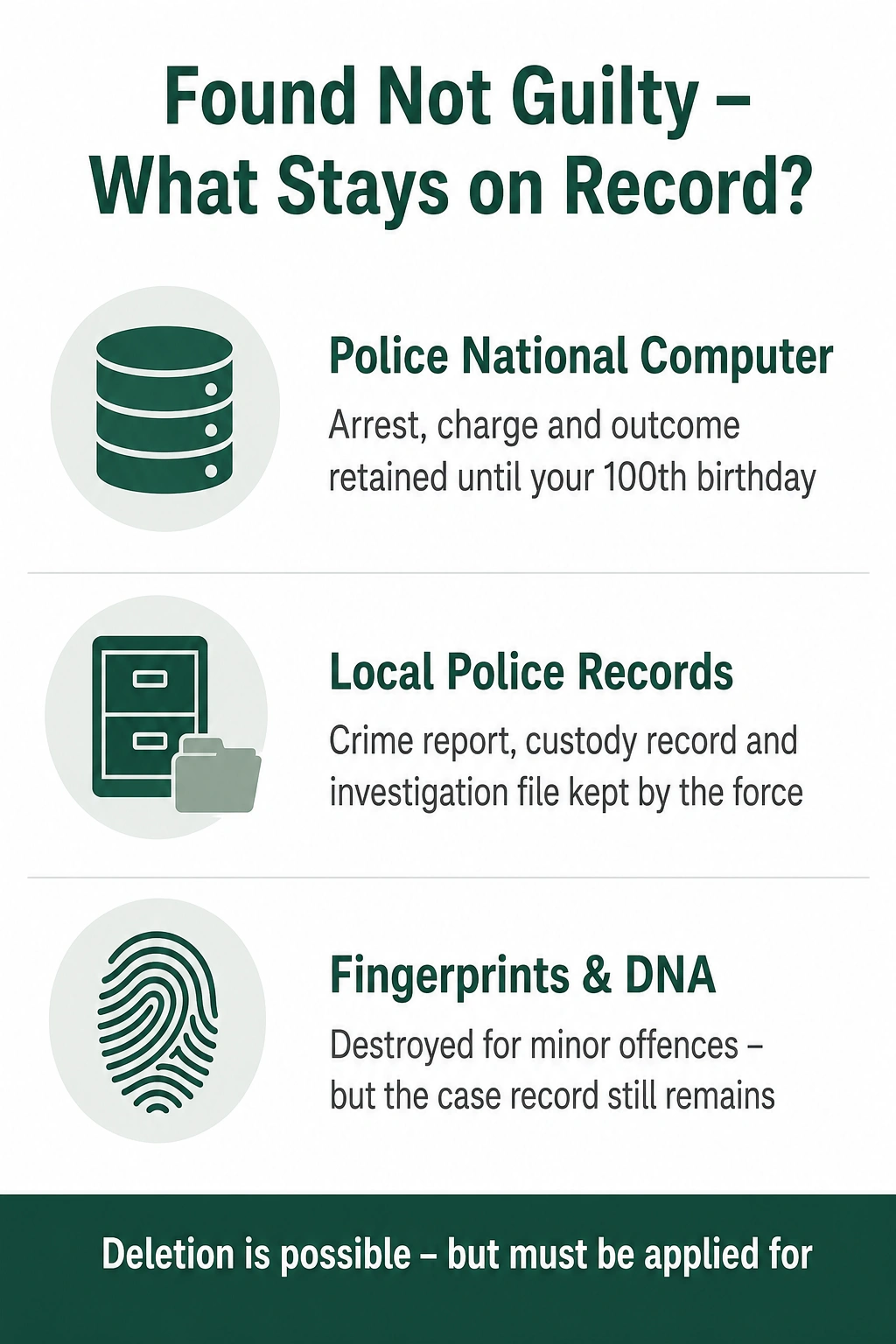
The first is the Police National Computer (PNC) – the national database used by every force in England and Wales. The PNC holds what is called the event history of your case: the arrest, the offence you were charged with, and the outcome. When the outcome is an acquittal, the PNC records exactly that. It does not delete the event. A person checking the PNC sees that you were arrested for the offence, prosecuted for it, and found not guilty of it.
The second is the local records held by the force that investigated you. These include the crime report, the custody record, the interview material and the investigation file. They sit on the force’s own systems, separate from the PNC, and they are governed by different rules. Our guide on what local police records are explains these systems in detail.
Under current retention rules, the PNC record is kept until your 100th birthday. Local records are retained under the police’s own frameworks, often for many years. Neither system treats an acquittal as a reason to delete anything.
Why the Police Keep Records of Failed Prosecutions
The police treat records as an operational resource. A record of a past investigation can be relevant to a future one – for identification, for intelligence, or for building a picture of repeated allegations. The retention rules were written with those purposes in mind, and they do not distinguish between prosecutions that succeeded and prosecutions that failed.
A not guilty verdict also means only that the prosecution did not prove its case to the criminal standard. It does not mean the police accept you were innocent. Forces sometimes take the view that a crime was committed and the acquittal changes nothing. That view shapes how they respond when asked to delete the record.
None of this means the records are untouchable. It means the starting point is retention, and anyone who wants the record removed has to make the case for it.
Fingerprints and DNA – Where the Confusion Starts
Much of the confusion about acquittals and police records comes from one source: fingerprints and DNA.
When you were arrested, the police took your fingerprints and a DNA sample. What happens to that biometric material after an acquittal depends on the offence. For less serious offences, the material must be destroyed once you are cleared. For the more serious offences, classed in law as qualifying offences, the position is different. The police can seek to retain biometrics for a period even though you were not convicted.
Many people acquitted of less serious offences are told, correctly, that their fingerprints and DNA will be destroyed. They understandably assume this means their record is gone. It does not. The destruction of biometric material and the deletion of the case record are entirely separate things. The PNC event history – the arrest, the charge, the acquittal – survives the destruction of your fingerprints and DNA. So do the local records of the investigation.
The police may no longer hold your DNA, yet still hold a full record of the case for the rest of your life.
Will an Acquittal Show on a DBS Check?
This is usually the first question, and the answer depends on the level of check.
Basic and Standard DBS checks disclose convictions and cautions. An acquittal is neither, so it will not appear on these checks.
Enhanced DBS checks are different. On an Enhanced check, the police can disclose non-conviction information where the chief officer considers it relevant to the role and proportionate to disclose. That category is wide enough to include the case behind an acquittal. It does not happen in every case, because the police have to apply legal tests before disclosing. But it does happen. It is most common where the allegation touched on safeguarding and the role involves children or vulnerable adults. Our guide on relevant police information on Enhanced DBS certificates explains how these decisions are made.
An acquittal removes the case from the criminal courts. It does not remove it from the pool of information the police can draw on when an Enhanced check is run. As long as the records exist, the possibility of disclosure exists with them.
Vetting, Travel and Other Checks
DBS checks are not the only way a retained record can surface.
Security vetting for government and sensitive roles draws on police records, including information that would never appear on a DBS certificate. An old prosecution, even one that ended in acquittal, is exactly the kind of matter a vetting process will want explained.
Police vetting for those joining or working with police forces goes further still, and routinely considers non-conviction history.
International travel and visas can also be affected, though not in the way most people expect. An ACRO police certificate, the document most visa applications rely on, does not disclose arrests or non-conviction outcomes. But some countries ask applicants directly whether they have ever been arrested. The United States is the best-known example, and the honest answer depends on the records that exist. Some overseas employers also ask candidates to supply their own copy of their full PNC record through a subject access request, which shows everything, including arrests and acquittals. Requiring that in the UK is a criminal offence, known as enforced subject access. Companies abroad do not always feel bound by it.
The acquittal answered the criminal charge. The records simply sit there, available to any process with the right to look.
Disclosure Without a Check – Common Law Powers, Sarah’s Law and Clare’s Law
Checks and vetting are not the only routes by which a retained record can reach other people. The police also have powers to disclose information on their own initiative, without any application being made at all.
Under their common law powers, the police can share information with a third party to protect the public. The statutory guidance on disclosure expressly recognises this route, including the possibility of the police informing an employer in confidence. These disclosures are exceptional and must be justified. But they are lawful, and they can include non-conviction material. The case behind an acquittal is within their reach.
Two formal schemes build on the same foundations. Under the Child Sex Offender Disclosure Scheme, known as Sarah’s Law, a parent or carer can ask the police whether someone with access to a child poses a risk. The presumption to disclose applies to convictions for child sexual offences. But the scheme’s guidance goes further. The police can also consider disclosing other information they hold, including intelligence about people who have never been convicted, where it indicates a risk of harm to children. The Domestic Violence Disclosure Scheme, known as Clare’s Law, works in a similar way for domestic abuse. It gives partners a right to ask about a person’s history. It too can extend beyond convictions.
Disclosure under these schemes is assessed case by case. The police must weigh the reliability of the information and the proportionality of sharing it. An acquittal is a powerful factor against disclosure. But the schemes all depend on the records existing in the first place. Where the records have been deleted, there is nothing to assess and nothing to disclose.
Who This Affects
The people who contact us about this problem fall into two broad groups.
The first group faced lower-level charges – common assault, criminal damage, public order offences and similar. These are the high-volume cases of the magistrates’ courts. Many involve disputes that should never have been prosecuted: neighbour fallouts, chaotic evenings, relationship breakdowns, mistaken accounts. The trial ends in acquittal, everyone moves on – and years later the record surfaces in a check nobody saw coming.
The second group faced serious charges and were acquitted at the Crown Court. For these people the stakes of the record are higher still. The offence named in the PNC entry is grave. Its appearance in any check, however clearly marked as an acquittal, invites exactly the suspicion the verdict was supposed to end.
Both groups share the same underlying problem, and the same solution applies to both.
Can the Record Be Deleted?
In many cases, yes – but not automatically, and not simply because you were acquitted.
Records held on national police systems can be the subject of a deletion application through the Record Deletion Process, administered by ACRO. The decision does not sit with ACRO itself. It sits with the Chief Officer of the police force that owns the record, and it is a discretionary decision. Our guide to the Record Deletion Process explains how the process works.
An acquittal is not, on its own, a ground for deletion. Forces refuse applications from acquitted people regularly, sometimes on the express basis that they still consider a crime was committed. A successful application has to be built on specific recognised grounds and supported by the right evidence. It must be presented in a way the force has to engage with properly. Identifying the grounds that fit your case is where these applications are won or lost – and it is where specialist preparation earns its place.
Where an application succeeds, the result is substantial. The event history comes off the PNC, and with it goes the record that has been feeding checks and shadowing your name. Our record deletion after acquittal service covers exactly this work.
The Local Records – The Second Half of the Problem
Deleting the PNC record deals with the national systems. It does not touch the local records – the crime report, custody record and investigation file held by the force itself. Those are governed by data protection law and the police’s own retention frameworks, and they need a separate application through a different route.
This matters because local records are the main source of non-conviction disclosure on Enhanced DBS checks. A person who clears the PNC but leaves the local file in place has solved half the problem. For anyone whose career involves Enhanced checks – healthcare, teaching, care work, security-cleared roles – the local records usually matter as much as the national ones.
Our local police record deletion service deals with this second track. In most acquittal cases we advise on both together, so nothing is left behind on any system.
How Legisia Can Help
We act for people whose prosecutions ended without a conviction and whose records did not end with them. We obtain the records and assess the realistic prospects of deletion. We then prepare the applications, across the national systems and the local ones, so that a case the courts rejected stops following you.
We will always give you an honest assessment. Not every record can be deleted, and if yours cannot, we will tell you before you spend money finding out the hard way. Where the prospects are good, we will tell you that too, and exactly why.
We offer a fixed-fee initial consultation where we will assess your case in detail and provide clear written advice on your prospects of success.
To discuss your case, contact us or call 020 8099 9051.
Frequently Asked Questions
Does a not guilty verdict delete my police record?
No. The record of your arrest, the charge and the outcome remains on the Police National Computer after an acquittal. The police force involved also keeps its own local records of the investigation and prosecution. Under current retention rules, the PNC record is kept until your 100th birthday unless it is deleted through a successful application.
Will an acquittal show on a DBS check?
An acquittal is not a conviction or a caution, so it does not appear on a Basic or Standard DBS check. On an Enhanced DBS check, however, the police can disclose non-conviction information where they consider it relevant to the role and proportionate to disclose. That means the case behind an acquittal can still appear on an Enhanced certificate in some circumstances.
How long do the police keep records after an acquittal?
By default, until your 100th birthday. The Police National Computer retains the event history of the case regardless of the outcome. Local police records are kept under the force’s own retention frameworks. Neither is deleted automatically because you were found not guilty.
Are my fingerprints and DNA destroyed if I am found not guilty?
It depends on the offence. For less serious offences, fingerprints and DNA must be destroyed following an acquittal. For the more serious offences classed as qualifying offences, the police can apply to retain biometric material for a period even though you were not convicted. Either way, the destruction of biometrics does not remove the record of the case itself, which stays on the Police National Computer.
Can I get the record of my case deleted after an acquittal?
In many cases, yes – but not automatically. An application can be made for deletion of the records, and the decision sits with the Chief Officer of the force that owns them. An acquittal on its own is not enough. The application has to be built on recognised grounds and supported by evidence, which is where specialist preparation makes the difference.
Share this Post, Choose your platform!

Matt is a Solicitor Advocate and Director of Legisia Legal Services. He specialises exclusively in police record deletion, DBS appeals, and regulatory defence. With over 20 years of experience, he has advised hundreds of professionals and individuals on high-stakes matters affecting careers, reputations, and legal standing. His work focuses on challenging unlawful data retention, safeguarding thresholds, and procedural breaches across UK policing and disclosure systems.
Matt is a Solicitor Advocate and Director of Legisia Legal Services. He specialises exclusively in police record deletion, DBS appeals, and regulatory defence. With over 20 years of experience, he has advised hundreds of professionals and individuals on high-stakes matters affecting careers, reputations, and legal standing. His work focuses on challenging unlawful data retention, safeguarding thresholds, and procedural breaches across UK policing and disclosure systems.
Disclosure & DBS: the complete CPD course for professionals
Written by a solicitor who handles these cases every day. For HR, compliance, safeguarding and legal professionals who make decisions about police records and DBS disclosures.
- Eleven modules covering disclosure, DBS checks, barring, regulatory interface and employment decisions
- The only UK course that also covers how UK records affect work, travel and employment abroad
- CPD-accredited, with written feedback on a final applied-scenario exercise
- Waitlist members get 20% off and a sample module ahead of launch
We'll email you the checklist and news about the course launch – nothing else. See the full course →


Police Record Deletion Process Explained
Oct 1, 2020