- Enhanced DBS Disclosure
-

 15 min read





Healthcare professionals face Enhanced DBS checks at almost every stage of their career. For many, the first check comes before the course even starts — most universities require an Enhanced DBS check as a condition of admission to medical, nursing and allied health programmes, because students typically have patient contact from early in their training. From that point, Enhanced DBS checks continue through every job application, every move between trusts, every new clinical placement, and every regulatory revalidation cycle. The question of what a DBS check might disclose is never far away.
For most healthcare professionals, the check is a routine formality. For those with anything in their police history, it can be the moment when a career suddenly hangs in the balance. This is true even where the matter never led to a charge or a conviction. Disclosure of non-conviction information on a DBS certificate is the single most common way in which healthcare careers are derailed by police records.
This guide explains why healthcare is uniquely exposed to DBS disclosure, what is actually at stake, and what the practical options are. For a broader background, see our complete guide to what can show on an Enhanced DBS check.
Why Healthcare Roles Require Enhanced DBS Checks
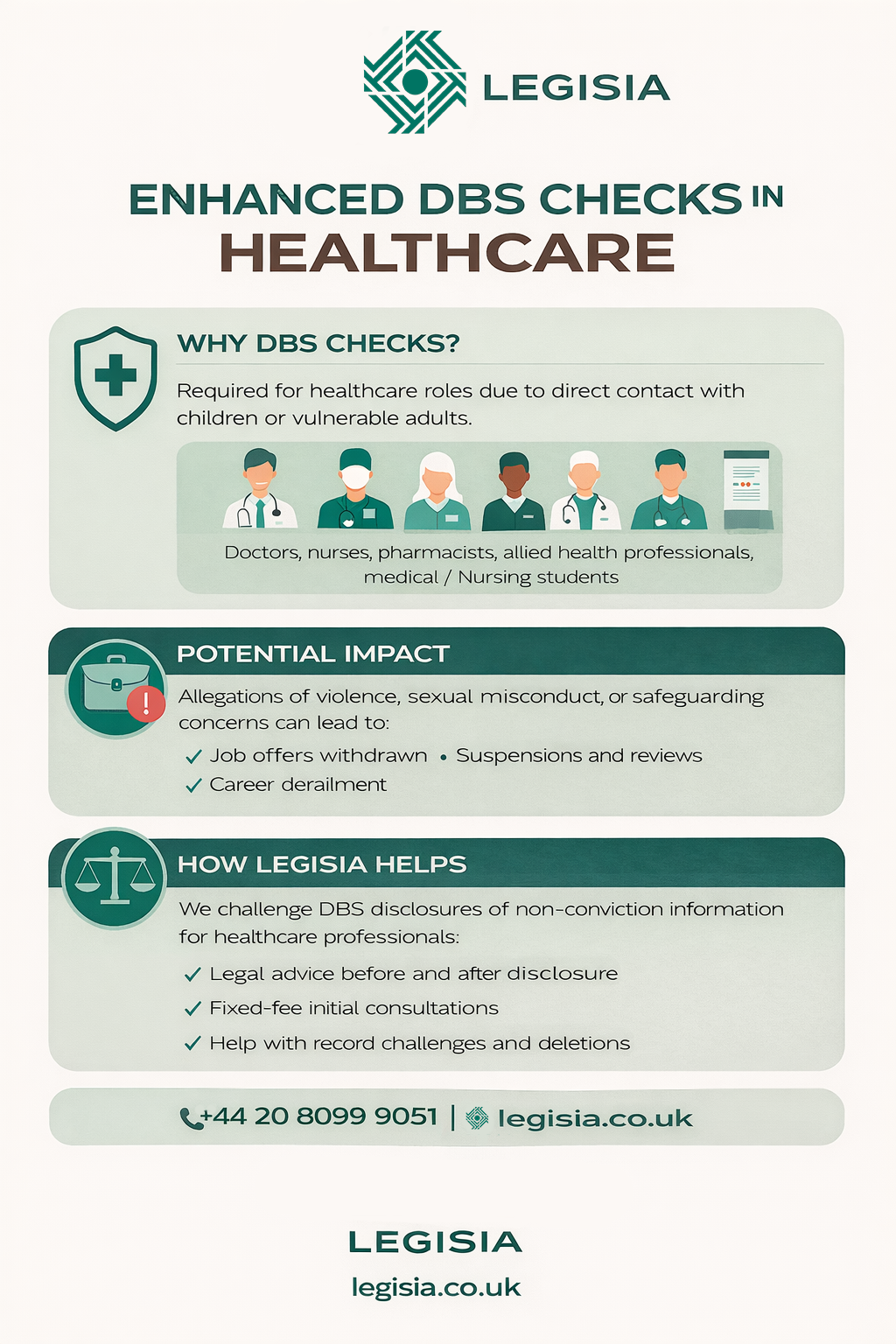
Most healthcare roles involve direct contact with patients. Many of those patients are children or vulnerable adults. The law treats this as regulated activity, and the law requires Enhanced DBS checks for people working in these settings. Many of those checks will also include a check against the barred lists — the highest level of background screening available in the UK system. Where the DBS proposes to go further and place a professional on a barred list, different rules apply, and our note on barred list appeals after SA v DBS explains them.
The professions most directly affected include doctors, nurses, midwives, healthcare assistants, allied health professionals (such as physiotherapists, occupational therapists, paramedics and radiographers), dentists, pharmacists, optometrists and clinical psychologists. Medical and nursing students also require Enhanced DBS checks before they can begin clinical placements. The same applies to people training for any allied health profession.
This means that the question of “what might come up on my DBS check” is not a one-off concern for healthcare professionals. It is a recurring concern that follows them through their career.
Repeated Exposure Throughout a Healthcare Career
One of the features that makes the healthcare context so difficult is the sheer frequency of Enhanced DBS checks throughout a career. A single doctor or nurse may face many DBS checks over the course of their working life.
The points at which a check is typically triggered include several stages. Entry to a clinical training programme. Application for foundation or specialty posts. Every move between NHS trusts or private healthcare providers. Locum and agency engagements. Joining a private practice. Roles involving children or vulnerable adults in any setting. Some healthcare workers face Enhanced DBS checks several times in a single year.
This matters because each new check is a fresh opportunity for the same information to surface. A successful challenge to a disclosure on one certificate prevents the disclosure on that occasion. But the underlying local police record remains on the force’s systems. The next check can trigger the same disclosure all over again. Our guide on how local police records feed into Enhanced DBS disclosure explains why this matters and why deletion of the underlying record is often the only durable solution.
What Can Be Disclosed on a Healthcare Worker’s Certificate
An Enhanced DBS certificate for a healthcare role can include the same range of information as any other Enhanced check. That includes convictions and cautions held on the Police National Computer. It also includes — most importantly for the people we act for — non-conviction information held on local police records.
The non-conviction category includes allegations that were never charged or prosecuted. It includes arrests that did not lead to a charge. It includes investigations that ended in no further action, community resolutions and police intelligence entries. All of this falls under the umbrella of relevant police information. All of it can be disclosed at the discretion of the chief officer of the relevant police force.
The risk in healthcare is amplified by the kinds of allegations that tend to be disclosed. Domestic incidents, allegations of violence, allegations involving children and allegations of sexual misconduct. These are exactly the kinds of allegations that an NHS trust or private healthcare employer is least willing to overlook. The information may relate to a matter that was investigated and closed without any criminal outcome. But the headline of the allegation is what an employer reads.
The Real Risk — The Employer’s Reaction
It is important to be realistic about where the actual risk lies. For most healthcare professionals facing a DBS disclosure, the immediate and most significant risk is the employer’s reaction to seeing the information.
An NHS trust receiving a certificate that discloses a historic allegation will typically pause the recruitment process. The trust may seek further information, ask the applicant to explain the circumstances, or refer the matter to its own internal safeguarding processes. In many cases, the trust will simply withdraw the job offer without any detailed engagement. For someone already in post, a disclosure on a renewal check can trigger suspension or internal review.
Private healthcare employers tend to be even more risk-averse. Locum agencies, private clinics and independent providers operate in commercial environments where the appearance of risk can cost a person work, regardless of the underlying facts.
The central task in most healthcare DBS cases is to secure the removal of information from the certificate before the employer sees it. If the employer has already seen it, the task is to secure a corrected certificate as quickly as possible. The legal arguments about relevance and proportionality matter because they are the route to that result.
The Regulators — GMC, NMC, HCPC and Others
Every healthcare profession in the UK is regulated. The main regulators are the General Medical Council for doctors, the Nursing and Midwifery Council for nurses and midwives, and the Health and Care Professions Council for paramedics, physiotherapists, occupational therapists, radiographers and several other allied health professions. Other regulators cover dentists (GDC), pharmacists (GPhC), opticians (GOC), osteopaths (GOsC) and chiropractors (GCC).
Each regulator has powers to investigate fitness to practise concerns. Each can ultimately remove a professional from the register. The question for our purposes is when, and how, an Enhanced DBS disclosure interacts with these regulatory processes.
In our experience, a DBS disclosure on its own does not usually trigger a fresh regulatory investigation. If a referral was going to happen, it would typically have happened at the time of the original incident. That referral usually comes through a police referral, an employer concern, or a regulatory self-disclosure made at the time. An historic allegation surfacing years later on a DBS certificate is more often a problem for the employer than for the regulator directly.
That said, the relationship between employer action and regulatory action can blur. An employer responding to a DBS disclosure may suspend the professional, institute an internal investigation, or terminate their employment. That employer action can itself become a matter that the regulator wants to know about. In that sense, the DBS disclosure is sometimes the spark that lights a longer fuse — but it is the employer’s reaction, not the disclosure itself, that drives the chain.
Self-Disclosure Obligations
Healthcare professionals have a general duty to be open and honest with their regulator. Most regulators require professionals to inform them of certain specific matters. These include criminal investigations, charges, cautions, convictions, and any adverse findings by another professional body, employer or court. The exact rules vary between regulators and between the kind of matter involved.
The key point is that the trigger for self-disclosure is normally the underlying event itself. An arrest. A charge. A conviction. The trigger is not usually the appearance of information on a later DBS certificate. If a healthcare professional was investigated by the police several years ago and the matter ended without action, the obligation to inform their regulator (if any) typically arose at the time. The fact that the matter has now appeared on a DBS check does not, on its own, usually create a fresh duty to disclose.
However, the position becomes more complicated where a healthcare professional has not previously informed their regulator about a matter that they should have. In that situation, the appearance of the information on a DBS certificate can expose a separate failure — the failure to self-disclose at the time the duty arose. Regulators sometimes treat that failure as a more serious concern than the original matter itself.
This is an area where it is important to take legal advice before making any decision. An ill-judged self-disclosure can create problems that did not previously exist. An unjustified failure to disclose can create different problems. The right approach depends on the specific facts and the specific regulator.
Why Non-Conviction Disclosure Causes Particular Concern
Healthcare professionals facing a DBS disclosure are often dealing with a particular form of injustice. The information being disclosed almost always relates to a matter that never resulted in a conviction. Often it never resulted in a caution. In many cases it never even resulted in a charge. By every normal measure of the criminal justice system, the matter is closed.
And yet, on a DBS certificate, the matter is not closed. It appears as relevant police information, often with a brief description of the allegation and the outcome. An employer reading the certificate sees the headline of the allegation. The details — that the case was not pursued, that the complainant withdrew, that the investigation found no basis to proceed — get lost in the framing.
This is a particular problem for healthcare workers because of the safeguarding sensitivity of the work. An employer is entitled to be cautious about safeguarding. But the proportionality test the police are required to apply is meant to filter out information that does not justify disclosure in the first place. Where that test has not been properly applied, the resulting disclosure is unfair — and it can be challenged.
What to Do If You Face Disclosure
The right course of action depends on the stage at which you become aware of the issue. The earlier the intervention, the better the prospects of avoiding the consequences that follow disclosure.
Pre-issue stage. You may receive a notification from a police force telling you that they are proposing to disclose information on your forthcoming Enhanced DBS certificate. This is the most important moment. The window to make representations is short — usually a matter of weeks. The quality of those representations can be the difference between a clean certificate and a damaging disclosure. Specialist legal advice at this stage is highly valuable.
After the certificate has been issued. If the certificate has been issued with the disclosure on it, the formal route is the DBS certificate disputes process. The dispute is reviewed by the police force itself. If the police refuse to amend or withdraw the disclosure, it is referred to the Independent Monitor as the built-in escalation stage. Our guide on how to challenge information on an Enhanced DBS certificate explains the process in detail.
For long-term protection. Where the underlying local police records remain on the force’s systems, the same information can be disclosed again on a future check. Healthcare professionals will face repeated checks throughout their career. For them, the most durable solution is often to seek deletion of the underlying records as well as challenging the immediate disclosure.
Real Cases — Healthcare Professionals We Have Helped
We have acted in many cases involving healthcare professionals facing the disclosure of non-conviction information. A number of cases illustrate the range of situations that arise.
Doctor — domestic assault allegation, prosecution dropped. A doctor faced disclosure of an allegation following an arrest where the prosecution had been dropped. We made representations to the police at the pre-issue stage. The certificate was issued without the disclosure.
Nurse — workplace intoxication allegation. A nurse had been the subject of a workplace allegation that she had been intoxicated on duty. The investigation had ended without formal action, but the allegation had been disclosed on the certificate. We secured the removal of the information.
Doctor — false sexual allegation involving a neighbour’s child. A doctor was the subject of a false allegation of sexual misconduct involving a neighbour’s child. The investigation cleared him, but the police proposed to disclose the allegation. Pre-issue representations prevented the information from being included on the certificate.
Medical student — community resolution from a family incident. A medical student had accepted a community resolution following a family incident. The community resolution had been disclosed on a certificate needed for clinical placement. We appealed the disclosure on proportionality grounds and the information was removed.
Healthcare applicant — ABH allegation involving a family member. We acted for a healthcare applicant where local police records relating to an ABH allegation represented a future risk for repeated DBS checks. We secured the deletion of the underlying records, eliminating the risk at source.
What these cases share is that, in each one, the disclosure or proposed disclosure was challenged successfully by engaging directly with the legal tests the police were required to apply. The right approach depends on the stage and the facts — but the principle is the same throughout.
How Legisia Can Help
We act for healthcare professionals facing the disclosure of non-conviction information on Enhanced DBS certificates. Our clients include doctors, nurses, midwives, healthcare assistants, allied health professionals, dentists, pharmacists, and medical and nursing students. We understand the regulatory and employment context healthcare professionals operate in. We work to limit the consequences of disclosure as effectively as possible.
Depending on the stage and the facts, we can advise on challenging the disclosure on the certificate, seeking deletion of the underlying local police records, or both. Where there is an additional regulatory dimension, we work alongside specialist regulatory advisors as appropriate.
We offer a fixed-fee initial consultation where we will assess your case in detail and provide clear written advice on your prospects of success.
To discuss your case, contact us or call 020 8099 9051.
Frequently Asked Questions
Why do healthcare professionals need Enhanced DBS checks?
Most healthcare roles involve regulated activity with patients, including children and vulnerable adults. The law requires Enhanced DBS checks for people working in these settings. Many checks also include a barred list check. Healthcare professionals typically face Enhanced DBS checks at multiple points throughout their career. These include applying for jobs, moving between trusts, entering training programmes, and joining clinical placements.
What is the main risk to a healthcare professional from a DBS disclosure?
The main practical risk is the employer’s reaction. An NHS trust or private healthcare employer reading a certificate that includes an allegation of violence, sexual misconduct or safeguarding concern may withdraw a job offer. They may suspend an existing role pending internal review. They may take other employment action. The damage is often done by the disclosure itself, regardless of whether the matter ever resulted in any criminal outcome.
Will a DBS disclosure automatically trigger a fitness to practise investigation?
Not usually. If a regulatory referral was going to happen, it would typically have happened at the time of the original incident. That referral would normally come through a police referral or through an employer concern raised at the time. A disclosure on a DBS certificate years later does not, on its own, usually trigger a fresh regulatory referral. The more common risk is that the employer who sees the disclosure may take action, which can in turn lead to consequences. The DBS disclosure itself is rarely the primary regulatory trigger.
Do I have to disclose a DBS certificate to my regulator?
The duty to be open and honest with your regulator is a general professional obligation. But it usually requires disclosure of specific matters such as criminal charges, cautions, convictions and adverse findings, rather than the contents of every DBS check. Whether a particular DBS disclosure needs to be reported depends on the regulator and the nature of the information disclosed. If you are unsure, you should take advice before deciding whether and how to disclose. A failure to self-disclose can be treated as a separate concern in its own right.
Can I challenge a disclosure before it appears on the certificate?
Yes. Under the statutory quality assurance framework, the police are required to notify the applicant where they are proposing to disclose non-conviction information. They must also give the applicant an opportunity to make representations before the certificate is issued. This pre-issue stage is often the most important opportunity to prevent disclosure altogether. For healthcare professionals in particular, securing the removal of information at the pre-issue stage avoids the consequences that flow from an employer or regulator ever seeing the information.
Share this Post, Choose your platform!

Matt is a Solicitor Advocate and Director of Legisia Legal Services. He specialises exclusively in police record deletion, DBS appeals, and regulatory defence. With over 20 years of experience, he has advised hundreds of professionals and individuals on high-stakes matters affecting careers, reputations, and legal standing. His work focuses on challenging unlawful data retention, safeguarding thresholds, and procedural breaches across UK policing and disclosure systems.
Matt is a Solicitor Advocate and Director of Legisia Legal Services. He specialises exclusively in police record deletion, DBS appeals, and regulatory defence. With over 20 years of experience, he has advised hundreds of professionals and individuals on high-stakes matters affecting careers, reputations, and legal standing. His work focuses on challenging unlawful data retention, safeguarding thresholds, and procedural breaches across UK policing and disclosure systems.
Disclosure & DBS: the complete CPD course for professionals
Written by a solicitor who handles these cases every day. For HR, compliance, safeguarding and legal professionals who make decisions about police records and DBS disclosures.
- Eleven modules covering disclosure, DBS checks, barring, regulatory interface and employment decisions
- The only UK course that also covers how UK records affect work, travel and employment abroad
- CPD-accredited, with written feedback on a final applied-scenario exercise
- Waitlist members get 20% off and a sample module ahead of launch
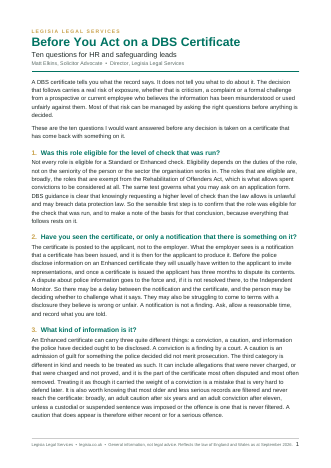
We'll email you the checklist and news about the course launch – nothing else. See the full course →