


-

 8 min read





Do Police Cautions Show on an Enhanced DBS Check?
If you are asking whether a police caution will show on an Enhanced DBS check, the answer is often yes – but not in every case, and not always for the same reason.
An Enhanced DBS certificate can include criminal record information from the Police National Computer (PNC) and, in some cases, additional local police information that the police consider relevant to the role. That means a caution may appear automatically under the filtering rules, or information related to it may still be disclosed on a separate discretionary basis.
This is where many people get confused. A caution may be spent, or even filtered from automatic DBS disclosure, and yet still continue to cause problems on an Enhanced DBS certificate.
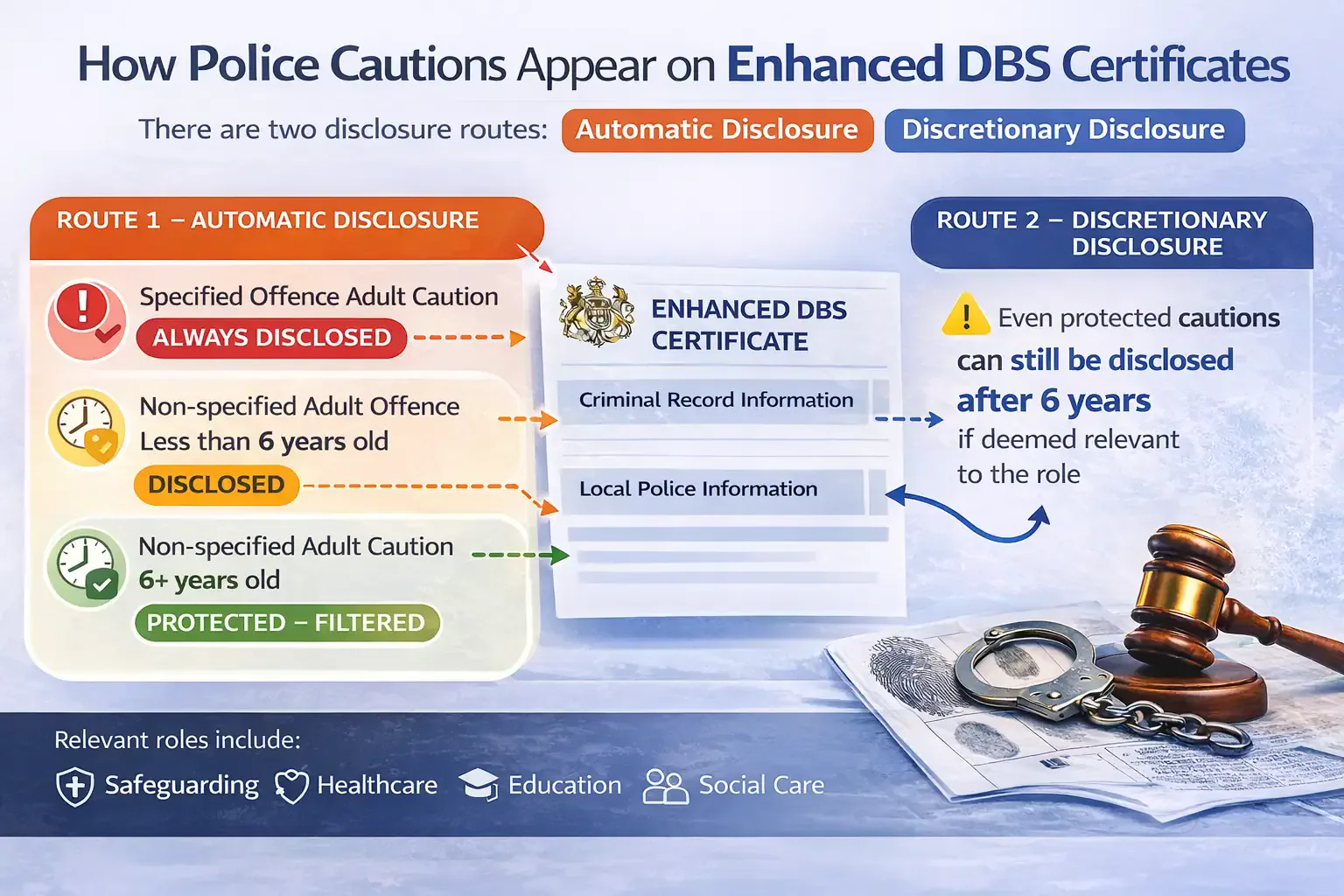
Yes, police cautions can show on an Enhanced DBS check. Adult cautions for specified offences can continue to appear automatically. Adult cautions for non-specified offences usually stop appearing automatically after 6 years. Youth cautions are treated differently, but local police information related to a caution can still create disclosure issues in some cases.
Do Police Cautions Show on an Enhanced DBS Check?
Yes. A police caution can show on an Enhanced DBS certificate. The question is when, why, and through which disclosure route.
For some people, the caution appears automatically because it is still disclosable under the DBS filtering rules. For others, the caution may no longer be automatically disclosed, but the police may still consider related information relevant enough to include on an Enhanced DBS certificate for the role in question.
That is why it is important to separate three different issues:
- whether the caution is still on the PNC;
- whether it is still automatically disclosable under the DBS filtering rules; and
- whether local police information related to the caution may still be disclosed on an Enhanced DBS certificate.
The Short Answer
If you received an adult caution, it may show on an Enhanced DBS check automatically depending on the offence type and how long ago it was given.
- Adult cautions for specified offences can continue to be disclosed automatically.
- Adult cautions for non-specified offences will usually stop being automatically disclosed after 6 years.
- Youth cautions are treated differently and are not automatically disclosed in the same way.
But automatic disclosure is not the whole story. Even where a caution becomes protected from automatic disclosure, an Enhanced DBS certificate can still include relevant local police information in some circumstances.
What an Enhanced DBS Check Can Show
An Enhanced DBS certificate is not the same as a Basic DBS check.
A Basic DBS only shows unspent convictions and conditional cautions. A Standard DBS can show spent and unspent cautions and convictions that remain disclosable under the filtering rules. An Enhanced DBS shows the same as a Standard DBS, but can also include relevant local police information if the police consider it relevant and proportionate to disclose for the role. GOV.UK explains the different levels of DBS check and what each can contain. Official DBS guidance.
That additional local police information is one of the main reasons Enhanced DBS checks cause difficulty even where someone believes their caution should no longer matter.
If you want a quick tool-based indication of how the automatic filtering rules may apply to your own caution, Legisia’s Police Caution Calculator is a useful starting point.
When an Adult Police Caution Will Show
For adult cautions, the broad automatic disclosure position on an Enhanced DBS certificate is usually as follows:
- Specified offence caution – this can continue to appear automatically.
- Non-specified offence caution – this will usually stop appearing automatically after 6 years.
That is why the type of offence matters so much. A person with a low-level, non-specified caution may eventually find that it no longer appears automatically on an Enhanced DBS certificate. Someone with a specified offence caution may face a much longer-term disclosure problem.
This is also where people sometimes mix up spent and filtered. A simple caution becomes spent immediately, but that does not mean it is filtered straight away for Enhanced DBS purposes. Our article on how long a police caution stays on the PNC explains the timeline in more detail.
What About Youth Cautions?
Youth cautions are treated differently from adult cautions. They are not automatically disclosed in the same way on Standard and Enhanced DBS certificates.
That does not mean a youth caution can never cause an Enhanced DBS problem. The police still have powers to disclose relevant local police information where they consider that necessary and proportionate for the role.
If your case involves a youth caution, warning or reprimand, read Legisia’s guide on youth cautions, warnings and reprimands.
Can Filtered Information Still Appear?
Yes, potentially. This is one of the most important points to understand about Enhanced DBS checks.
Even where a caution is no longer automatically disclosed as PNC information, the police may still consider related information relevant to the role and decide that it ought to be included as local police information. That is a separate disclosure route from automatic disclosure under the filtering rules.
This usually matters most in safeguarding roles, healthcare, education, social care, and other posts involving children or vulnerable adults. The more relevant the incident appears to the duties of the role, the greater the risk of disclosure.
If your concern is not the PNC caution itself but information held locally by police outside the PNC, see our local police record deletion service. If an Enhanced DBS certificate has already disclosed information unfairly, see our Enhanced DBS Certificate Appeals service.
What If the Caution Should Not Be There at All?
Sometimes the real problem is not merely that the caution is showing on an Enhanced DBS check. It is that the caution should never have been issued, or should not still remain on police systems.
Where that is the issue, the better long-term strategy may be to challenge the underlying record itself. If a police caution is successfully deleted from the PNC, that is usually a stronger outcome than relying only on filtering rules or arguing about one certificate at a time.
We cover that in more detail in our related guides:
- Can a Police Caution Be Removed From the PNC?
- When Can a Police Caution Be Deleted?
- How Long Does a Police Caution Stay on the PNC?
How Legisia Can Help
At Legisia, we look at the whole problem rather than only the certificate in front of you. Sometimes the issue is automatic DBS disclosure. Sometimes it is relevant local police information. Sometimes the real answer is to seek deletion of the underlying caution from the PNC.
That is why we advise on both police caution removal and Enhanced DBS disclosure challenges. The right strategy depends on the nature of the caution, the role you are applying for, the disclosure route involved, and whether there are grounds to remove the record altogether.
Concerned that a police caution may appear on your Enhanced DBS?
If a police caution is affecting a job application, professional registration, or safeguarding role, it may be possible either to challenge the disclosure itself or, in some cases, to seek deletion of the underlying record.
Legisia advises clients on police caution removal, Enhanced DBS certificate appeals, and the wider disclosure issues that arise when old cautions continue to affect work.
Frequently Asked Questions
Do all police cautions show on an Enhanced DBS check?
No. Adult cautions for specified offences can continue to appear automatically, while adult cautions for non-specified offences will usually stop appearing automatically after 6 years. Youth cautions are treated differently. But local police information can still create disclosure issues in some cases.
Can a filtered caution still cause a problem on an Enhanced DBS certificate?
Yes. Even if a caution is filtered from automatic disclosure, related local police information may still be disclosed on an Enhanced DBS certificate if the police consider it relevant and proportionate for the role.
Does a spent caution stay off an Enhanced DBS check?
Not necessarily. “Spent” and “filtered” are different concepts. A caution may be spent for Rehabilitation of Offenders Act purposes but still remain automatically disclosable on an Enhanced DBS certificate until the filtering rules stop applying.
Can an employer ask for an Enhanced DBS check for any job?
No. Enhanced DBS checks are only available for roles that are legally eligible for that level of check. The type of role matters because it affects both eligibility and the relevance of any local police information.
If a caution appears on my Enhanced DBS, can it be removed from future certificates?
Potentially, yes. In some cases the issue can be challenged as unfair local police disclosure. In others, the better route is to seek deletion of the underlying caution from the PNC through the Record Deletion Process.
Does a specified offence caution ever stop showing automatically on an Enhanced DBS certificate?
An adult caution for a specified offence will continue to be automatically disclosed on an Enhanced DBS certificate. That is one reason deletion from the underlying police record can become strategically important.
Share this Post, Choose your platform!

Matt is a Solicitor Advocate and Director of Legisia Legal Services. He specialises exclusively in police record deletion, DBS appeals, and regulatory defence. With over 20 years of experience, he has advised hundreds of professionals and individuals on high-stakes matters affecting careers, reputations, and legal standing. His work focuses on challenging unlawful data retention, safeguarding thresholds, and procedural breaches across UK policing and disclosure systems.
Matt is a Solicitor Advocate and Director of Legisia Legal Services. He specialises exclusively in police record deletion, DBS appeals, and regulatory defence. With over 20 years of experience, he has advised hundreds of professionals and individuals on high-stakes matters affecting careers, reputations, and legal standing. His work focuses on challenging unlawful data retention, safeguarding thresholds, and procedural breaches across UK policing and disclosure systems.



When Can a Police Caution Be Deleted?
Mar 9, 2026


Should I Accept a Police Caution?
Nov 7, 2020

Police Caution Removal Solicitor
Oct 24, 2020