- Court Record Deletion
-

 10 min read





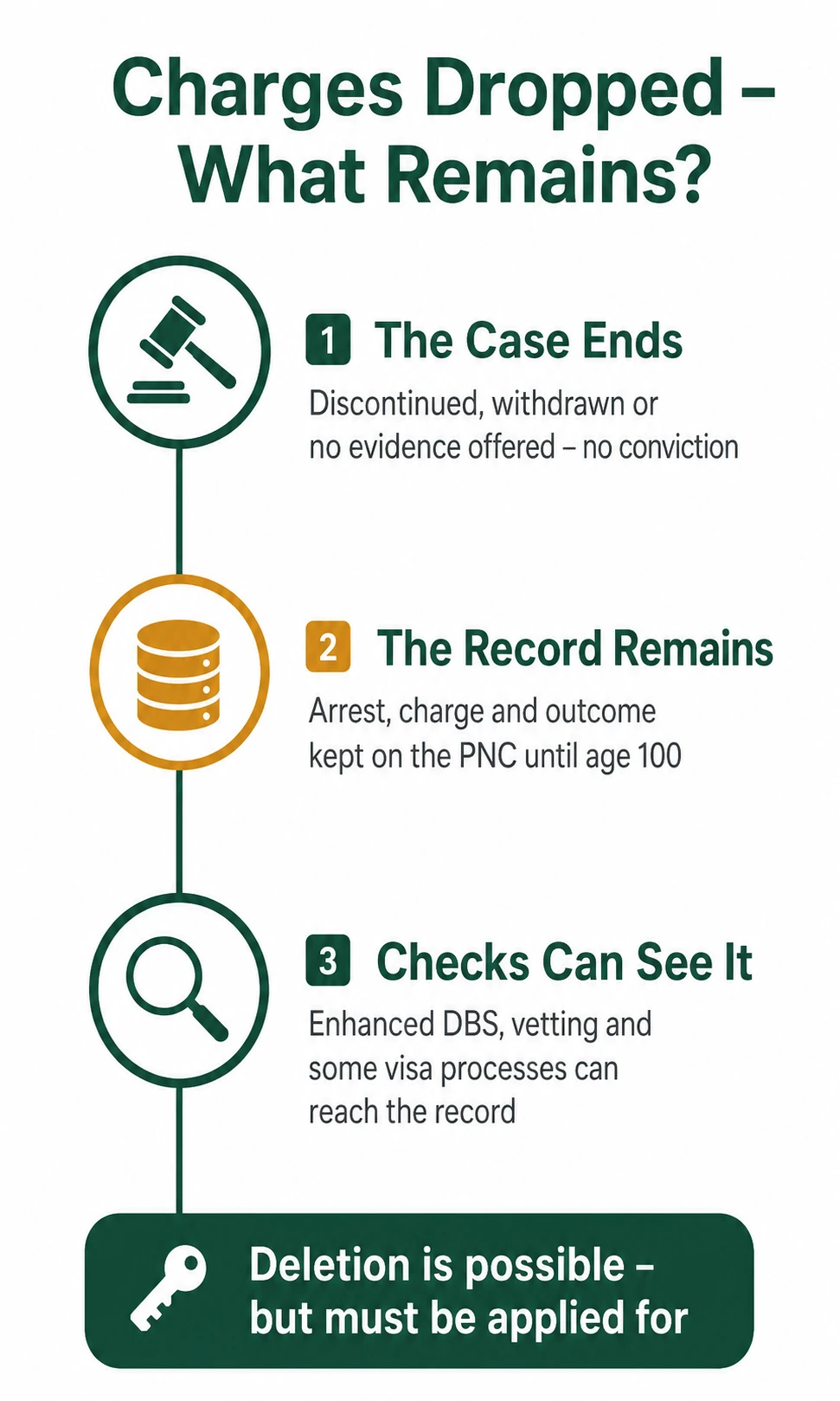
You were charged. Perhaps you attended court, perhaps the case collapsed before you got there. Either way, the prosecution ended without a trial and without a conviction. The letter or the phone call came, the case was over, and you could finally breathe.
What nobody tells you at that moment is that the record of the case survives it. The arrest, the charge and the way the case ended all remain on police systems. By default, they stay there until your 100th birthday. Years later, an Enhanced DBS check, a vetting process or a visa application can put the whole episode back on the table.
This guide covers cases that ended after charge but before a verdict. If the police decided not to charge you at all, the position is slightly different – see our guides on no further action decisions and being arrested but not charged. If your case went all the way to trial and you were acquitted, see our guide on whether a not guilty verdict stays on your police record.
The Ways a Prosecution Ends Without a Trial
Prosecutions collapse in several different ways, and the label attached to yours matters more than most people realise.
Discontinuance. The CPS can discontinue a prosecution by written notice. This usually happens because the evidence no longer supports a realistic prospect of conviction. Sometimes it happens because prosecution is no longer in the public interest. The case ends without any verdict.
Withdrawal. In the magistrates’ court, the prosecution can withdraw a charge. The practical effect is similar – the case ends, and no verdict is entered.
No evidence offered. Where the prosecution formally offers no evidence, the court enters a not guilty verdict. This outcome is widely misunderstood. If your case ended this way, you were acquitted. Legally, you are in the same position as someone found not guilty after a trial. Many people who were told “the case was dropped” were in fact formally acquitted and never realised it.
Left to lie on file. Occasionally a charge is left on file, usually where a defendant has been convicted of other matters. The charge is not pursued, but it is not formally resolved either.
In every one of these scenarios, the outcome recorded on police systems is a non-conviction outcome. And in every one of them, the records remain.
What Remains on Your Record
Two sets of records survive a dropped prosecution, on two separate systems.
The Police National Computer holds the event history of the case: the arrest, the offence you were charged with, and the outcome. Under current retention rules, that entry stays on the PNC until your 100th birthday. It is not removed because the prosecution was discontinued, withdrawn, or ended with no evidence offered.
The local records held by the investigating force sit alongside it. These include the crime report, the custody record, the interview material and the case file. Our guide on what local police records are explains these systems in detail. They are governed by separate rules and retained under the force’s own frameworks.
A charge that was dropped within weeks can therefore generate records that last a lifetime. The brevity of the case has no bearing on the longevity of the record.
The Ambiguity Problem – Why a Dropped Case Reads Badly
A dropped case carries a particular disadvantage that even an acquittal does not.
A person acquitted at trial can point to a verdict. Twelve jurors, or a bench of magistrates, heard the evidence and rejected the case. Whatever a record says, the verdict answers it.
A person whose case was discontinued has no verdict to point to. The record shows a charge and then an ending. It rarely explains why, and anyone reading it is left to guess. Did the case collapse because the accused was innocent? Because a witness moved abroad? Because of a procedural failure? The record does not say, and the reader’s imagination fills the gap. In safeguarding-sensitive settings, that gap tends to be filled unfavourably.
This is the quiet unfairness of the dropped case. You were never convicted of anything. But you were never cleared of anything either, and the record preserves that ambiguity indefinitely. It is one of the strongest practical reasons for seeking deletion rather than living with the record.
Where a Dropped Case Can Surface
A dropped charge is not a conviction or a caution, so it will not appear on a Basic or Standard DBS check.
On an Enhanced DBS check, the position changes. The police can disclose non-conviction information where they consider it relevant to the role and proportionate to disclose. A charged case that ended without a verdict sits squarely within that category. Whether it is disclosed depends on the facts, the role, and how the force applies the legal tests. But the possibility exists for as long as the records do.
Security vetting and police vetting go further, routinely considering the full picture of a person’s police history. A prosecution that ended abruptly is exactly the kind of matter a vetting officer will ask about.
Visa and immigration processes are something of an anomaly. An ACRO police certificate, the document most visa applications rely on, does not disclose arrests or non-conviction outcomes. But some countries ask applicants directly whether they have ever been arrested or charged. The United States is the best-known example, and the honest answer to that question depends on exactly the records this guide is about. Some overseas employers go further and ask candidates to supply a copy of their own subject access response from the PNC, which shows everything, including arrests and dropped cases. Requiring that in the UK is a criminal offence, known as enforced subject access. Companies abroad do not always feel bound by it.
In each setting, the ambiguity does the damage. The record shows a charge that went nowhere, and leaves whoever reads it to draw their own conclusions.
Can the Record Be Deleted?
Often, yes – but not automatically, and not simply because the case was dropped.
Records on national police systems can be the subject of a deletion application through the Record Deletion Process, administered by ACRO. The decision sits with the Chief Officer of the force that owns the record, and it is discretionary. Our guide to the Record Deletion Process explains the mechanics.
The end of the prosecution is a starting point, not a conclusion. Forces sometimes take the view that the case was sound and failed for reasons that say nothing about innocence. They refuse deletion on that basis. A successful application has to be built on specific recognised grounds and supported by the right evidence. It must be presented so the force engages with it properly. That preparation is where these applications are won or lost, and it is the core of our record deletion service for acquittals and discontinued cases.
Why the Reason the Case Was Dropped Matters
Not all dropped cases are equal, and the reason yours ended shapes the prospects of deletion.
Some prosecutions collapse because the case against the accused fell apart. The account was disproved, the complainant’s version did not withstand scrutiny, or evidence emerged pointing the other way. Records of cases like these are strong candidates for deletion. The material that ended the prosecution often supports the grounds an application needs.
Other prosecutions end for reasons that leave the underlying question open. A witness became unavailable, a procedural deadline was missed, or the public interest shifted. These cases can still succeed, but they need more careful handling. The force will be readier to argue that the allegation itself was never undermined.
This is why the paperwork from your case matters. The discontinuance notice, the CPS’s stated reasons, the correspondence. All of it feeds the assessment of whether an application is likely to succeed, and shapes how the application should be put. It is also why we start every case by reviewing what actually happened, rather than applying a template.
The Local Records
Deleting the PNC entry deals with the national record. The local records held by the force survive it, and they need a separate application under data protection law.
For anyone whose work involves Enhanced DBS checks, the local records matter at least as much as the PNC entry. They are the main source of non-conviction disclosure. Our local police record deletion service deals with that second track, and in most dropped-case matters we advise on both together.
How Legisia Can Help
We act for people whose prosecutions ended without a conviction and whose records did not end with them. We obtain the records and review how and why the case was dropped. We then give you a clear view of the realistic prospects of deletion. Where the prospects are good, we prepare the applications across the national and local systems.
We will always be honest with you. Not every record can be deleted, and if yours cannot, we will tell you before you spend money finding out the hard way.
We offer a fixed-fee initial consultation where we will assess your case in detail and provide clear written advice on your prospects of success.
To discuss your case, contact us or call 020 8099 9051.
Frequently Asked Questions
If my case was dropped, do I have a criminal record?
You do not have a conviction, so you can honestly say you have no criminal record in the sense most people mean. But the police still hold records of the case. The arrest, the charge and the outcome remain on the Police National Computer, and the force keeps its own local records of the investigation. Those records can surface in Enhanced DBS checks, vetting and some visa processes.
What is the difference between no further action and a discontinued case?
No further action is a decision made before charge – the police or CPS decide not to prosecute at all. A discontinued case is one that ended after you were charged, when the prosecution decided not to continue. Both outcomes leave records on police systems, but the record of a discontinued case includes the charge itself, which can carry more weight in checks.
Will a dropped charge show on a DBS check?
Not on a Basic or Standard check, because a dropped charge is not a conviction or caution. On an Enhanced DBS check, the police can disclose the case as non-conviction information where they consider it relevant to the role and proportionate to disclose. The records behind a dropped charge remain available to that process for as long as they exist.
Does no evidence offered mean I was found not guilty?
Yes. Where the prosecution formally offers no evidence, the court enters a not guilty verdict. Legally, you were acquitted. The records of the case still remain on police systems, in the same way as after any other acquittal, and deletion has to be applied for separately.
Can I get the record of a dropped case deleted?
Often, yes – but not automatically. An application can be made for deletion of the records, and the decision sits with the Chief Officer of the force that owns them. The fact that the prosecution was dropped is a starting point, not a conclusion. The application has to be built on recognised grounds and supported by evidence, and the reason the case was dropped usually shapes how strong those grounds are.
Share this Post, Choose your platform!

Matt is a Solicitor Advocate and Director of Legisia Legal Services. He specialises exclusively in police record deletion, DBS appeals, and regulatory defence. With over 20 years of experience, he has advised hundreds of professionals and individuals on high-stakes matters affecting careers, reputations, and legal standing. His work focuses on challenging unlawful data retention, safeguarding thresholds, and procedural breaches across UK policing and disclosure systems.
Matt is a Solicitor Advocate and Director of Legisia Legal Services. He specialises exclusively in police record deletion, DBS appeals, and regulatory defence. With over 20 years of experience, he has advised hundreds of professionals and individuals on high-stakes matters affecting careers, reputations, and legal standing. His work focuses on challenging unlawful data retention, safeguarding thresholds, and procedural breaches across UK policing and disclosure systems.
Disclosure & DBS: the complete CPD course for professionals
Written by a solicitor who handles these cases every day. For HR, compliance, safeguarding and legal professionals who make decisions about police records and DBS disclosures.
- Eleven modules covering disclosure, DBS checks, barring, regulatory interface and employment decisions
- The only UK course that also covers how UK records affect work, travel and employment abroad
- CPD-accredited, with written feedback on a final applied-scenario exercise
- Waitlist members get 20% off and a sample module ahead of launch
We'll email you the checklist and news about the course launch – nothing else. See the full course →


Police Record Deletion Process Explained
Oct 1, 2020