- Enhanced DBS Disclosure
-

 14 min read





An allegation that was never proven, never charged, and never resulted in any criminal outcome can still appear on an Enhanced DBS certificate. For many professionals, this comes as a serious and unwelcome shock — particularly when the allegation was false, malicious, or made in circumstances that had nothing to do with their professional role.
This is one of the most difficult areas of Enhanced DBS disclosure, and it is one of the most common reasons people contact us at Legisia. If you are facing the disclosure of an allegation on your Enhanced DBS certificate, or you are worried that an old allegation may appear on a future check, this guide explains how it happens, what the police are required to consider, and what you can do about it.
For a broader overview of everything that can appear on an Enhanced DBS certificate — including convictions, cautions, and other forms of non-conviction information — see our complete guide to what can show on an Enhanced DBS check.
How Allegations End Up on an Enhanced DBS Certificate
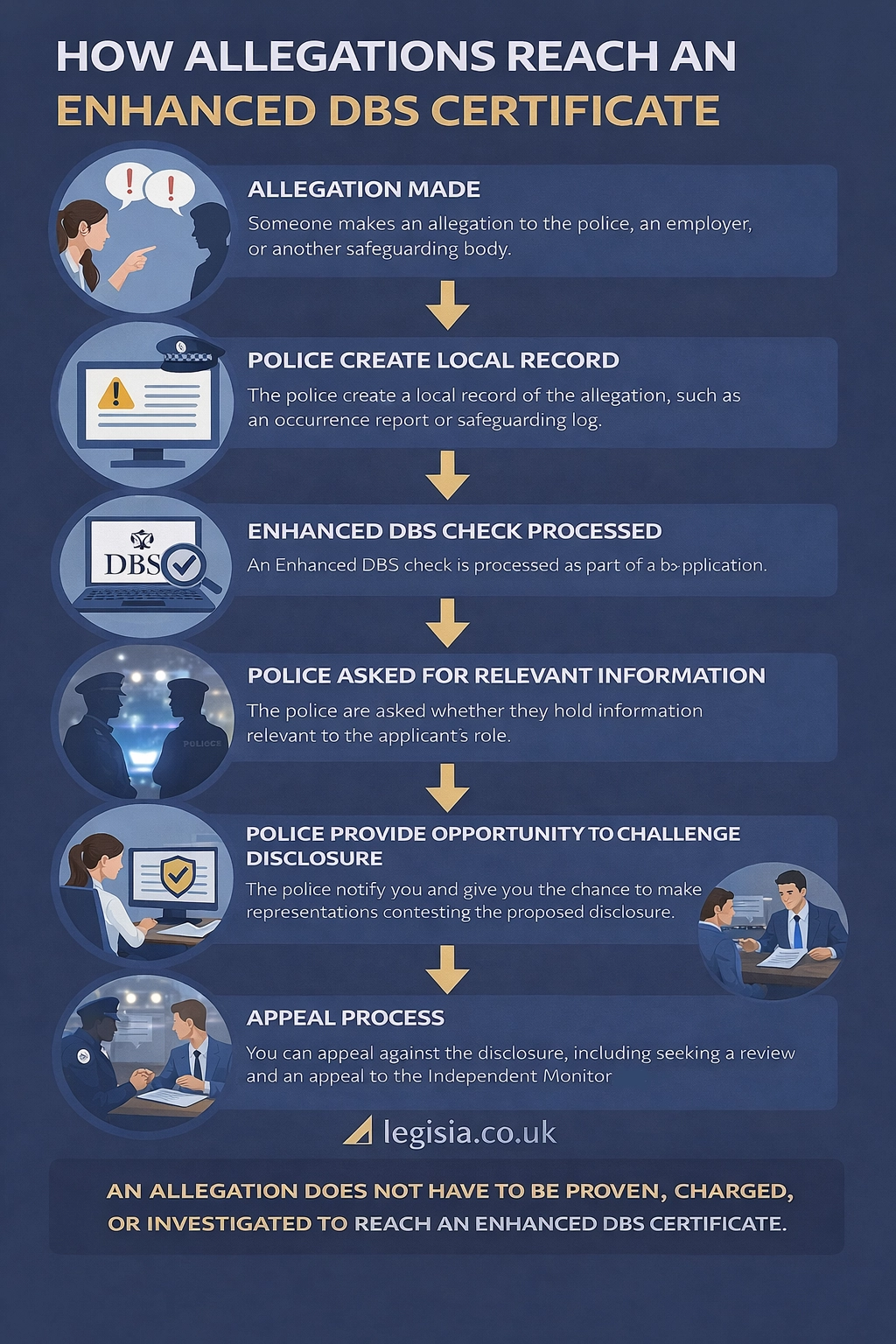
When the police respond to a report or complaint, they create a record on their local systems. This happens regardless of whether the matter goes any further. If someone makes an allegation against you — whether to the police directly, through an employer, through a safeguarding referral, or through any other route — the police will typically create a local record of that contact.
That record is not stored on the Police National Computer (PNC). It sits on the individual police force’s own systems as locally held data. It may be recorded as an occurrence report, an intelligence entry, a safeguarding log, or a crime report — even where no crime was ultimately identified.
When an Enhanced DBS check is processed, the Disclosure and Barring Service contacts the relevant police force and asks whether it holds any information that it considers ought to be disclosed. If the police hold a local record of an allegation and the chief officer considers it relevant to the role being applied for, the allegation can be disclosed on the certificate as approved information.
This is the critical point: the police do not need to prove that the allegation is true. They do not need to have charged anyone. They do not even need to have investigated the matter to conclusion. If they hold the information locally and consider it relevant, they have the power to disclose it.
What Types of Allegations Can Be Disclosed?
There is no closed list. Any allegation of misconduct or criminal behaviour that is recorded on local police systems can, in principle, be disclosed on an Enhanced DBS certificate. In practice, the types of allegation that most commonly appear on certificates include:
Allegations of sexual misconduct — including sexual assault, indecent behaviour, and inappropriate contact. These are among the most frequently disclosed categories, particularly where the role involves children or vulnerable adults, and they carry the most serious professional consequences.
Allegations of violence — including domestic assault, common assault, ABH, and threats. Domestic allegations are particularly common because they are routinely recorded by the police even where no charge follows and the complainant does not wish to pursue the matter.
Allegations of neglect or safeguarding concern — including child neglect, failure to protect, and concerns raised by social services or schools. These can arise from a single incident or from a pattern of referrals.
Workplace allegations — including allegations of misconduct, inappropriate behaviour, dishonesty, or substance misuse made by colleagues, managers, or patients. These are often reported to the police by an employer as part of a safeguarding or disciplinary process, and can be recorded locally even where the police take no action.
Allegations made by family members — including allegations arising from custody disputes, relationship breakdowns, and family conflict. These are among the most contentious because the allegation is often made in the context of a personal dispute rather than a genuine safeguarding concern.
It does not matter who made the allegation, or in what circumstances. What matters is whether the police recorded it, whether they still hold it, and whether they consider it relevant to the role.
False and Malicious Allegations
One of the most difficult aspects of the Enhanced DBS system is that it does not distinguish between proven and unproven allegations. A false allegation — one that was fabricated, exaggerated, or made maliciously — can be disclosed on an Enhanced DBS certificate in exactly the same way as a genuine one, provided the police hold a local record of it and consider it relevant.
This creates a serious problem for people who have been falsely accused. The allegation was never tested in court. No finding was ever made. But the information sits on police systems, and every time an Enhanced DBS check is processed, there is a risk that it will be disclosed — potentially destroying a career that the person has built over many years.
We have acted for professionals in exactly this position, including a doctor who was falsely accused of sexual assault involving a neighbour’s child. The allegation was never charged, but it was recorded locally and proposed for disclosure on the doctor’s Enhanced DBS certificate. Through targeted representations to the police, we secured the removal of the information from the certificate.
The fact that an allegation is false does not automatically prevent disclosure — but it is a powerful factor in any challenge. Where the allegation has been investigated and found to be without substance, or where there is positive evidence that it was fabricated, these are matters that the police are required to take into account when deciding whether disclosure is proportionate.
The Legal Tests the Police Must Apply
The police do not have an unrestricted power to disclose allegations on Enhanced DBS certificates. The disclosure decision is governed by statute and by case law, and the chief officer is required to apply specific legal tests before deciding to include the information.
The key legal framework comes from the Police Act 1997, the statutory quality assurance framework, and the Supreme Court’s judgment in R (L) v Commissioner of Police of the Metropolis [2009]. The police must consider whether disclosure is relevant to the role and proportionate in all the circumstances. The factors the police are required to weigh include:
- The gravity and nature of the allegation
- The relevance of the allegation to the specific role being applied for
- The reliability of the information — including whether the allegation was tested, investigated, or supported by other evidence
- The outcome of any investigation — including whether the matter was NFA’d, discontinued, or resulted in an acquittal
- The age of the allegation
- The impact of disclosure on the individual — including their career, livelihood, and personal circumstances
This is not a rubber-stamping exercise. The police are required to carry out a genuine balancing assessment, and disclosure should not be automatic simply because an allegation exists on their systems. Where the allegation is old, unsubstantiated, or of limited relevance to the role, the balance may weigh against disclosure.
Where the Police Get It Wrong
In our experience, the most common failures in police decision-making around allegation disclosure fall into several recurring patterns.
Disclosing without genuine assessment. Some forces treat disclosure as the default position whenever a safeguarding-related allegation exists, without carrying out the proportionality assessment required by law. The existence of an allegation on the system is treated as sufficient reason to disclose it, regardless of its age, reliability, or the circumstances in which it arose.
Ignoring the outcome of the investigation. Where an allegation was investigated and resulted in no further action, that outcome is a relevant factor in the proportionality assessment. Some forces fail to give it proper weight, or treat the NFA decision as irrelevant to the disclosure question. Our guide on no further action and Enhanced DBS disclosure explains why this matters.
Failing to consider the reliability of the allegation. The police are not required to prove the allegation is true, but they are required to consider the reliability of the information. Where the allegation was made in suspicious circumstances — for example, during a custody dispute, a workplace grievance, or as a counter-allegation during a domestic incident — the police should consider whether the information is sufficiently reliable to justify disclosure.
Failing to consider the impact on the individual. The proportionality assessment requires the police to weigh the impact of disclosure on the individual against the public interest in disclosure. Where disclosure would effectively end someone’s career in a profession they have practised without incident for many years, that impact must be given real weight in the assessment.
These are not just procedural slip-ups. They go to the heart of whether the police applied the law correctly — and when they did not, that is exactly what makes a challenge viable.
The Connection to Local Police Records
Every allegation that appears on an Enhanced DBS certificate is ultimately sourced from a local police record. That record sits on the individual police force’s systems — an occurrence report, an intelligence log, a safeguarding referral, a crime report — and it is the existence of that record that gives the police something to disclose.
This means there are two possible routes to resolving the problem. The first is to challenge the disclosure on the certificate — arguing that the police should not have disclosed the information in the circumstances. The second is to seek deletion of the underlying local police record itself, so that the information is no longer available to be disclosed on future checks.
In many allegation cases, addressing the local record is the more durable solution. A successful challenge to a single certificate prevents the disclosure on that occasion, but if the local record remains, the police can disclose the same information again the next time a check is processed. Deleting the record removes the source of the problem entirely.
Whether deletion is realistic depends on the facts — including the nature and age of the allegation, the outcome of any investigation, and whether the police can demonstrate a continuing policing purpose for retaining the data. Our guide on what can show on an Enhanced DBS check explains this two-track approach in more detail.
Challenging the Disclosure of an Allegation
If an allegation has been disclosed or is proposed for disclosure on your Enhanced DBS certificate, there are clear legal routes available to challenge it.
Before the certificate is issued, the police are required to notify you under the quality assurance framework when they are proposing to disclose approved information. This notification gives you the opportunity to make representations directly to the police, arguing that the proposed disclosure does not meet the legal threshold. In allegation cases, this is often the most effective point of intervention — particularly where the representations are prepared by a solicitor who can address the legal tests directly and present evidence that the police may not have considered.
We have secured the removal of allegations at this pre-issue stage on multiple occasions, including for a doctor facing disclosure of a domestic assault allegation where the prosecution had been dropped. Early, targeted representations prevented the information from ever appearing on the certificate.
After the certificate has been issued, the first step is to challenge the police force directly. This can be done on any ground — whether the issue is that the information is factually inaccurate, or that the disclosure was disproportionate and should not have been made. If the police refuse to amend or withdraw the disclosure, the next step is an application to the Independent Monitor, who can review the chief officer’s decision on both accuracy and proportionality grounds.
In cases where the police decision-making was fundamentally flawed, judicial review may also be available.
Our detailed guide on how to challenge information on an Enhanced DBS certificate explains the full process, including timescales and what to expect at each stage.
Real Cases — Allegations Successfully Removed
We have acted in many cases where allegations have been successfully removed from Enhanced DBS certificates or prevented from being disclosed in the first place. These three cases illustrate the range of situations we deal with:
Care worker — workplace allegation. A care worker was facing disclosure of an allegation made by colleagues relating to inappropriate material. The allegation had never been formally investigated or substantiated, but it was recorded on local police systems and proposed for disclosure on her Enhanced DBS certificate. We successfully challenged the disclosure, and the information was removed from the certificate.
Doctor — domestic assault allegation. A doctor was arrested following an allegation of domestic assault against his wife. The prosecution was dropped, but the arrest and allegation remained on police systems. When an Enhanced DBS check was processed, the police proposed to disclose the information. Through early representations to the police, we secured the removal of the information before the certificate was issued.
Doctor — false sexual assault allegation. A doctor was falsely accused of sexual assault involving a neighbour’s child. The allegation was never charged, but it was recorded locally and proposed for disclosure. We prepared detailed representations addressing the reliability of the allegation, the outcome of the investigation, and the impact on the doctor’s career. The information was removed from the certificate.
Each of these cases turned on the specific facts, the quality of the representations, and whether the police had properly applied the legal tests. That is why early, expert legal advice can make a significant difference to the outcome.
How Legisia Can Help
If an allegation has been disclosed on your Enhanced DBS certificate, or you have been notified that the police are proposing to disclose one, we can help. We act for professionals across healthcare, education, social work, childcare, and care settings who are facing disclosure of allegations that are unfair, disproportionate, or factually wrong.
Depending on the circumstances, we can advise on challenging the disclosure on the certificate, seeking deletion of the underlying local police record, or both. Where the allegation also has implications for professional registration or regulatory proceedings — for example, with the GMC, NMC, or TRA — we can advise on those connected issues as well.
We offer a fixed-fee initial consultation where we will assess your case in detail and provide clear written advice on your prospects of success.
To discuss your case, contact us or call 020 8099 9051.
Frequently Asked Questions
Can a false allegation appear on an Enhanced DBS certificate?
Yes. The police do not need to prove that an allegation is true before disclosing it. If they hold a local record of the allegation and consider it relevant to the role being applied for, they can disclose it regardless of whether it was ever proven, charged, or prosecuted. However, the fact that an allegation is false or unsubstantiated is a relevant factor in any challenge to the disclosure decision, and can significantly strengthen your case.
Can an allegation from a colleague or employer appear on an Enhanced DBS certificate?
Yes. It does not matter who made the allegation. Allegations from colleagues, employers, family members, neighbours, patients, students, or members of the public can all be recorded on local police systems and subsequently disclosed on an Enhanced DBS certificate if the police consider the information relevant to the role.
How long can an allegation continue to be disclosed on Enhanced DBS certificates?
There is no fixed time limit. An allegation can continue to be disclosed for as long as the police hold the local record and consider it relevant. However, the age of the information is one of the factors the police must weigh when deciding whether disclosure is proportionate, and older allegations may be more vulnerable to challenge — particularly where there has been no repetition and the person has worked without further incident.
Can I stop an allegation from being disclosed before the certificate is issued?
Yes. Under the quality assurance framework, the police are required to notify you before disclosing approved information on an Enhanced DBS certificate. This gives you the opportunity to make representations arguing that the proposed disclosure does not meet the legal threshold. Representations made at this stage, particularly with legal support, can be highly effective in preventing disclosure before it reaches the certificate.
If the allegation was investigated and I was cleared, can it still appear on my Enhanced DBS certificate?
Yes. A decision to take no further action, or even an acquittal at court, does not automatically prevent the police from disclosing the underlying allegation. The disclosure decision is separate from the criminal justice outcome. However, the outcome of any investigation is one of the factors the police must consider, and a case that was dropped or resulted in a not guilty verdict can significantly strengthen a challenge to the proportionality of disclosure.
Share this Post, Choose your platform!

Matt is a Solicitor Advocate and Director of Legisia Legal Services. He specialises exclusively in police record deletion, DBS appeals, and regulatory defence. With over 20 years of experience, he has advised hundreds of professionals and individuals on high-stakes matters affecting careers, reputations, and legal standing. His work focuses on challenging unlawful data retention, safeguarding thresholds, and procedural breaches across UK policing and disclosure systems.
Matt is a Solicitor Advocate and Director of Legisia Legal Services. He specialises exclusively in police record deletion, DBS appeals, and regulatory defence. With over 20 years of experience, he has advised hundreds of professionals and individuals on high-stakes matters affecting careers, reputations, and legal standing. His work focuses on challenging unlawful data retention, safeguarding thresholds, and procedural breaches across UK policing and disclosure systems.
Disclosure & DBS: the complete CPD course for professionals
Written by a solicitor who handles these cases every day. For HR, compliance, safeguarding and legal professionals who make decisions about police records and DBS disclosures.
- Eleven modules covering disclosure, DBS checks, barring, regulatory interface and employment decisions
- The only UK course that also covers how UK records affect work, travel and employment abroad
- CPD-accredited, with written feedback on a final applied-scenario exercise
- Waitlist members get 20% off and a sample module ahead of launch
We'll email you the checklist and news about the course launch – nothing else. See the full course →