- Enhanced DBS Disclosure
-

 14 min read





Teachers work under some of the strictest safeguarding scrutiny of any profession. Schools are trusted with the care of children, and the legal framework around recruitment and background checks reflects that trust. Enhanced DBS checks — usually with a check of the children’s barred list — are a standard condition of teaching in England and Wales.
For most teachers, the check is a routine part of starting a new post. For those with anything in their police history, it can be the moment when a career is put at serious risk. Disclosure of non-conviction information on a DBS certificate is one of the most common ways in which teaching careers are derailed by historic police records.
This guide explains how Enhanced DBS disclosure interacts with the teaching profession. It covers what can appear on the certificate, how schools typically react, the role of the Teaching Regulation Agency, and what to do if you face disclosure. For broader background, see our complete guide to what can show on an Enhanced DBS check.
Why Teachers Need Enhanced DBS Checks
Teaching is regulated activity with children. The law requires all teaching staff in schools — and many other people working in school settings — to undergo an Enhanced DBS check as a condition of their role. In most cases, that check will also include a check of the children’s barred list.
The requirement applies across the state sector, the independent sector, academies and multi-academy trusts, early years settings and further education colleges where the role involves work with people under 18. It also applies to supply teachers and agency workers, school governors in some circumstances, and school staff in non-teaching roles who have sustained access to children.
For teachers, the Enhanced DBS check is not a one-off event. It is a recurring feature of the career. New checks are typically required at the start of each new role. Even within a single school, repeated checks can be requested as part of ongoing safer recruitment processes or when teachers move between sites or trusts.
Keeping Children Safe in Education — The Safer Recruitment Framework
The statutory guidance that governs how schools handle recruitment checks is called Keeping Children Safe in Education, usually abbreviated as KCSIE. It is issued by the Department for Education and updated regularly. Every school and college in England is required to have regard to it.
KCSIE sets out the safer recruitment steps that schools must take before appointing anyone to a role in contact with children. These include obtaining references, carrying out identity checks, verifying qualifications, and commissioning the correct level of DBS check.
The framework shapes how schools and governing bodies approach recruitment. A school reading an Enhanced DBS certificate is not reading it in a vacuum. It is reading it through the lens of the safer recruitment duties KCSIE imposes. That context makes schools especially cautious about anything on a certificate that touches on safeguarding. It sets the tone for the reaction a disclosure is likely to receive.
This matters because it explains why teachers face a steeper uphill battle than workers in some other sectors. KCSIE frames any safeguarding-adjacent information as a matter for serious concern. That framing can make it harder to persuade a school to look past a disclosure once it has been made.
What Can Be Disclosed on a Teacher’s Certificate
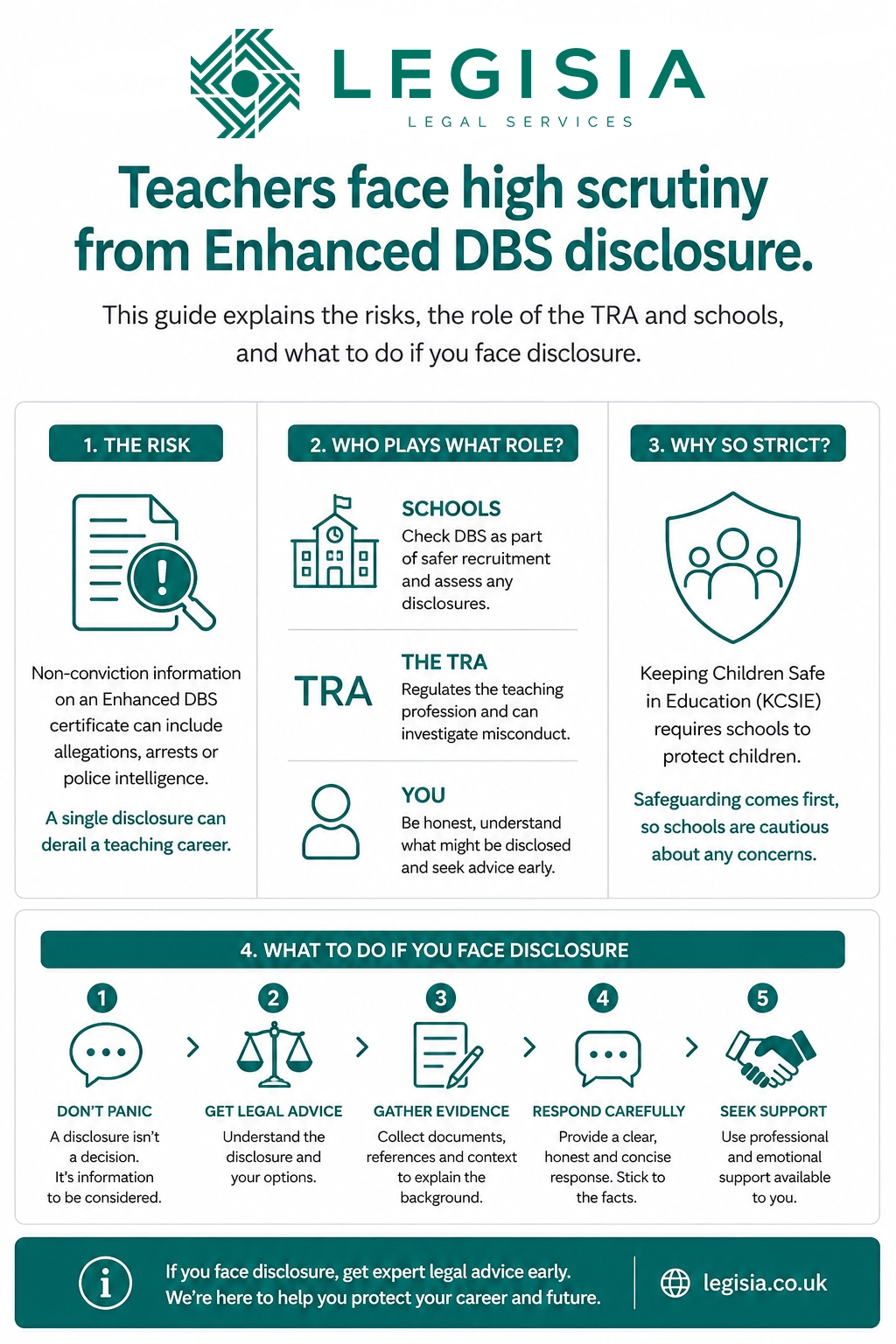
An Enhanced DBS certificate for a teaching role can include the same range of information as any other Enhanced check. That includes convictions and cautions from the Police National Computer. It also includes non-conviction information held on local police records. The non-conviction category is the one that causes the greatest difficulty in teaching.
The non-conviction category includes allegations that were never charged or prosecuted. It includes arrests that did not lead to a charge. It includes investigations that ended in no further action, community resolutions, and police intelligence entries. All of this falls under relevant police information. All of it can be disclosed at the discretion of the chief officer of the relevant police force.
For teachers, the particular concern is the kind of allegation that tends to be disclosed. Domestic incidents. Allegations involving children. Allegations of violence. Allegations of inappropriate conduct. These are exactly the categories that schools are least willing to overlook. Each one touches directly on the safeguarding sensitivity at the heart of the job. A single disclosure of this kind can derail a recruitment process that would otherwise have gone smoothly.
The Real Risk — The School’s Reaction
It is important to be realistic about where the actual risk lies. For most teachers facing a DBS disclosure, the immediate and most significant risk is the school’s reaction to seeing the information.
A school receiving a certificate that discloses a historic allegation will usually pause the recruitment process. The school may seek further information, ask the applicant to explain the circumstances, or refer the matter to its own internal safeguarding processes. In many cases, the school will simply withdraw the offer without any detailed engagement. For a teacher already in post, a disclosure on a renewal check can lead to suspension or internal investigation.
Multi-academy trusts and large independent schools can be especially risk-averse. They operate under the spotlight of Ofsted inspections, KCSIE compliance audits, and parental scrutiny. The appearance of a safeguarding-adjacent matter on a certificate is often enough to cost a teacher a role. That is the case regardless of whether the underlying matter ever amounted to anything.
This is the practical battleground. The central task in most teaching DBS cases is to secure the removal of information from the certificate before the school sees it. If the school has already seen it, the task is to secure a corrected certificate quickly. It is also to help the teacher manage the school’s response in the meantime.
The Teaching Regulation Agency
The Teaching Regulation Agency (TRA) is the body responsible for regulating the teaching profession in England. It is an executive agency of the Department for Education. Its main function is to investigate cases of serious misconduct by teachers and, where appropriate, to impose prohibition orders. A prohibition order prevents a person from carrying out teaching work in schools, sixth-form colleges, relevant youth accommodation and children’s homes in England.
A prohibition order is a career-ending step. Some orders are made with provision for review, allowing the teacher to apply to have the order set aside after a minimum period — at least two years from the date of the order, and often longer. Other orders are made without any review provision at all, which makes them effectively permanent.
The question for our purposes is when, and how, an Enhanced DBS disclosure interacts with TRA processes. In our experience, a DBS disclosure on its own does not usually trigger a fresh TRA investigation. The TRA gets involved when a school or another party refers a case to it. That usually happens because of a serious safeguarding or professional conduct concern at the time of the original incident, not years later when information surfaces on a DBS certificate.
That said, the relationship between the school’s reaction and the TRA is not always clean. A school responding to a DBS disclosure may dismiss a teacher, suspend them, or take other serious action. That school action can in some cases become the trigger for a TRA referral, even though the underlying matter on the DBS certificate is not itself the reason. In that sense, a DBS disclosure can sometimes be the first link in a longer chain. But it is the school’s response that actually drives what comes next.
Family-Linked Disclosure — A Distinctive Teaching Risk
One feature of Enhanced DBS disclosure that affects teachers in a particular way is what we call family-linked disclosure. This is where the police disclose information not about the teacher themselves, but about a family member or another person living at the same address.
The legal framework allows this in limited circumstances. The chief officer can include information about a third party on the certificate where he or she considers it relevant to the applicant’s suitability for the role. This typically happens because the safeguarding concern relates to the environment the applicant lives in, rather than their own conduct.
For teachers, family-linked disclosure is a particular risk. The safeguarding sensitivity of teaching, combined with the proximity of the teaching role to children’s welfare, makes family-linked concerns more likely to be treated as relevant. A teacher can find themselves facing disclosure of information that relates entirely to someone else. It might be a partner, a relative, or an acquitted family member. Their own clean record offers no protection.
Family-linked disclosure can be challenged. The key grounds are relevance and proportionality. Is the third-party information genuinely relevant to the teacher’s own suitability for the role? Is disclosure proportionate to the safeguarding concern? Where the answer to either question is no, the disclosure is vulnerable to challenge. A well-structured representation can secure removal of the information at the pre-issue stage, or its withdrawal through the formal disputes process after issue.
Supply Teachers and Agency Workers
Supply teachers and agency workers face particular difficulty with Enhanced DBS disclosure. The short-term, rolling nature of supply work means that each new school or each new agency assignment can involve a fresh check or a fresh review of an existing certificate.
Agencies are typically even more risk-averse than schools themselves. They are commercial businesses operating in a competitive market. The appearance of a disclosure on a certificate can be enough for an agency to withdraw a teacher from its register without detailed engagement. A supply teacher who has been working steadily for years can suddenly find the phone stops ringing, with little explanation.
For supply teachers, the importance of dealing with disclosure at source is even greater than for permanent staff. That means challenging the certificate and, where possible, deleting the underlying local police records. Our guide on how local police records feed into Enhanced DBS disclosure explains why the underlying record is the real problem. A single disclosure on a certificate used across multiple agencies can effectively shut a supply teacher out of the profession.
What to Do If You Face Disclosure
The right course of action depends on the stage at which you become aware of the issue. The earlier the intervention, the better the prospects of avoiding the consequences that follow disclosure.
Pre-issue stage. You may receive a notification from a police force telling you that they are proposing to disclose information on your forthcoming Enhanced DBS certificate. This is the most important moment. The window to make representations is short — usually a matter of weeks. The quality of those representations can be the difference between a clean certificate and a damaging disclosure. Specialist legal advice at this stage is highly valuable.
After the certificate has been issued. If the certificate has been issued with the disclosure on it, the formal route is the DBS certificate disputes process. The dispute is reviewed by the police force itself. If the police refuse to amend or withdraw the disclosure, it is referred to the Independent Monitor as the built-in escalation stage. Our guide on how to challenge information on an Enhanced DBS certificate explains the process in detail.
For long-term protection. Where the underlying local police records remain on the force’s systems, the same information can be disclosed again on a future check. Teachers will face repeated Enhanced DBS checks throughout their career. For them, the most durable solution is often to seek deletion of the underlying records as well as challenging the immediate disclosure.
Real Case — Teacher Family-Linked Disclosure Removed
We acted for a teacher facing disclosure of information relating to a relative who had been acquitted of an offence and was living at the same address. The teacher had a completely clean record. The disclosure did not relate to anything she had done herself. Yet the police included the information on her Enhanced DBS certificate on the basis that it was relevant to her suitability for the role.
The timing was acute. The teacher was in the middle of a recruitment process with a new school. With the disclosure on her certificate, the post was at risk, and the same information could have followed her into every future Enhanced DBS check throughout her career.
We challenged the disclosure. Our representations addressed the relevance test directly. The information did not relate to the teacher’s own conduct. There was no proper basis for treating a third-party matter as relevant to her own suitability. We also addressed proportionality. The career impact of disclosure was disproportionate to any speculative safeguarding concern. The police initially maintained the disclosure, but on appeal the information was removed and a clean certificate was issued. The teacher took up the post.
This case illustrates two points. First, family-linked disclosure can and should be challenged. The legal tests apply just as rigorously to third-party information as they do to conduct by the applicant themselves. Second, an initial refusal is not the end of the road. The challenge process has stages, and this case was won at the appeal stage after the police first maintained their position.
How Legisia Can Help
We act for teachers facing the disclosure of non-conviction information on Enhanced DBS certificates. Our clients include teachers in state, independent and academy schools, supply teachers, agency workers, early years practitioners and teaching assistants. We understand the safer recruitment framework that schools operate under, and we work to limit the consequences of disclosure as effectively as possible.
Depending on the stage and the facts, we can advise on challenging the disclosure on the certificate, seeking deletion of the underlying local police records, or both. Where there is an additional regulatory dimension involving the Teaching Regulation Agency, we work alongside specialist regulatory advisors as appropriate.
We offer a fixed-fee initial consultation where we will assess your case in detail and provide clear written advice on your prospects of success.
To discuss your case, contact us or call 020 8099 9051.
Frequently Asked Questions
Why do teachers need Enhanced DBS checks?
Teaching involves regulated activity with children. The law requires teachers and other staff in schools to have Enhanced DBS checks, usually with a check of the children’s barred list. The requirement is reinforced by the Keeping Children Safe in Education statutory guidance, which sets out the safer recruitment steps that schools must follow. Teachers face Enhanced DBS checks at recruitment, supply engagements, and when moving between schools or trusts.
What is the main risk to a teacher from a DBS disclosure?
The main practical risk is the school’s reaction. A headteacher or multi-academy trust reading a certificate that includes an allegation of violence, sexual misconduct or safeguarding concern will usually pause the recruitment process. They may make further enquiries or withdraw the offer. Schools operate in an environment of intense safeguarding scrutiny. They tend to be especially cautious when non-conviction information appears on a certificate, regardless of the underlying facts.
Will a DBS disclosure automatically trigger a TRA referral?
Not usually. Teaching Regulation Agency prohibition proceedings are typically triggered by serious safeguarding or professional misconduct concerns that arise during employment. If a referral was going to happen, it would usually have happened at the time of the original incident. A disclosure on a DBS certificate years later does not, on its own, usually trigger a fresh TRA referral. The more common risk is that the school seeing the disclosure may take action. That employer action can in some cases become the trigger for further processes.
Can information about a family member affect my Enhanced DBS certificate?
Yes. In limited circumstances, police information about a family member or other person living at the same address can be disclosed on an Enhanced DBS certificate. This can happen where the chief officer considers the information relevant to the applicant’s suitability for the role. This is a particular risk in teaching because of the safeguarding sensitivity of the context. It can arise even where the teacher themselves has a completely clean record. Family-linked disclosure can be challenged on relevance and proportionality grounds, because the disclosed conduct is not the applicant’s own.
Can I challenge a disclosure before my Enhanced DBS certificate is issued to the school?
Yes. Under the statutory quality assurance framework, the police are required to notify the applicant where they are proposing to disclose non-conviction information. They must give the applicant an opportunity to make representations before the certificate is issued. For teachers, this pre-issue stage is often the most important opportunity to prevent disclosure altogether and avoid the consequences that follow once a school sees the information.
Share this Post, Choose your platform!

Matt is a Solicitor Advocate and Director of Legisia Legal Services. He specialises exclusively in police record deletion, DBS appeals, and regulatory defence. With over 20 years of experience, he has advised hundreds of professionals and individuals on high-stakes matters affecting careers, reputations, and legal standing. His work focuses on challenging unlawful data retention, safeguarding thresholds, and procedural breaches across UK policing and disclosure systems.
Matt is a Solicitor Advocate and Director of Legisia Legal Services. He specialises exclusively in police record deletion, DBS appeals, and regulatory defence. With over 20 years of experience, he has advised hundreds of professionals and individuals on high-stakes matters affecting careers, reputations, and legal standing. His work focuses on challenging unlawful data retention, safeguarding thresholds, and procedural breaches across UK policing and disclosure systems.
Disclosure & DBS: the complete CPD course for professionals
Written by a solicitor who handles these cases every day. For HR, compliance, safeguarding and legal professionals who make decisions about police records and DBS disclosures.
- Eleven modules covering disclosure, DBS checks, barring, regulatory interface and employment decisions
- The only UK course that also covers how UK records affect work, travel and employment abroad
- CPD-accredited, with written feedback on a final applied-scenario exercise
- Waitlist members get 20% off and a sample module ahead of launch
We'll email you the checklist and news about the course launch – nothing else. See the full course →