- Enhanced DBS Disclosure
-

 15 min read





If information has appeared on your Enhanced DBS certificate that you believe is unfair, inaccurate, or disproportionate, there are clear legal routes available to challenge it. The same applies if the police have notified you that they are proposing to disclose information before the certificate is issued.
Many people assume that once information is on a certificate, nothing can be done. That is not correct. The police decision to disclose is not final — it can be challenged directly with the force, reviewed by the Independent Monitor, and in some cases taken to judicial review.
This guide explains each stage of the challenge process, what to expect, and what makes the difference between a challenge that succeeds and one that does not. For background on what types of information can appear on an Enhanced DBS certificate in the first place, see our complete guide to what can show on an Enhanced DBS check.
Two Types of Challenge — Accuracy and Proportionality
Before looking at the process, it helps to understand that there are two distinct grounds on which a disclosure can be challenged — and many cases involve both.
Factual accuracy. The information on the certificate is wrong. It may describe the wrong incident, contain incorrect dates, attribute the wrong outcome, or include details that are factually inaccurate. The challenge here is straightforward: the record does not accurately reflect what happened, and it needs to be corrected.
Proportionality. The information on the certificate may be factually accurate, but the decision to disclose it was not justified. The police are required to consider whether disclosure is relevant to the role and proportionate in all the circumstances. If the information is old, if the matter was never charged or prosecuted, if the person has worked without incident for years, or if the impact of disclosure on the individual is severe, those are all factors that may weigh against disclosure — even where the underlying facts are not in dispute.
Proportionality challenges are often the more important category, because many people accept that something happened but dispute whether it should still be appearing on their certificate years later. The police are not entitled to disclose information simply because they hold it — they must apply a genuine balancing test, and where they have not done so, the disclosure can be challenged.
Stage 1: Pre-Issue Representations to the Police
Under the quality assurance framework, the police are required to notify you when they are proposing to disclose relevant information on your Enhanced DBS certificate. This notification is sent before the certificate is issued, and it gives you the opportunity to make representations to the police arguing that the proposed disclosure should not go ahead.
This is often the most important stage in the entire process — and the stage where legal input has the greatest impact.
The representations are made directly to the police force. They should address the specific legal tests: is the information relevant to the role? Is disclosure proportionate? Has the police force properly considered the factors it is required to weigh — including the gravity of the information, the reliability of the underlying allegation, the age of the matter, the outcome of any investigation, and the impact on the individual?
Well-prepared representations at this stage can result in the police deciding not to disclose the information at all — meaning it never appears on the certificate. This is the best possible outcome, because it avoids the need for any further challenge and prevents the information from reaching the employer or any regulatory body.
We have secured the removal of proposed disclosures at the pre-issue stage on many occasions, including for a doctor facing disclosure of a domestic assault allegation where the prosecution had been dropped. Early representations addressing the circumstances, the NFA outcome, and the impact on the doctor’s career prevented the information from being included on the certificate.
Stage 2: The DBS Certificate Disputes Process
If the certificate has already been issued with disputed information on it — either because representations were not made in time, because the police went ahead despite representations, or because you were not notified before issue — the formal route for challenge is the DBS certificate disputes process.
A dispute is raised by submitting the DBS certificate dispute form to the Disclosure and Barring Service. The dispute should normally be raised within three months of the date on the certificate. The form allows you to identify whether the challenge is to personal information, criminal record information held on the PNC, barring records, or locally held police information — and the available review routes vary depending on which category the disputed information falls into.
Once the dispute is submitted, the DBS does not itself decide whether the information should be amended or removed. It forwards the dispute to the relevant police force and asks the force to reconsider its decision. It is the police force — not the DBS — that holds the information, reviews the dispute, and decides at first instance whether to amend or withdraw the disclosure. The DBS administers the process and communicates the outcome, but the substantive decision at this stage rests with the police.
A dispute can be raised on either ground: factual accuracy, relevance and proportionality, or both. In practice, specialist solicitors often write directly to the force’s disclosure unit in support of the dispute, providing detailed legal representations that go beyond what fits on the dispute form. The quality of those representations matters at this stage just as much as at the pre-issue stage. A detailed, legally grounded submission that engages with the statutory tests is significantly more likely to result in a change of decision than a general complaint that the disclosure is unfair.
If the police agree to amend or withdraw the disclosure, the DBS will issue a corrected certificate. If the police refuse, the process does not end there — the dispute is escalated to the Independent Monitor as the next stage of the same process.
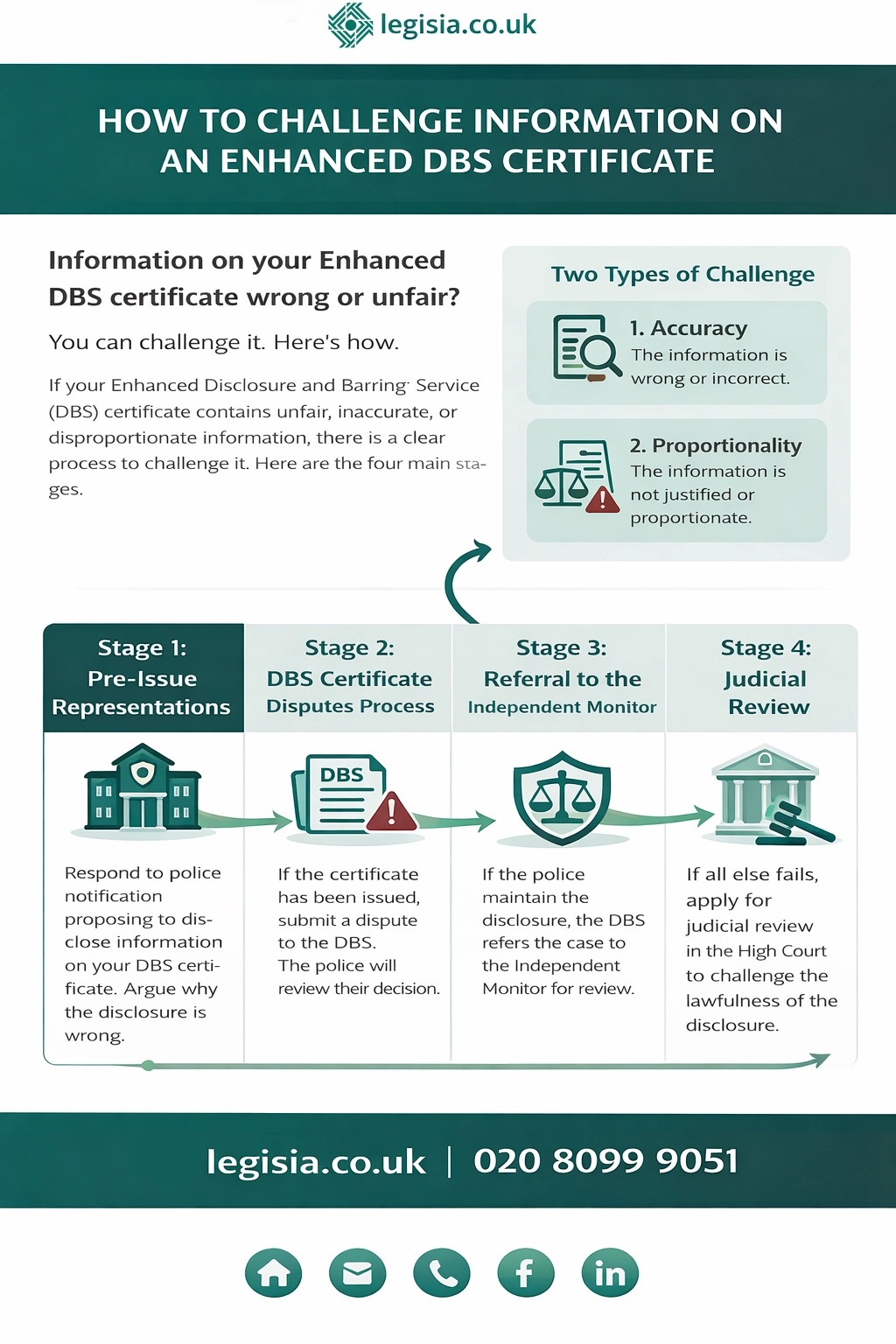
Stage 3: Referral to the Independent Monitor
If the police decline to change their decision, the case is referred to the Independent Monitor as the built-in escalation stage of the disputes process. This referral is made by the DBS — it is not a fresh application the applicant has to initiate separately.
The Independent Monitor is an independent person appointed under the Police Act 1997 with the specific function of reviewing chief officers’ disclosure decisions on Enhanced DBS certificates. The Independent Monitor’s jurisdiction is limited in an important way: it covers disputes about information disclosed from local police records, reviewed principally on grounds of relevance and proportionality. Disputes about the accuracy of PNC records — convictions, cautions, and similar — are resolved directly between the DBS and the relevant police force without Independent Monitor involvement.
The Independent Monitor’s review is not an appeal in the traditional sense. It is a review of the chief officer’s decision-making. The Independent Monitor will consider whether the police applied the correct legal tests, whether they weighed the relevant factors, and whether the decision to disclose was one that a reasonable chief officer could have reached on the information available.
If the Independent Monitor finds that the disclosure was not justified, the DBS will be asked to issue a new certificate without the disputed information.
The Independent Monitor route is important because it provides an independent check on police decision-making. In our experience, some forces are more receptive to challenge than others — and for forces that take a rigid or risk-averse approach to disclosure, the Independent Monitor provides the external scrutiny that is often needed to correct an unreasonable decision.
Stage 4: Judicial Review
In some cases — particularly where the police decision-making was fundamentally flawed, where there has been a serious failure to apply the legal tests, or where the Independent Monitor process has not resolved the matter — judicial review may be available.
Judicial review is a High Court process in which the court reviews the lawfulness of the police’s decision. It is not a re-hearing of the facts. The court will consider whether the police acted lawfully, whether they applied the correct legal tests, and whether the decision was one that no reasonable decision-maker could have reached.
Judicial review is the most formal and expensive route, and it is not appropriate in every case. But where the police have acted unreasonably or unlawfully, it provides a powerful mechanism for overturning the disclosure decision. The leading case law on Enhanced DBS disclosure — including the Supreme Court’s decision in R (L) v Commissioner of Police of the Metropolis [2009] — was developed through judicial review proceedings, and it continues to shape the legal framework within which all disclosure decisions are made.
The Other Route — Deleting the Underlying Record
The challenge routes described above all address the disclosure on the certificate. But there is another route that can be equally important — and in some cases more effective in the long term.
The information disclosed on an Enhanced DBS certificate almost always originates from a local police record. If that record can be deleted, the source of the disclosure is removed — and the information cannot be disclosed on future certificates.
This matters particularly for people who face repeated Enhanced DBS checks throughout their career. A successful challenge to one certificate prevents the disclosure on that occasion. But if the underlying record remains, the same information can be disclosed again the next time a check is processed. Deleting the record addresses the structural problem, not just the immediate one.
The two routes — challenging the certificate and deleting the record — are not alternatives. They are complementary, and in many cases the best approach is to pursue both. Our guide on how local police records feed into Enhanced DBS disclosure explains this relationship in detail.
What Makes a Challenge Succeed?
Having acted in many Enhanced DBS certificate challenges, there are clear patterns in what makes the difference between a challenge that succeeds and one that does not.
Engaging with the legal tests directly. The police are required to apply specific tests — relevance, proportionality, necessity. Representations that address those tests head-on, using the language of the statutory framework and the relevant case law, are taken far more seriously than general complaints about unfairness. The police disclosure units deal with these challenges regularly, and they respond to legal argument, not emotion.
Presenting evidence the police may not have. The police make their disclosure decision based on the information on their systems. In many cases, that information is incomplete — it records the allegation and the police response, but it does not record the person’s side of the story, their professional record, their personal circumstances, or the impact of disclosure on their career. Representations that fill in those gaps give the police a fuller picture and a stronger basis for reconsidering.
Addressing the specific type of disclosure. The arguments that work in an allegation case are different from those in an arrest-without-charge case, a no further action case, or a community resolution case. Each type of non-conviction disclosure has its own characteristics, and the representations need to be tailored accordingly.
Acting early. Pre-issue representations — before the certificate is issued — give the best chance of a clean outcome. Once the certificate has been issued and the information is in the hands of an employer, the person faces a difficult choice: disclose the certificate and deal with the consequences, or withdraw from the role to avoid disclosing it. Getting the information removed before the certificate is issued avoids that choice altogether.
Timescales
There are no fixed statutory timescales for most stages of the challenge process, and the speed varies depending on the police force, the complexity of the case, and the route being used.
Pre-issue representations need to be made within the window given by the police notification. This is usually a matter of weeks, and it is important to act quickly — if the deadline passes without representations being made, the police may proceed to issue the certificate with the disclosure included.
Post-issue challenges to the police can take several weeks to a few months, depending on the force’s responsiveness. Some forces deal with challenges promptly; others are slow and require chasing.
The Independent Monitor process typically takes longer. The exact timescale depends on the caseload and the complexity of the review.
Judicial review operates on court timescales and can take several months or longer, depending on the stage of proceedings and whether the matter is resolved before a full hearing.
The key practical point is that speed matters. Getting legal advice early — ideally before the certificate is issued — gives the best chance of resolving the matter before those consequences arise.
Real Cases — Successful Challenges
We have acted in many Enhanced DBS certificate challenges across a range of disclosure types. Four cases illustrate the different routes and the different kinds of information involved:
Doctor — domestic assault allegation. The prosecution had been dropped, but the police proposed to disclose the allegation on the doctor’s Enhanced DBS certificate. We prepared detailed representations at the pre-issue stage, and the police agreed not to disclose. The certificate was issued clean.
Care worker — workplace allegation. An allegation made by colleagues had been disclosed on the certificate without proper consideration of the circumstances. We challenged the disclosure and the information was removed.
Medical student — community resolution. A community resolution for a family incident had been disclosed on a certificate needed for a clinical placement. We appealed the disclosure, arguing that it was disproportionate given the circumstances and the student’s career stage. The information was removed.
Doctor — false sexual assault allegation. A false allegation involving a neighbour’s child had been proposed for disclosure. We prepared representations addressing the reliability of the allegation and the outcome of the investigation. The information was not disclosed.
Each of these cases turned on its specific facts, but all shared a common feature: legally grounded representations that engaged directly with the tests the police are required to apply.
How Legisia Can Help
If information has been disclosed on your Enhanced DBS certificate, or if you have been notified that the police are proposing to disclose information, we can help at every stage of the challenge process.
We prepare pre-issue representations, challenge police forces directly after issue, handle applications to the Independent Monitor, and advise on judicial review where appropriate. Where the disclosure is being driven by an underlying local police record, we can also advise on deletion of the record to prevent future disclosure.
For full details of our Enhanced DBS certificate appeals service, including how we work and our fee structure, see our service page.
We offer a fixed-fee initial consultation where we will assess your case in detail and provide clear written advice on your prospects of success.
To discuss your case, contact us or call 020 8099 9051.
Frequently Asked Questions
Can I challenge information on an Enhanced DBS certificate?
Yes. There are established legal routes for challenging information disclosed on an Enhanced DBS certificate. You can make representations to the police before the certificate is issued, challenge the police directly after the certificate is issued, and if the police refuse to change their decision, apply to the Independent Monitor for a review. In some cases, judicial review may also be available.
What is the Independent Monitor for DBS?
The Independent Monitor is an independent person appointed under the Police Act 1997 who has the power to review a chief officer’s decision to disclose information on an Enhanced DBS certificate. If you have challenged the police directly and they have refused to change their decision, you can apply to the Independent Monitor for a review on both factual accuracy and proportionality grounds.
How long does an Enhanced DBS certificate challenge take?
Timescales vary depending on the route and the police force involved. Pre-issue representations may be resolved within a few weeks. Post-issue challenges to the police can take several weeks to months. An application to the Independent Monitor typically takes longer. There are no fixed statutory timescales for most stages, so the speed depends on the force’s responsiveness and the complexity of the case.
Do I need a solicitor to challenge an Enhanced DBS certificate?
You do not legally need a solicitor, but the process involves applying specific legal tests — relevance, proportionality, necessity — and engaging with police disclosure units that handle these challenges regularly. In practice, representations prepared by a solicitor who understands the legal framework and the relevant case law are significantly more likely to succeed.
Can I challenge a disclosure if the information on the certificate is factually correct?
Yes. The information can be factually accurate and still be challengeable. The question is not only whether the information is true but whether it ought to have been disclosed — whether disclosure was relevant to the role and proportionate in all the circumstances. Many successful challenges are brought on proportionality grounds rather than factual accuracy.
Share this Post, Choose your platform!

Matt is a Solicitor Advocate and Director of Legisia Legal Services. He specialises exclusively in police record deletion, DBS appeals, and regulatory defence. With over 20 years of experience, he has advised hundreds of professionals and individuals on high-stakes matters affecting careers, reputations, and legal standing. His work focuses on challenging unlawful data retention, safeguarding thresholds, and procedural breaches across UK policing and disclosure systems.
Matt is a Solicitor Advocate and Director of Legisia Legal Services. He specialises exclusively in police record deletion, DBS appeals, and regulatory defence. With over 20 years of experience, he has advised hundreds of professionals and individuals on high-stakes matters affecting careers, reputations, and legal standing. His work focuses on challenging unlawful data retention, safeguarding thresholds, and procedural breaches across UK policing and disclosure systems.
Disclosure & DBS: the complete CPD course for professionals
Written by a solicitor who handles these cases every day. For HR, compliance, safeguarding and legal professionals who make decisions about police records and DBS disclosures.
- Eleven modules covering disclosure, DBS checks, barring, regulatory interface and employment decisions
- The only UK course that also covers how UK records affect work, travel and employment abroad
- CPD-accredited, with written feedback on a final applied-scenario exercise
- Waitlist members get 20% off and a sample module ahead of launch
We'll only email you about the course launch – nothing else. See the full course →