- Enhanced DBS Disclosure
-

 13 min read





A community resolution is one of the most misunderstood disposals in the criminal justice system. It is not a conviction. It is not a caution. Many people accept one without any legal advice, often at the suggestion of the police, on the understanding that it is an informal way to deal with a minor matter and move on.
What most people are not told — and what many only discover later — is that a community resolution can be recorded on police systems and disclosed on an Enhanced DBS certificate. For anyone working in healthcare, education, social work, childcare, or any other role requiring an Enhanced DBS check, this can come as a serious shock.
This guide explains what a community resolution is, how it is recorded, why it can appear on an Enhanced DBS certificate, and what can be done about it. For a broader overview of everything that can appear on an Enhanced DBS certificate, see our complete guide to what can show on an Enhanced DBS check.
What Is a Community Resolution?
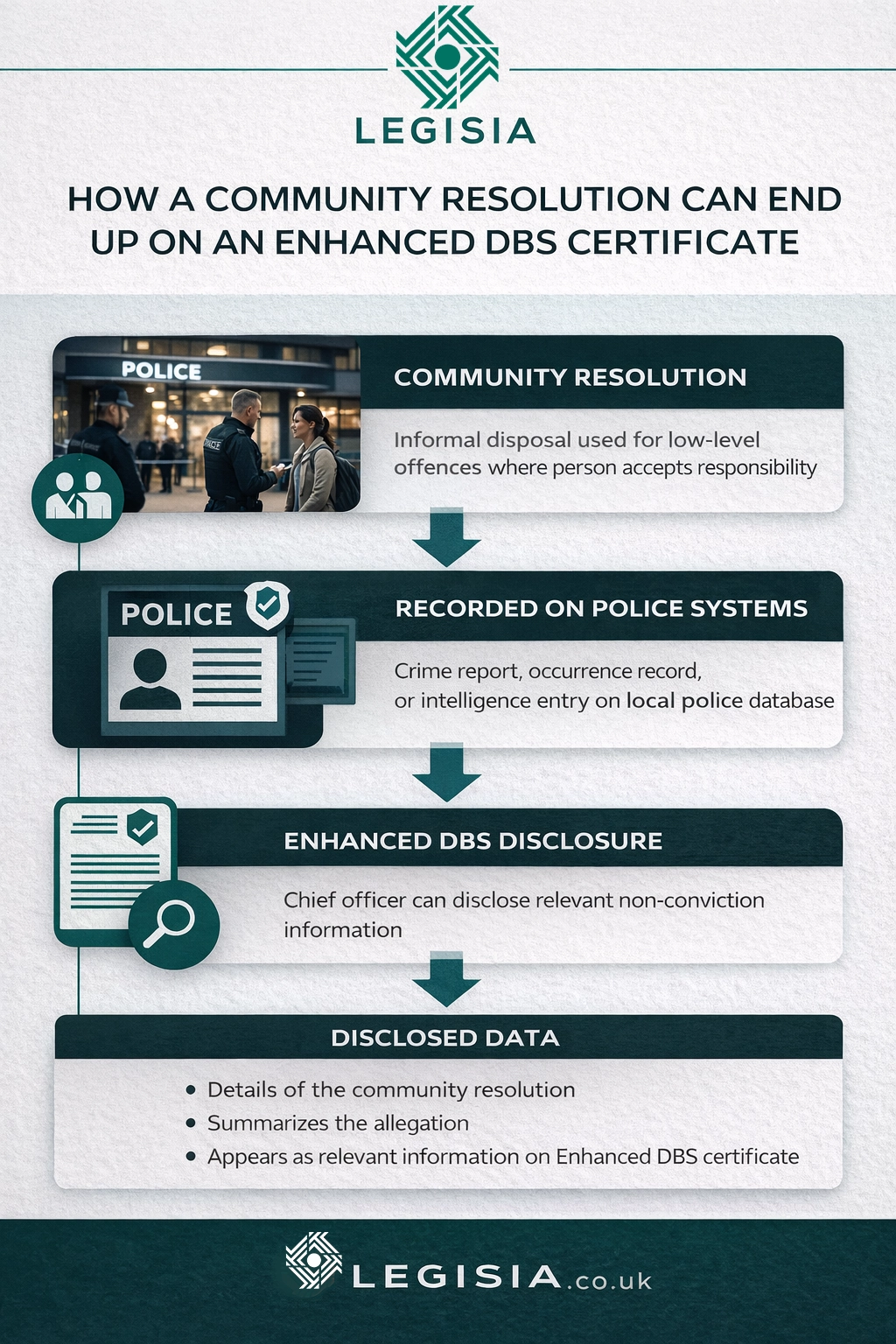
A community resolution is an informal disposal used by the police as an alternative to charging, cautioning, or prosecuting someone for a relatively low-level offence. It is designed to resolve matters quickly and proportionately, usually where the offence is minor, the person accepts responsibility for their actions, and the complainant agrees to the outcome.
The resolution might involve an apology, compensation, or an agreement to attend a course or seek support. The police present it as a pragmatic way to close the matter without the formality of a caution or the risk of prosecution. In many cases, people accept a community resolution because a police officer tells them it is the least serious option available — and at the time, that may well be true.
But what is rarely explained clearly at the time is what happens to the record afterwards — and specifically, what it can mean for future Enhanced DBS checks.
How Is a Community Resolution Recorded?
The way a community resolution is recorded varies between police forces, and this inconsistency is part of what makes the disclosure position so unpredictable.
In most cases, a community resolution is recorded on the force’s local police systems — as a crime report, an occurrence record, or an intelligence entry. Some forces also record community resolutions on the Police National Database (PND). In some circumstances, a community resolution may also be recorded on the PNC, depending on the force’s practice and the nature of the offence.
The critical point is that regardless of where the record sits, it is a police record. It is retained. And it can be accessed by the force when it is asked to review whether it holds any information that ought to be disclosed on an Enhanced DBS certificate.
Not a Caution, Not a Conviction — But Still a Problem
One of the reasons community resolutions cause so much confusion is that they do not fit neatly into the categories most people understand. A conviction is serious. A caution is a step down. A community resolution sits below even that — and many people assume that means it does not really count.
In criminal justice terms, that is broadly right. A community resolution is not a formal criminal outcome. It does not appear on a person’s criminal record in the way that a conviction or caution does. It is not subject to the same filtering rules that determine when cautions and convictions stop appearing on DBS certificates.
But in disclosure terms, none of that matters. The Enhanced DBS system does not only disclose formal criminal outcomes. It can also disclose relevant information held on local police systems — and a community resolution is exactly the kind of information that the police may consider relevant, particularly for roles involving children or vulnerable adults.
The fact that a community resolution is informal and low-level does not prevent it from being disclosed. If anything, the informality can work against the person — because the lack of formal legal process at the time means there was no opportunity to challenge the facts, test the evidence, or make a considered decision about whether to accept it.
How a Community Resolution Can Appear on an Enhanced DBS Certificate
The disclosure route for a community resolution is the same as for any other non-conviction information on an Enhanced DBS certificate. When a check is processed, the relevant police force reviews its local records. If it holds a record of a community resolution and considers the information relevant to the role, the chief officer can decide to disclose it on the certificate as relevant information.
The certificate will typically describe the offence, the date, and the fact that a community resolution was given. It may also include a summary of the allegation and any other detail the police consider relevant. For an employer reading the certificate, the community resolution label may mean very little — what they see is the allegation itself.
This is the central problem. A disposal that was presented to the person as informal and inconsequential can later appear on an Enhanced DBS certificate in terms that make it look like a serious safeguarding concern.
Why Community Resolutions Catch People Out
The disclosure of a community resolution on an Enhanced DBS certificate catches people out for several reasons, and almost all of them come down to what was not explained at the time.
People are not warned about DBS consequences. When the police offer a community resolution, the focus is on resolving the immediate situation. The person is rarely told — clearly or at all — that the resolution will be recorded on police systems and may be disclosed on future Enhanced DBS checks. Many people accept because they are told it is “not a caution” and will not go on their record.
There is no legal advice requirement. Unlike a police caution, where the person must be offered the opportunity to take legal advice, there is no equivalent safeguard for community resolutions. People routinely accept them without understanding what they are agreeing to or what the consequences might be.
The acceptance of responsibility can be used against them. A community resolution requires the person to accept responsibility for their actions. Under the NPCC Community Resolution Guidance, this is not the same as a PACE-compliant formal admission in interview — but the distinction is a fine one, and in practice the acceptance is recorded on police systems and can be presented in a way that looks very much like an admission. If the matter is later disclosed on an Enhanced DBS certificate, the recorded acceptance of responsibility is part of the picture — which can make it harder to argue that the underlying allegation was unfounded or that the person was not responsible.
The gap between acceptance and discovery can be years. Many people accept a community resolution for a minor matter and think nothing more of it. It is only when they apply for a role requiring an Enhanced DBS check that the community resolution surfaces and causes a problem they never anticipated.
The Impact on Regulated Professionals
For people in regulated professions, the disclosure of a community resolution on an Enhanced DBS certificate is not just an employment problem — it can also raise questions about professional registration.
Some regulatory bodies — including the GMC, NMC, and HCPC — expect registrants to disclose community resolutions as part of their registration or revalidation obligations. Because a community resolution involves an acceptance of responsibility, regulators can treat it as equivalent to an admission to a criminal offence — even though it was never prosecuted, never tested in court, and never resulted in a formal criminal outcome.
For healthcare professionals and others in regulated roles, a community resolution can cause problems with both employers and regulators — and where there has been a failure to self-disclose, that failure can be treated as a separate concern in its own right, sometimes more seriously than the original matter.
This is another reason why addressing the community resolution early — either by challenging the disclosure or by seeking deletion of the record — can be more effective than waiting for the problem to surface on a certificate.
Challenging the Disclosure
If a community resolution has been disclosed or is proposed for disclosure on your Enhanced DBS certificate, routes to challenge it follow the same framework as other non-conviction disclosures.
Before the certificate is issued, the police are required to notify you under the quality assurance framework when they are proposing to disclose relevant information. This gives you the opportunity to make representations directly to the police, arguing that the proposed disclosure does not meet the legal threshold. In community resolution cases, the key arguments often focus on the minor nature of the original offence, the circumstances in which the resolution was accepted, the lack of legal advice at the time, the age of the matter, and the disproportionate impact of disclosure on the person’s career.
After the certificate has been issued, you can challenge the police force directly on grounds of factual accuracy, proportionality, or both. If the police refuse to amend or withdraw the disclosure, the next step is an application to the Independent Monitor, who can review the decision on both accuracy and proportionality grounds. In appropriate cases, judicial review may also be available.
Our guide on how to challenge information on an Enhanced DBS certificate explains the full process.
Deleting the Community Resolution From Police Records
Challenging the certificate addresses the immediate disclosure problem. But if the community resolution remains on police systems, it can be disclosed again on future checks. For long-term protection, it is often worth considering whether the record itself can be deleted.
The route to deletion depends on where the community resolution is recorded. A community resolution will always be on local records, which can be challenged under data protection law, specifically Part 3 of the Data Protection Act 2018. In some cases the community resolution may also appear on the PNC, in which case the PNC entry can be challenged separately through the Record Deletion Process.
The arguments for deletion of a community resolution can be strong — particularly where the resolution was accepted without legal advice, where the underlying offence was minor, where the person was young at the time, and where there has been no repetition. Our guide on how to apply for deletion of local police records explains the process, and our guide on how local police records feed into Enhanced DBS disclosure explains why deletion of the record can be the most effective way to resolve the disclosure problem permanently.
Real Case — Community Resolution Disclosed on Medical Student’s Enhanced DBS Certificate
We acted for a medical student who had been involved in a family incident — an allegation of assault against his sister. The police had initially considered issuing a caution, but the matter was ultimately dealt with by way of a community resolution. At the time, the student accepted it on the understanding that it was the least serious option and would not affect his future.
Later, when an Enhanced DBS check was processed for a clinical placement, the community resolution was disclosed on the certificate. For a medical student, this was potentially career-ending — it raised safeguarding questions that could have derailed his training and future registration with the GMC.
We challenged the disclosure through the appeal process, arguing that the underlying incident was a one-off family matter that did not reflect any ongoing risk, and that disclosure was disproportionate to the circumstances. The information was successfully removed from the certificate.
This case is a clear example of the gap between what people are told when they accept a community resolution and what can happen years later when it surfaces on an Enhanced DBS check.
How Legisia Can Help
If a community resolution has been disclosed on your Enhanced DBS certificate — or you are concerned that one may be disclosed on a future check — we can help.
We act for professionals and private individuals across healthcare, education, social work, childcare, and care settings who are dealing with the disclosure consequences of community resolutions. Depending on the circumstances, we can advise on challenging the disclosure on the certificate, seeking deletion of the underlying police record, or both.
We offer a fixed-fee initial consultation where we will assess your case in detail and provide clear written advice on your prospects of success.
To discuss your case, contact us or call 020 8099 9051.
Frequently Asked Questions
What is a community resolution?
A community resolution is an informal disposal used by the police as an alternative to a formal charge, caution, or prosecution. It is typically offered for low-level offences where the person accepts responsibility for their actions and the complainant agrees to the resolution. It is not a conviction and it is not a caution, but it is recorded on police systems and can be disclosed on an Enhanced DBS certificate.
Will a community resolution show on a Basic or Standard DBS check?
No. A community resolution is not recorded on the PNC as a conviction or caution, so it does not appear on Basic or Standard DBS checks. However, it is recorded on local police systems and can be disclosed on an Enhanced DBS certificate as relevant information if the police consider it appropriate for the role.
Can a community resolution be deleted from police records?
A community resolution will always be held on local police records, which can be challenged under data protection law, specifically Part 3 of the Data Protection Act 2018. Where the community resolution is also recorded on the PNC, that PNC entry can be challenged separately through the Record Deletion Process. In some cases, both routes may be needed.
I accepted a community resolution years ago — can it still appear on an Enhanced DBS check?
Yes. There is no fixed time limit on how long a community resolution can be disclosed on an Enhanced DBS certificate. As long as the police hold the record and consider the information relevant to the role, it can be disclosed. However, the age of the record is a factor in the proportionality assessment, and older community resolutions may be more vulnerable to challenge.
Is a community resolution the same as a police caution?
No. A community resolution is a less formal disposal than a police caution. A caution is recorded on the Police National Computer and is subject to specific filtering rules that determine when it stops appearing on DBS certificates. A community resolution is typically recorded on local police systems rather than the PNC and follows a different disclosure route — it can appear on an Enhanced DBS certificate as relevant information disclosed at police discretion, rather than through the automatic PNC disclosure route.
Share this Post, Choose your platform!

Matt is a Solicitor Advocate and Director of Legisia Legal Services. He specialises exclusively in police record deletion, DBS appeals, and regulatory defence. With over 20 years of experience, he has advised hundreds of professionals and individuals on high-stakes matters affecting careers, reputations, and legal standing. His work focuses on challenging unlawful data retention, safeguarding thresholds, and procedural breaches across UK policing and disclosure systems.
Matt is a Solicitor Advocate and Director of Legisia Legal Services. He specialises exclusively in police record deletion, DBS appeals, and regulatory defence. With over 20 years of experience, he has advised hundreds of professionals and individuals on high-stakes matters affecting careers, reputations, and legal standing. His work focuses on challenging unlawful data retention, safeguarding thresholds, and procedural breaches across UK policing and disclosure systems.
Disclosure & DBS: the complete CPD course for professionals
Written by a solicitor who handles these cases every day. For HR, compliance, safeguarding and legal professionals who make decisions about police records and DBS disclosures.
- Eleven modules covering disclosure, DBS checks, barring, regulatory interface and employment decisions
- The only UK course that also covers how UK records affect work, travel and employment abroad
- CPD-accredited, with written feedback on a final applied-scenario exercise
- Waitlist members get 20% off and a sample module ahead of launch
We'll email you the checklist and news about the course launch – nothing else. See the full course →