- Enhanced DBS Disclosure
-

 14 min read





NFA stands for “No Further Action” — the decision by the police or the Crown Prosecution Service to end a criminal investigation without charging you. An NFA is not a conviction and it does not give you a criminal record. However, the arrest and the investigation records remain on police systems, and in limited circumstances they can still be disclosed on an Enhanced DBS certificate.
If the police or the Crown Prosecution Service decided to take no further action against you, you would be forgiven for thinking the matter is closed. In criminal justice terms, it largely is. But in disclosure terms — and specifically when it comes to Enhanced DBS checks — an NFA outcome does not mean the record has disappeared.
The police records created during the investigation remain on local police systems. And if the police consider those records relevant to a role you are applying for, they can disclose the underlying allegation on your Enhanced DBS certificate — regardless of the fact that nothing came of it.
This guide explains what NFA actually means in practice, why it does not protect you from Enhanced DBS disclosure, and what can be done about it. For a broader overview of everything that can appear on an Enhanced DBS certificate, see our complete guide to what can show on an Enhanced DBS check.
What Does No Further Action Actually Mean?
“No further action” is not a formal legal status in the way that an acquittal or a discharge is. It is an operational decision — a decision by the police or the CPS that the case will not proceed any further. It can happen at different stages and for different reasons.
The police may decide to take no further action shortly after the initial report, if they conclude that no criminal offence has been committed or that the evidence does not justify further investigation. They may NFA a case after an arrest, if the interviews and enquiries do not support a charge. Or they may refer the file to the CPS and the CPS may decide not to prosecute — either because the evidential test is not met or because prosecution is not considered to be in the public interest.
What all of these have in common is that the person was never convicted, never cautioned, and in many cases never charged. From a criminal justice perspective, that should be the end of the matter. But from a police records and disclosure perspective, it is not — because the records created during the investigation do not go away when the NFA decision is made.
Why NFA Does Not End the Disclosure Risk
This is the point that most people struggle with. It feels fundamentally unfair, and in many cases it is. But the legal position is clear: an NFA outcome does not prevent the police from disclosing the underlying allegation on an Enhanced DBS certificate.
The reason is that the Enhanced DBS disclosure system operates independently of the criminal justice outcome. The question the police ask when deciding whether to disclose is not “was this person convicted?” or “was this person charged?” It is “do we hold information that is relevant to the role this person is applying for, and is it proportionate to disclose it?” Those are different questions — and the answer can be yes even where the criminal case went nowhere.
This means that a person who was reported to the police, investigated, and completely cleared can still find the allegation appearing on their Enhanced DBS certificate years later. The NFA decision closes the criminal case but leaves the records intact — and the records are what the police draw on when making disclosure decisions.
The Records That Remain After an NFA Decision
When the police investigate an allegation, they create records at every stage. Even after the decision is made to take no further action, those records remain on the force’s systems unless they are separately deleted.
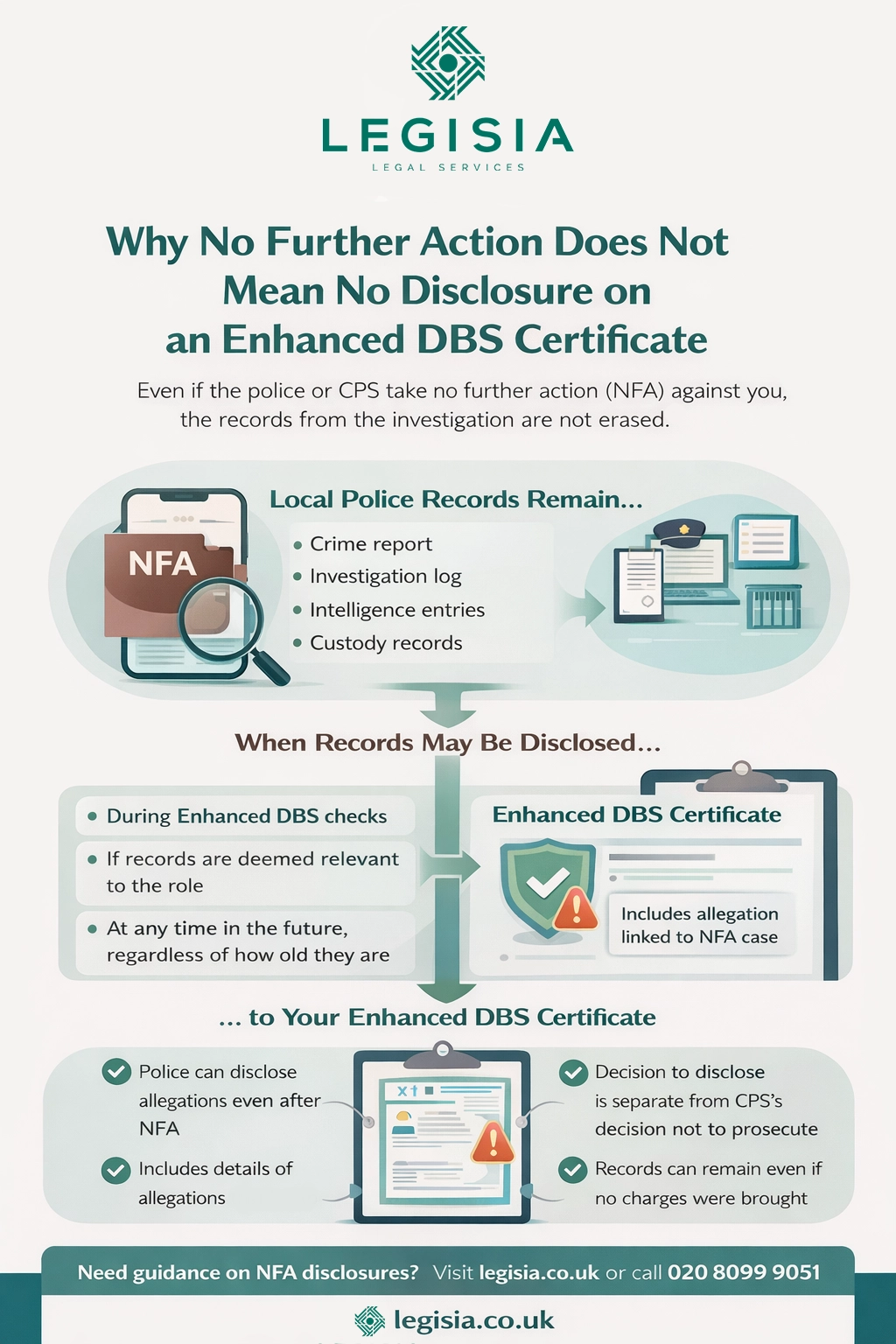
The records that typically survive an NFA decision include:
The crime report or occurrence report — recording the initial allegation, the details of what was reported, and how the police responded.
The investigation log — recording the steps taken during the investigation, including interviews, witness statements, forensic enquiries, and the reasons for the NFA decision.
Intelligence entries — in some cases the police will create an intelligence record on their local systems or on the Police National Database (PND), flagging the allegation even though no further action was taken.
A PNC arrest record — if you were arrested during the investigation, the arrest and the NFA outcome will have been recorded on the Police National Computer. This is a national record, not a local one, and it is retained on the PNC until the person reaches 100 years of age unless it is separately deleted through the Record Deletion Process.
Custody records — if you were detained, the custody record will be held by the force.
None of these records are automatically deleted when the NFA decision is made. The local records — the crime report, investigation log, intelligence entries, and custody records — are retained under the force’s own data retention policies, which typically allow retention for extended periods, particularly where the allegation involved safeguarding concerns. These are all forms of locally held police data, and it is these local records that the police draw on when deciding whether to disclose information on an Enhanced DBS certificate. The PNC arrest record is a separate national record that can also need to be addressed, but through a different route.
How an NFA Matter Can Appear on an Enhanced DBS Certificate
The mechanism is the same as for any non-conviction disclosure. When an Enhanced DBS check is processed, the Disclosure and Barring Service contacts the relevant police force. The force reviews its local records. If it finds records relating to an investigation — even one that resulted in NFA — it must decide whether the information is relevant to the role and whether disclosure is proportionate.
If the chief officer decides that it is, the information appears on the certificate as relevant information. The certificate will typically summarise the allegation, the date, and the outcome — including the fact that no further action was taken. But the damage is often done by the allegation itself, not by the outcome. An employer reading a certificate that describes an allegation of sexual misconduct, domestic violence, or child safeguarding concerns may be reluctant to proceed with a hire regardless of the NFA endorsement.
This is why NFA disclosure is so corrosive. The system is designed to allow the police to share information that may be relevant to safeguarding — but in practice, the mere presence of the allegation on the certificate can be treated as disqualifying, even where the person was never charged and the case was closed without action.
When the CPS Decided Not to Prosecute
A CPS decision not to prosecute might feel like even stronger grounds for expecting the matter to go away. If the independent prosecuting authority looked at the case and decided it should not go to court, it seems obvious that the allegation should not be appearing on a DBS certificate years later.
But the disclosure framework does not work that way. The CPS decision and the Enhanced DBS disclosure decision are separate processes, governed by different legal tests. The CPS considers whether there is a realistic prospect of conviction and whether prosecution is in the public interest. The police, when considering Enhanced DBS disclosure, are asking whether the information is relevant to the role and whether disclosure is proportionate. A case can fail the CPS’s evidential test and still pass the police’s relevance test.
That said, the CPS decision is not irrelevant. It is a factor the police should be weighing in the proportionality assessment. Where the CPS declined to prosecute because the evidence was weak, the complainant was unreliable, or the allegation was not supported by independent evidence, those are all matters that go to the quality and reliability of the information — and they should count against disclosure. Where the police disclose regardless, without properly considering the CPS reasoning, that can form the basis of a challenge.
NFA and Professional Consequences
The practical damage from an NFA matter appearing on an Enhanced DBS certificate is usually about the employer’s reaction. An employer reading a certificate that describes an allegation of violence, sexual misconduct, or safeguarding concern may decide not to proceed with a hire, or may begin internal processes of their own — regardless of the NFA outcome.
For people applying for new roles, this can mean being shut out of the profession entirely. For those already in post, it can raise questions about their suitability that would never have arisen if the disclosure had not been made. This is why challenging an NFA disclosure early — ideally at the representations stage before the certificate is issued — can be so important.
Challenging the Disclosure of an NFA Matter
If an NFA matter has been disclosed or is proposed for disclosure on your Enhanced DBS certificate, the challenge routes follow the same framework as other non-conviction disclosure cases.
Before the certificate is issued, the police are required to notify you under the quality assurance framework when they are proposing to disclose relevant information. This gives you the opportunity to make representations directly to the police. In NFA cases, the key arguments typically focus on the weakness of the underlying allegation, the reasons for the NFA decision, the age of the matter, the absence of any repetition, and the disproportionate impact that disclosure would have on your career.
We have acted at this pre-issue stage for a doctor facing disclosure of a domestic assault allegation where the prosecution had been dropped. Early representations addressed the circumstances of the allegation, the reasons the case did not proceed, and the impact on the doctor’s professional standing. The information was removed before the certificate was issued.
After the certificate has been issued, you can challenge the police force directly on grounds of factual accuracy, proportionality, or both. If the police refuse to amend or withdraw the disclosure, the next step is an application to the Independent Monitor, who can review the decision on both accuracy and proportionality grounds. In appropriate cases, judicial review may also be available.
Our guide on how to challenge information on an Enhanced DBS certificate explains the full process.
Deleting the Records From an NFA Case
Challenging the certificate addresses the immediate problem — the disclosure on a specific check. But if the underlying local police records remain on the force’s systems, the same information can be disclosed again the next time an Enhanced DBS check is processed.
For long-term protection, it is often worth considering whether the local records from the NFA case can be deleted. The records — crime reports, investigation logs, intelligence entries, and any associated data — can be challenged under data protection law, specifically Part 3 of the Data Protection Act 2018. Our guide on how to apply for deletion of local police records explains the process.
If there is also a PNC arrest record associated with the NFA case, that can be challenged separately through the Record Deletion Process.
The strength of a deletion application in an NFA case often depends on the same factors that make a disclosure challenge strong: the weakness of the original allegation, the passage of time, the absence of any similar concerns, and whether there is any continuing policing purpose in retaining the data. In cases where the allegation was never substantiated and the person has worked without incident for years, the argument for deletion can be compelling.
Real Case — NFA Matter Successfully Removed From Certificate
We acted for a doctor who had been arrested following a domestic assault allegation made by his wife. The matter was investigated and the prosecution was dropped, with an NFA outcome. But the arrest and the allegation remained on police systems, and when an Enhanced DBS check was processed, the police proposed to disclose the information.
For a doctor, this kind of disclosure is career-threatening. It can trigger a GMC investigation, jeopardise revalidation, and make it extremely difficult to take up new posts — particularly in settings involving vulnerable patients.
We prepared early representations to the police, addressing the circumstances of the allegation, the reasons the prosecution was dropped, the doctor’s professional record, and the disproportionate impact that disclosure would have. The police agreed not to disclose the information, and the certificate was issued without it.
This case illustrates why acting early matters. Once the information is on an issued certificate, the person faces a difficult choice — either disclose the certificate to their employer and deal with the consequences, or withdraw from the role to avoid disclosing it, which can be equally damaging. Getting the information removed before the certificate is issued avoids that choice altogether.
How Legisia Can Help
If you are dealing with the disclosure of an NFA matter on your Enhanced DBS certificate — or you are concerned that a past NFA case may be disclosed on a future check — we can help.
We act for professionals and private individuals across healthcare, education, social work, childcare, and care settings who are affected by the disclosure of matters that were investigated and closed without any criminal outcome. Depending on the circumstances, we can advise on challenging the disclosure on the certificate, seeking deletion of the underlying local police records, or both.
We offer a fixed-fee initial consultation where we will assess your case in detail and provide clear written advice on your prospects of success.
To discuss your case, contact us or call 020 8099 9051.
Frequently Asked Questions
What does no further action (NFA) mean?
No further action means the police or Crown Prosecution Service have decided not to proceed with a case. It can happen at various stages — after an initial report, after an arrest, after a full investigation, or after a file has been referred to the CPS. The decision may be made because there is insufficient evidence, because the complainant has withdrawn, or because prosecution is not considered to be in the public interest. An NFA outcome does not mean the person was found innocent — it simply means the case did not progress further through the criminal justice system.
Will an NFA show on a Basic or Standard DBS check?
No. Basic and Standard DBS checks only draw on PNC records of unspent/unprotected convictions and cautions. An NFA outcome is not a conviction or caution, so it will not appear on these levels of check. However, the police records created during the investigation can be disclosed on an Enhanced DBS certificate as relevant information if the police consider it appropriate for the role.
Can the police disclose an NFA matter on an Enhanced DBS certificate years after it happened?
Yes. There is no fixed time limit on disclosure. The police can disclose information from an NFA case for as long as they hold the local record and consider it relevant. However, the age of the information is a factor the police must consider in the proportionality assessment, and an old NFA matter may be more vulnerable to challenge — particularly where the person has worked without incident in the years since.
If the CPS decided not to prosecute, can the allegation still appear on my Enhanced DBS certificate?
Yes. A CPS decision not to prosecute does not prevent the police from disclosing the underlying allegation. The CPS decision relates to whether there is enough evidence to prosecute and whether prosecution is in the public interest. The Enhanced DBS disclosure decision is a separate question about whether the information is relevant to the role. However, the CPS reasoning is a factor the police should weigh in the proportionality assessment, and failure to do so can strengthen a challenge.
Can I get the police records from an NFA case deleted?
It is possible to apply for deletion of the local police records under data protection law. If there is also a PNC arrest record, that can be challenged separately through the Record Deletion Process. Deleting the local record can prevent the NFA matter from being disclosed on future Enhanced DBS certificates, which is often the most important step for long-term protection.
How long does an NFA stay on your record?
Indefinitely, unless you take action. There is no automatic deletion period: the arrest and investigation records from an NFA case are retained on the Police National Computer and local police systems until you reach 100 years of age. They are not disclosed on Basic or Standard DBS checks, but they can potentially be disclosed on an Enhanced DBS certificate — which is why many people apply to have the records deleted through the record deletion process.
Share this Post, Choose your platform!

Matt is a Solicitor Advocate and Director of Legisia Legal Services. He specialises exclusively in police record deletion, DBS appeals, and regulatory defence. With over 20 years of experience, he has advised hundreds of professionals and individuals on high-stakes matters affecting careers, reputations, and legal standing. His work focuses on challenging unlawful data retention, safeguarding thresholds, and procedural breaches across UK policing and disclosure systems.
Matt is a Solicitor Advocate and Director of Legisia Legal Services. He specialises exclusively in police record deletion, DBS appeals, and regulatory defence. With over 20 years of experience, he has advised hundreds of professionals and individuals on high-stakes matters affecting careers, reputations, and legal standing. His work focuses on challenging unlawful data retention, safeguarding thresholds, and procedural breaches across UK policing and disclosure systems.
Disclosure & DBS: the complete CPD course for professionals
Written by a solicitor who handles these cases every day. For HR, compliance, safeguarding and legal professionals who make decisions about police records and DBS disclosures.
- Eleven modules covering disclosure, DBS checks, barring, regulatory interface and employment decisions
- The only UK course that also covers how UK records affect work, travel and employment abroad
- CPD-accredited, with written feedback on a final applied-scenario exercise
- Waitlist members get 20% off and a sample module ahead of launch
We'll only email you about the course launch – nothing else. See the full course →