- Enhanced DBS Disclosure
-

 13 min read





Being arrested is not the same as being guilty of anything. If you were arrested and released without charge, you may reasonably assume that the matter is finished and that no record of it will follow you. For Basic and Standard DBS checks, that assumption is broadly correct. But for an Enhanced DBS check, it is not.
An Enhanced DBS certificate can include information drawn from local police records — and that includes records of arrests that never led to a charge, a caution, or any other formal outcome. If you work in healthcare, education, social work, childcare, or any role requiring an Enhanced DBS check, an old arrest can resurface in ways that most people do not expect.
This guide explains how arrest records are held by the police, why they can appear on Enhanced DBS certificates even without a charge, and what can be done to challenge the disclosure or remove the underlying records. For a broader overview of everything that can appear on an Enhanced DBS certificate, see our complete guide to what can show on an Enhanced DBS check.
What Records Are Created When You Are Arrested?
When the police arrest someone, several records are created — and they are created regardless of what happens next. Even if you are released within hours and never hear from the police again, the records will already exist.
The main records are:
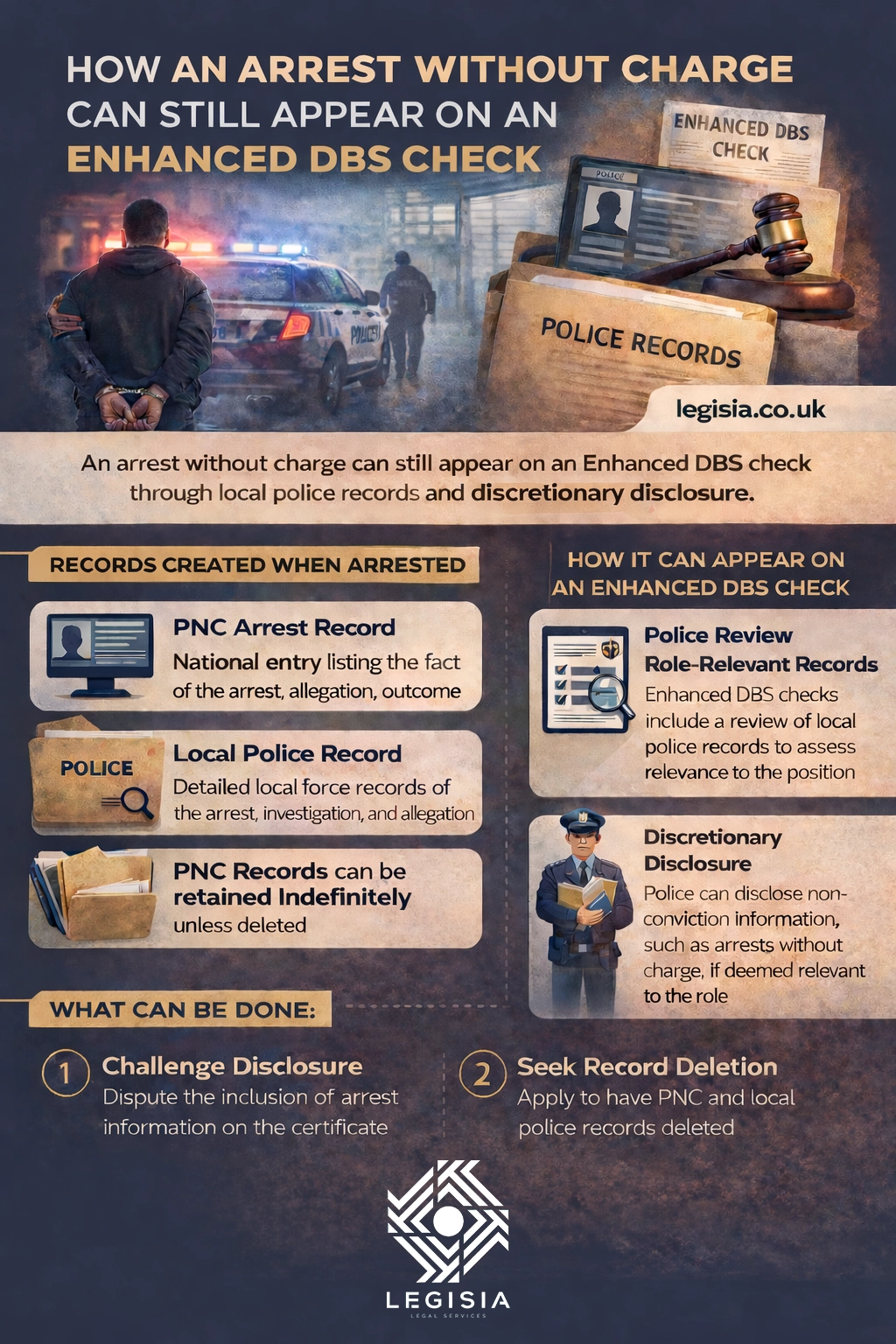
A PNC arrest record. An entry is created on the Police National Computer recording the fact of the arrest, the offence for which you were arrested, and the outcome. This record is retained indefinitely unless it is deleted through the Record Deletion Process. It does not disappear simply because no charge followed.
A local custody record. The arresting force creates a custody record on its own systems, recording the details of the detention — the time of arrest, the reason, the interviews conducted, and the disposal decision.
A local investigation record. Depending on the nature of the allegation, the force may also create an occurrence report, a crime report, an intelligence entry, or a safeguarding log. These records sit on the force’s local systems and can contain significantly more detail than the PNC entry — including the substance of the allegation, the names of complainants, and the police assessment of the matter.
The fact that you were never charged does not trigger automatic deletion of any of these records.
The PNC Arrest Record vs the Local Police Record
This distinction matters because the two types of record cause different problems — and require different solutions.
The PNC arrest record is a national database entry. It records the bare facts: that you were arrested, for what offence, and what happened next. The PNC record does not appear directly on a Basic or Standard DBS certificate, because those levels of check only show unspent/unprotected convictions and cautions. But an arrest record can trigger further enquiries during an Enhanced DBS check.
The local police record is held by the individual force and typically contains the real substance of the matter — the allegation itself, the detail of the investigation, and any related intelligence. It is this local record that the police draw on when deciding whether to disclose information on an Enhanced DBS certificate. Our guide on how local police records feed into Enhanced DBS disclosure explains this mechanism in detail.
In practical terms, this means that when someone says “my arrest is showing on my Enhanced DBS certificate,” it is usually not the PNC entry itself that is appearing. It is the local police record — the underlying allegation, the investigation details, the police assessment — that has been disclosed as relevant information on the certificate.
How an Arrest Can Appear on an Enhanced DBS Certificate
When an Enhanced DBS check is processed, the Disclosure and Barring Service contacts the relevant local police force and asks whether it holds any information that it considers ought to be disclosed for the role. The force reviews its local records. If it finds a record of an arrest — and the underlying allegation — it must decide whether that information is relevant to the role and whether disclosure is proportionate.
If the chief officer decides that it is, the information is disclosed on the certificate as approved information. The certificate will not simply say “arrested for X.” It will typically include a summary of the allegation, the date, the outcome, and any other detail the police consider relevant.
The fact that there was no charge, no caution, and no conviction does not prevent disclosure. The police are disclosing the allegation and the surrounding information, not a criminal outcome. And because the test is relevance and proportionality rather than guilt, the absence of a charge does not automatically close the door to disclosure.
No Charge Does Not Mean No Disclosure
This is the single most important point in this guide, and it is the one that catches most people off guard.
Many people assume that if they were arrested and released without charge — or if the case was investigated and resulted in no further action — the matter is over. In criminal justice terms, it largely is. But in disclosure terms, the records remain, and the police retain the power to disclose them on an Enhanced DBS certificate for as long as they hold the information and consider it relevant.
This is particularly harsh for people who were arrested for something they did not do. A false allegation can lead to an arrest, the arrest creates records on both the PNC and local systems, and those records can follow the person for years — appearing on Enhanced DBS certificates, triggering questions from employers, and in some cases putting professional registration at risk.
The lack of a charge is a relevant factor in any challenge to the disclosure — and it can be a powerful one. But it does not, by itself, prevent disclosure.
Multiple Arrests Without Charge
The disclosure problem becomes more acute where a person has been arrested more than once without charge. Each arrest creates a separate set of records — PNC entries, local custody records, investigation logs — and the police may view a pattern of arrests as more significant than a single isolated incident, even where none of the arrests led to any formal action.
In the police’s assessment, repeated arrests can be taken as reinforcing the relevance of the information — a kind of cumulative case for disclosure, even though each individual arrest resulted in nothing. This can feel deeply unfair, particularly where the arrests arose from a single set of circumstances (for example, a domestic relationship), or where the person was the victim of repeated false allegations.
We have acted for professionals in this position, including a case where a professional had been arrested repeatedly for harassment without ever being cautioned or convicted. The local police records were removed, eliminating the risk of future Enhanced DBS disclosure.
Where multiple arrests are creating a cumulative disclosure problem, addressing the local records is often more important than challenging any single certificate, because it is the accumulation of records on the force’s systems that is driving the police’s assessment of relevance.
Two Routes to Resolving the Problem
As with all non-conviction disclosure on Enhanced DBS certificates, there are two related but distinct approaches — and in many cases, both need to be considered together.
Challenging the disclosure on the certificate. This means arguing that the police should not have disclosed the information in the circumstances — that the disclosure was not relevant to the role, or was disproportionate given the age of the arrest, the absence of a charge, and the impact on the individual. This route addresses the immediate problem: the information that has appeared, or is proposed to appear, on a specific certificate.
Deleting the underlying police records. This means seeking removal of the PNC arrest record and, critically, the local police records that sit behind the disclosure. Deleting the local record removes the source of the information, preventing it from being disclosed on future Enhanced DBS checks. This is the more durable solution, particularly for people who face repeated checks throughout their career.
The two routes are not alternatives — they are complementary. In urgent cases, challenging the certificate may be the priority. But for long-term protection, addressing the records is usually essential.
Challenging the Disclosure on the Certificate
The process for challenging disclosure of arrest-related information follows the same framework as any Enhanced DBS challenge.
Before the certificate is issued, the police are required to notify you under the quality assurance framework when they are proposing to disclose approved information. This gives you the opportunity to make representations directly to the police, arguing that the proposed disclosure does not meet the legal threshold. In arrest cases, the key arguments typically focus on the absence of a charge, the age of the arrest, the circumstances in which it arose, and the lack of any continuing relevance to the role.
After the certificate has been issued, you can challenge the police force directly — on grounds of factual accuracy, proportionality, or both. If the police refuse to amend or withdraw the disclosure, the next step is an application to the Independent Monitor, who can review the decision on both accuracy and proportionality grounds. In appropriate cases, judicial review may also be available.
Our detailed guide on how to challenge information on an Enhanced DBS certificate explains the full process.
Deleting the Underlying Records
If the arrest created records on both the PNC and the local police force’s systems, there are two separate deletion routes.
The PNC arrest record can be challenged through the Record Deletion Process — the same route used for caution and conviction records on the PNC. The police apply a set of criteria to decide whether retention remains justified, taking into account the nature of the alleged offence, the outcome, and the time that has passed.
The local police records — the custody record, investigation log, intelligence entries, and any related data — can be challenged under data protection law, specifically Part 3 of the Data Protection Act 2018. Our guide on how to apply for deletion of local police records explains this process in detail.
In the Enhanced DBS context, deleting the local record can be the more important step. It is the local record — not the PNC arrest entry — that the police draw on when deciding the specific details to disclose on a certificate.
In a recent case, we acted for a healthcare applicant whose local police records relating to an ABH allegation and arrest were deleted, removing the risk of disclosure on future Enhanced DBS checks before they could affect her career.
Real Cases — Arrest Records Successfully Challenged
We regularly act for people whose arrest records — often years old and never resulting in any charge — are causing Enhanced DBS problems or threatening to do so. Two of our past cases illustrate the type of matters that we deal with:
Healthcare applicant — ABH allegation. Our client had been arrested in connection with an ABH allegation arising from a family dispute. The matter never progressed beyond arrest, but local police records of the allegation remained on the force’s systems. With a healthcare career ahead of her, the risk of future Enhanced DBS disclosure was a serious concern. We secured the deletion of the local police records, removing the source of the potential disclosure before it could affect her career.
Professional — repeated harassment arrests. Our client had been arrested on multiple occasions for harassment, without ever receiving a caution or being convicted. Each arrest had generated a separate set of local records, and the cumulative picture was creating a significant risk for future employment and professional checks. We secured the removal of all the local police records, eliminating the ongoing disclosure risk.
In both cases, the critical step was addressing the local police records rather than waiting for a disclosure to appear on a certificate. Early action on the records prevented the Enhanced DBS problem from arising in the first place.
How Legisia Can Help
If you were arrested but never charged, and you are concerned about what may appear on an Enhanced DBS check — or if arrest-related information has already been disclosed on a certificate — we can help.
We act for professionals and private individuals across healthcare, education, social work, childcare, and care settings who are dealing with the disclosure consequences of old arrest records. Depending on the circumstances, we can advise on challenging the disclosure on the certificate, seeking deletion of the underlying local police records, applying for deletion of the PNC arrest record, or pursuing all three together.
We offer a fixed-fee initial consultation where we will assess your case in detail and provide clear written advice on your prospects of success.
To discuss your case, contact us or call 020 8099 9051.
Frequently Asked Questions
If I was arrested but not charged, will it show on a DBS check?
It will not appear on a Basic or Standard DBS check, because those only draw on the PNC criminal record. However, on an Enhanced DBS check, the police can disclose information from local police records — and that includes records of the arrest and the underlying allegation. If the police consider the information relevant to the role, it can appear on the certificate even though you were never charged.
Does an arrest record stay on the PNC even if I was never charged?
Yes. A PNC entry is created when you are arrested, and it is retained until you are 100 years old, regardless of whether you are subsequently charged, cautioned, or released without further action. The record can remain on the PNC unless it is deleted through the Record Deletion Process. A separate local record will also be held by the arresting force on their own systems.
Can I get an arrest record deleted if I was never charged?
It is possible to apply for deletion of both the PNC arrest record and the local police records associated with the arrest. The PNC record is subject to the Record Deletion Process, and the local records can be challenged under data protection law. Deletion of the local record is particularly important in the Enhanced DBS context, because it is the local record that typically feeds into discretionary disclosure on the certificate.
Can the police disclose an arrest on an Enhanced DBS certificate if I was found not guilty?
Yes. An acquittal does not automatically prevent the police from disclosing the underlying allegation and arrest information. The disclosure decision is separate from the criminal justice outcome. However, the acquittal is a factor the police must weigh in their proportionality assessment, and it can significantly strengthen a challenge to the disclosure.
What is the difference between the PNC arrest record and the local police record of the arrest?
The PNC arrest record is a national database entry recording the fact of the arrest, the offence, and the outcome. The local police record is held by the individual force and typically contains more detail — the allegation itself, interview notes, custody records, and the investigation log. It is the local record that the police draw on when deciding whether to disclose information on an Enhanced DBS certificate. Addressing the local record can therefore sometimes be the important step for anyone concerned about Enhanced DBS disclosure.
Share this Post, Choose your platform!

Matt is a Solicitor Advocate and Director of Legisia Legal Services. He specialises exclusively in police record deletion, DBS appeals, and regulatory defence. With over 20 years of experience, he has advised hundreds of professionals and individuals on high-stakes matters affecting careers, reputations, and legal standing. His work focuses on challenging unlawful data retention, safeguarding thresholds, and procedural breaches across UK policing and disclosure systems.
Matt is a Solicitor Advocate and Director of Legisia Legal Services. He specialises exclusively in police record deletion, DBS appeals, and regulatory defence. With over 20 years of experience, he has advised hundreds of professionals and individuals on high-stakes matters affecting careers, reputations, and legal standing. His work focuses on challenging unlawful data retention, safeguarding thresholds, and procedural breaches across UK policing and disclosure systems.
Disclosure & DBS: the complete CPD course for professionals
Written by a solicitor who handles these cases every day. For HR, compliance, safeguarding and legal professionals who make decisions about police records and DBS disclosures.
- Eleven modules covering disclosure, DBS checks, barring, regulatory interface and employment decisions
- The only UK course that also covers how UK records affect work, travel and employment abroad
- CPD-accredited, with written feedback on a final applied-scenario exercise
- Waitlist members get 20% off and a sample module ahead of launch
We'll email you the checklist and news about the course launch – nothing else. See the full course →