- Enhanced DBS Disclosure
-

 16 min read





An Enhanced DBS check can reveal far more than a criminal conviction. For thousands of people working in healthcare, education, and social care it is the non-conviction information on a certificate — not the criminal record section — that causes the most serious career damage.
The group facing these checks is also about to grow. From 1 September 2026, the supervision exemption is removed from regulated activity with children, and many volunteers will need an enhanced check with barred list information for the first time. Our guide to the September 2026 DBS changes explains who is affected.
If you are facing an Enhanced DBS check and you are worried about what might appear, or if you have already received a certificate containing information you did not expect, this guide explains the full scope of what an Enhanced DBS certificate can show, how the police decide what to disclose, and what can be done about it.
What Is an Enhanced DBS Check?
An Enhanced DBS check is one of the most extensive levels of criminal record check available through the Disclosure and Barring Service. It is required for any role involving regular, close contact with children or vulnerable adults — including positions in the NHS, schools, care homes, social work, and many voluntary and charity-sector roles. The check may also include a search of the DBS barred lists — this is known as an Enhanced DBS check with barring and is the highest level of check available.
What sets it apart from a Basic or Standard DBS check is that the certificate draws on two separate sources of information:
The Police National Computer (PNC) — the national database that holds records of convictions, cautions, reprimands, and warnings.
Local police records — information held by individual police forces on their own systems, sometimes referred to as locally held data or police intelligence. This is not a national database. It includes investigation logs, occurrence reports, custody records, safeguarding referrals, and intelligence entries that may never have led to any formal outcome.
A Basic DBS check only shows unspent convictions. A Standard check shows spent and unspent convictions and cautions, subject to filtering rules. But an Enhanced check goes further. It can include additional police information that has never resulted in a conviction, a charge, or even an arrest — and this is where the real difficulty lies for most people.
Convictions and Cautions — The PNC Side of the Certificate
An Enhanced DBS certificate will show unspent convictions and, in most cases, spent convictions and police cautions — unless the record qualifies for filtering under the statutory filtering rules. Whether a particular conviction or caution is filtered depends on its age, its seriousness, and whether it relates to a specified offence. Our separate guide on whether police cautions show on an Enhanced DBS check explains how the filtering rules work in practice.
But this is only half the picture. The PNC record — convictions and cautions — is the part of the system that most people already expect. What they do not expect is the other source of information on an Enhanced DBS certificate: local police records. And it is that second source that causes the most serious and least understood problems.
Even where a caution or conviction has been filtered from the PNC section of the certificate, the underlying information — the allegation, the police involvement, the circumstances — may still be held locally by the police force that dealt with the matter. If the police consider that information relevant, it can be disclosed separately as additional police information. That means filtering does not always end the problem. It can simply move it from one part of the certificate to another.
Non-Conviction Information — The Category That Causes the Most Difficulty
For the majority of people we advise at Legisia, the most damaging part of an Enhanced DBS certificate is not the criminal record section. It is non-conviction information — sometimes referred to as approved information or relevant police information — that the police choose to disclose because they consider it relevant to the role.
This part of the system is poorly understood by most people until it affects them directly. There is no conviction. There is no caution. In many cases, there was never even a charge. And yet the information appears on the certificate, and the practical consequences can be devastating.
Non-conviction information disclosed on an Enhanced DBS certificate can include any of the following:
Allegations
An allegation of misconduct or criminal behaviour can be disclosed on an Enhanced DBS certificate regardless of whether it was investigated, charged, or prosecuted. This includes allegations that were never proven, allegations that were investigated and dropped, and allegations made by colleagues, family members, neighbours, or members of the public. The allegation does not need to have been tested in any court or tribunal. In one recent case, we successfully challenged the disclosure of an allegation made by colleagues against a care worker that had been included on her Enhanced DBS certificate without any formal investigation or finding.
Arrests with No Charge
If you were arrested but never charged, the fact of the arrest and the underlying allegation may still be recorded on local police systems. That record can be disclosed on an Enhanced DBS certificate even though no prosecution ever took place and the case was closed without any further action.
No Further Action (NFA) Outcomes
A decision by the police or CPS to take no further action does not erase the record. The police may retain local records of the investigation — the allegation, the interviews, the decision — and those records can form the basis of a disclosure on an Enhanced DBS certificate. Many people assume that NFA means the matter is closed. In disclosure terms, it is not.
Community Resolutions
A community resolution is an informal disposal used by the police as an alternative to arrest, charge, or caution. It is not a conviction. It is not a caution. But it can be recorded on local police systems and disclosed on an Enhanced DBS certificate — something many people do not discover until the certificate arrives.
Other Locally Held Police Intelligence
This is a broad and often surprising category. It can include information drawn from domestic incident logs, child protection referrals, safeguarding reports, intelligence entries, and other records held by individual police forces that may never have been shared with the person they relate to. Our guide on what counts as relevant police information on an Enhanced DBS certificate explains this category in full.
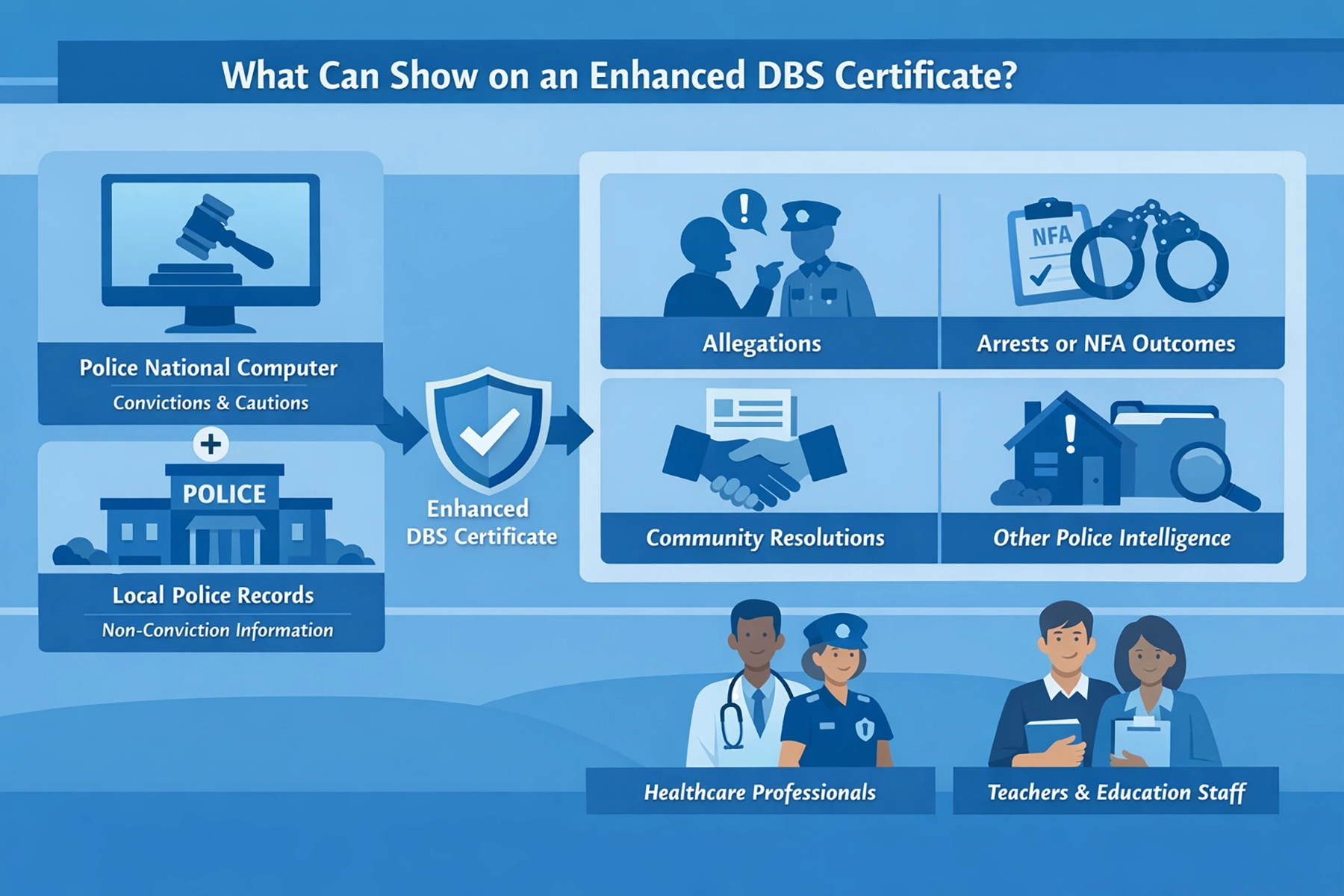
The common thread running through every one of these categories is that the person has not been convicted of anything. In many cases, they have not even been charged. Yet the information appears on the certificate, and in professional and safeguarding settings it can be treated just as seriously as a criminal conviction — sometimes more so, because the person never had the opportunity to defend themselves in court.
How the Police Decide What to Disclose
When an Enhanced DBS check is processed, the Disclosure and Barring Service contacts the relevant local police force and asks whether it holds any information that it considers ought to be disclosed. The chief officer of police must then make a decision: is the information relevant to the specific role, and ought it, in their reasonable opinion, to be included on the certificate?
This decision is governed by the statutory quality assurance framework and by case law — most importantly the Supreme Court’s judgment in R (L) v Commissioner of Police of the Metropolis [2009] and subsequent decisions. The police are required to consider whether disclosure is necessary and proportionate, weighing up several factors:
- The gravity of the information
- The relevance to the specific role being applied for
- The age of the information
- The reliability of the underlying intelligence
- The impact of disclosure on the individual
In practice, however, the quality of police decision-making in this area varies considerably between forces. Some apply the legal tests carefully and with genuine scrutiny. Others take an overly cautious, risk-averse approach and disclose information that does not meet the legal threshold — particularly in cases involving safeguarding-adjacent allegations.
This inconsistency is one of the main reasons why legal challenges to Enhanced DBS disclosure can succeed. Where the police have not applied the correct legal test, or have failed to weigh relevant factors before deciding to disclose, the decision can be vulnerable to challenge.
The Link Between Local Police Records and Enhanced DBS Disclosure
This is the part of the system that most people do not see until the damage is done.
The non-conviction information appearing on an Enhanced DBS certificate almost always originates from local police records — data held on individual police force systems rather than on the PNC. These are the investigation logs, occurrence reports, intelligence entries, safeguarding records, and custody records that sit behind the headline disclosure on the certificate.
This creates a direct connection between two related but distinct legal problems:
The Enhanced DBS certificate — the disclosure that appears when a check is processed. This is the immediate problem: the information is on the certificate, and an employer or regulatory body will see it if the certificate is presented to them.
The underlying local police record — the source data that the police drew on when making the disclosure decision. This is the structural problem: as long as the record exists, the police can disclose it again on every future check.
In some cases, the right approach is to challenge the disclosure on the certificate. In other cases, the better route is to seek deletion of the local police record that is feeding the disclosure. And in many cases — particularly where a person faces repeated checks throughout their career — both approaches need to be considered together.
Our guide on how local police records feed into Enhanced DBS disclosure explains this relationship in detail. The key point is this: addressing only the certificate can leave the underlying record in place, creating the risk of the same information being disclosed again and again. Deleting the local record can remove the source of the problem entirely.
Who Is Most Affected?
Enhanced DBS disclosure can affect anyone who needs a check for their role. But the consequences are most severe — and the stakes highest — for people in regulated professions where an Enhanced DBS certificate is not simply a pre-employment formality but a gateway to professional registration, training placements, and career progression.
Healthcare professionals are particularly exposed. Doctors, nurses, midwives, healthcare assistants, medical students, and allied health professionals all require Enhanced DBS checks, and a disclosure can trigger a separate fitness-to-practise investigation by the GMC, NMC, or HCPC — even where the underlying matter never resulted in any criminal outcome. Our guide on Enhanced DBS checks and healthcare professionals explains how these issues interact and why early action matters.
Social workers face a similar exposure. Social work is a regulated profession requiring Enhanced DBS checks with barring, and any disclosure — particularly involving allegations of violence, neglect, or safeguarding concerns — can trigger a referral to Social Work England and put the social worker’s registration at risk.
Teachers and education professionals are in the same position. The Teaching Regulation Agency (TRA) can impose prohibition orders on the basis of information disclosed on an Enhanced DBS certificate, and school employers are increasingly cautious about any disclosure in a safeguarding context. Disclosure can even arise from information that does not relate to the teacher’s own conduct — in one case, we successfully secured the removal of a family-linked disclosure involving an acquitted relative living at the same address.
Care workers, support workers, and childcare professionals are also directly affected. These roles require Enhanced DBS checks — often with barring — and a disclosure involving an allegation of abuse, neglect, or inappropriate conduct can make it extremely difficult to continue working in the sector, even where the allegation was never substantiated.
Can You Challenge What Appears on an Enhanced DBS Certificate?
Yes. There are established legal routes for challenging information that has been unfairly or disproportionately disclosed on an Enhanced DBS certificate. The right route depends on the circumstances and the stage at which the problem is identified.
Before the certificate is issued, the government’s quality assurance framework requires the police to notify the applicant when they are proposing to disclose approved information on the certificate. This notification gives the applicant the opportunity to make representations to the police arguing that the proposed disclosure does not meet the legal threshold — for example, that it is not relevant to the role, that it is disproportionate given the age or nature of the information, or that it is factually inaccurate. These representations are made directly to the police force, and they are most effective where they are prepared by a lawyer who understands the legal tests and the relevant case law.
After the certificate has been issued, the first step is to challenge the police force directly. This can be done on any ground — whether the issue is factual inaccuracy (for example, the information is wrong or relates to the wrong person) or whether the information ought to have been disclosed at all (a question of relevance and proportionality). A dispute can be raised through the DBS, but it is the relevant police force that holds the data, reviews the challenge, and decides whether to correct or withdraw the disclosure.
If the police refuse to change their decision, the next step is an application to the Independent Monitor, who has the power to review the chief officer’s disclosure decision. The Independent Monitor can consider challenges on both accuracy and proportionality grounds, and can determine whether the decision to disclose was reasonable.
In some cases, particularly where the police decision-making was fundamentally flawed, judicial review may also be available.
Our detailed guide on how to challenge information on an Enhanced DBS certificate explains each of these routes, including the timescales, the legal tests applied at each stage, and what you can realistically expect from the process.
Where the disclosure is being driven by an underlying local police record, it may also be possible to seek deletion of that record under data protection law — either alongside or instead of challenging the certificate. This is particularly important where the concern is not one certificate but the ongoing risk of repeated disclosure throughout a professional career.
How Legisia Can Help
At Legisia, we act for professionals and private individuals who are facing unfair or disproportionate disclosure on Enhanced DBS certificates, and for those who need local police records deleted to protect their career and future.
If information has appeared on your Enhanced DBS certificate — or you are concerned about what may appear on a future check — we can advise on the best route to resolve the problem. That may mean challenging the certificate itself, seeking deletion of the underlying local police records, or pursuing both approaches together.
We offer a fixed-fee initial consultation where we will assess your case in detail and provide clear written advice on your prospects of success. If we take the case on, we will usually be able to conduct it on a fixed-fee basis so that you know the cost from the outset.
To discuss your case, contact us or call 020 8099 9051.
Frequently Asked Questions
What is the difference between a Standard and an Enhanced DBS check?
A Standard DBS check shows spent and unspent convictions and cautions held on the PNC, subject to filtering rules. An Enhanced DBS check includes the same PNC information but can also include additional non-conviction information from local police records if the police consider it relevant to the role. It is this additional discretionary disclosure that makes the Enhanced check more extensive — and more unpredictable.
Can something show on an Enhanced DBS check even if I was never convicted?
Yes. Non-conviction information — including allegations, arrests without charge, NFA outcomes, community resolutions, and other locally held police intelligence — can all be disclosed on an Enhanced DBS certificate if the police consider the information relevant to the role being applied for. There is no requirement for a conviction, charge, or caution before information can be disclosed.
Can I find out what local police records are held about me before applying for a DBS check?
You can make a subject access request under the UK GDPR and the Data Protection Act 2018 to the relevant police force. The force is then required to disclose the personal data it holds about you, including locally held records. This can be a valuable first step in understanding what information exists and whether it might be disclosed on a future Enhanced DBS check.
What if the same information keeps appearing on every Enhanced DBS check I apply for?
If the underlying local police record has not been deleted, the police can disclose it each time a new Enhanced DBS check is processed. This is why it is sometimes essential to address the source of the disclosure rather than the certificate alone. Seeking deletion of the local police record can prevent the same information from being disclosed on future checks.
Is there a time limit on how long non-conviction information can be disclosed?
There is no fixed statutory time limit. The police can disclose non-conviction information regardless of its age, provided they consider it relevant and proportionate to the role. However, the age of the information is one of the factors the police must take into account when deciding whether to disclose, and older information may be more vulnerable to a legal challenge on proportionality grounds.
Can an Enhanced DBS check show information about a family member rather than about me?
In some circumstances, yes. If you live with someone who has a relevant criminal history or is the subject of police intelligence, and the role you are applying for involves working with children or vulnerable adults, the police may consider that information relevant to your check. This is sometimes called third-party or family-linked disclosure, and it can be particularly difficult for the individual affected because the information does not relate to anything they have done.
Share this Post, Choose your platform!

Matt is a Solicitor Advocate and Director of Legisia Legal Services. He specialises exclusively in police record deletion, DBS appeals, and regulatory defence. With over 20 years of experience, he has advised hundreds of professionals and individuals on high-stakes matters affecting careers, reputations, and legal standing. His work focuses on challenging unlawful data retention, safeguarding thresholds, and procedural breaches across UK policing and disclosure systems.
Matt is a Solicitor Advocate and Director of Legisia Legal Services. He specialises exclusively in police record deletion, DBS appeals, and regulatory defence. With over 20 years of experience, he has advised hundreds of professionals and individuals on high-stakes matters affecting careers, reputations, and legal standing. His work focuses on challenging unlawful data retention, safeguarding thresholds, and procedural breaches across UK policing and disclosure systems.
Disclosure & DBS: the complete CPD course for professionals
Written by a solicitor who handles these cases every day. For HR, compliance, safeguarding and legal professionals who make decisions about police records and DBS disclosures.
- Eleven modules covering disclosure, DBS checks, barring, regulatory interface and employment decisions
- The only UK course that also covers how UK records affect work, travel and employment abroad
- CPD-accredited, with written feedback on a final applied-scenario exercise
- Waitlist members get 20% off and a sample module ahead of launch
We'll email you the checklist and news about the course launch – nothing else. See the full course →