


- Police Caution Deletion
-

 16 min read





For many people, the first time a police caution causes a serious problem is when they apply for a visa. A caution accepted years ago — perhaps for something minor, perhaps under pressure at a police station — suddenly becomes the reason a visa application is delayed, questioned, or refused. The destinations that generate many enquiries of this kind are Australia and Canada.
This guide explains how each country treats a UK police caution, what your ACRO Police Certificate will show, and why deletion of the underlying record can make a decisive difference to whether your application succeeds.
If your concern relates to a US visa rather than Australia or Canada, see our separate guide: US Immigration and Cannabis Criminal Records.
The ACRO Police Certificate — where it starts
Before getting into the rules for each country, it is important to understand the document that sits at the centre of almost every international visa application involving a UK criminal record: the ACRO Police Certificate.
An ACRO Police Certificate is issued by ACRO Criminal Records Office for immigration purposes. It is not the same as a DBS certificate, which is used for employment in the UK. The ACRO certificate shows your UK criminal record — including cautions, convictions, reprimands, and warnings held on the Police National Computer (PNC) — and is required for visa applications to Australia, Canada, New Zealand, the United States, and several other countries.
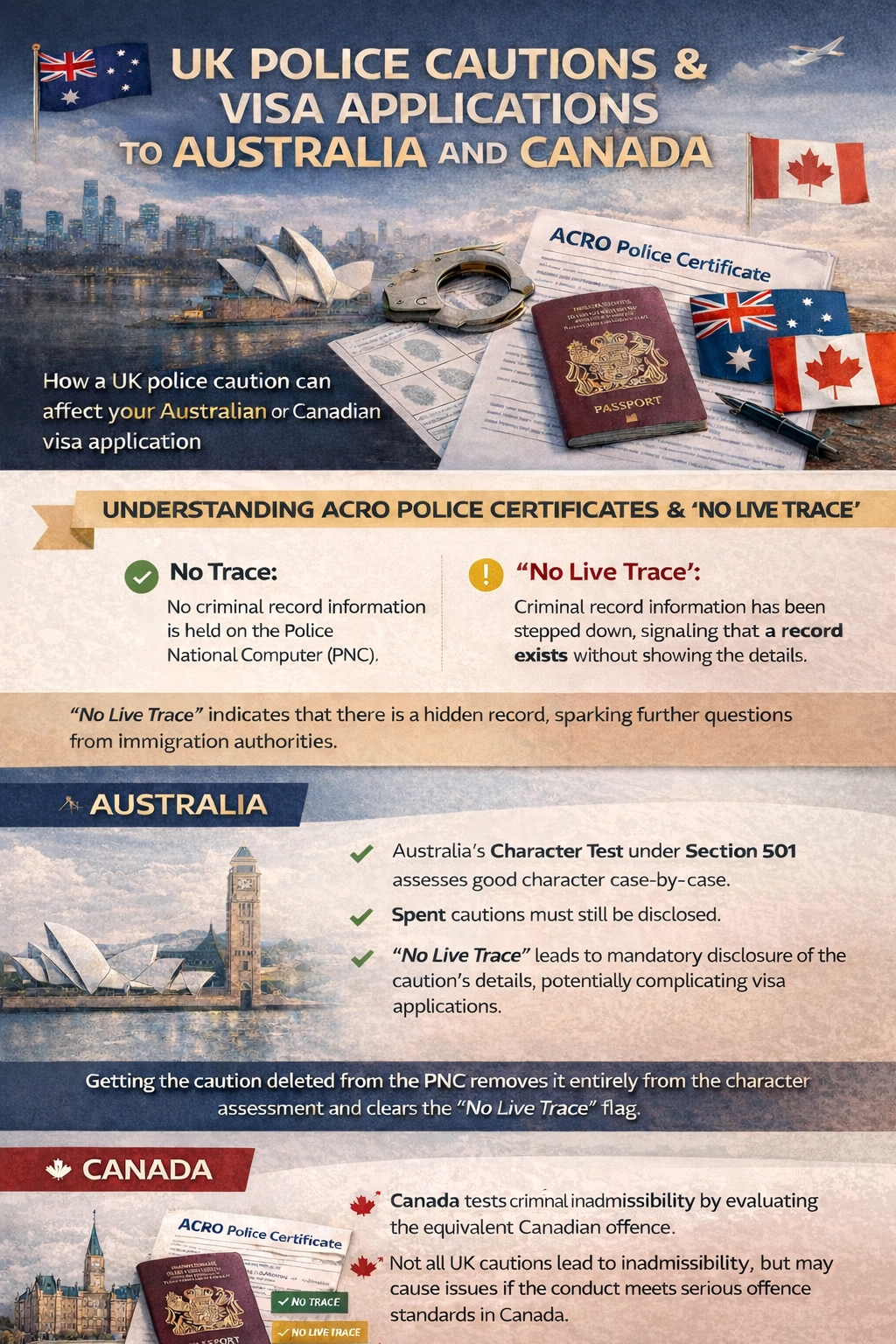
The critical point is this: the ACRO certificate does not simply say “clear” or “not clear”. For a person with any history on the PNC, there are three possible outcomes:
No Trace — no criminal record information is held on the PNC at all. This is the only result that presents a genuinely clean record to any foreign authority.
Direct disclosure — the caution is still within its step-down period and so appears in full on the certificate, with the details of the offence, date, and disposal visible to the embassy or immigration authority receiving it. For adult cautions, lower-level offences step down after five years; more serious offences step down after ten years. Until that point, the certificate discloses the caution directly.
No Live Trace — the caution has passed its step-down period and no longer appears in full, but the certificate signals that criminal record information is held on the PNC. No detail is shown, but the record is not clean either.
Direct disclosure means the embassy sees the full record and makes a judgment on it — at least the position is transparent. No Live Trace is in some respects the more difficult position: any embassy or immigration authority that receives a certificate showing that wording knows that something exists on your record without being able to see what it is. They will typically ask you to provide further details, putting you in the position of explaining a historic record that the certificate has already flagged.
It is also important to understand that ACRO operates a different framework from the DBS. A caution that no longer appears on a DBS certificate — because it has become protected under the six-year filtering rule — may still be within its ACRO step-down period and therefore appear in full on a police certificate. The two systems do not mirror each other, and assuming that a clean DBS check means a clean ACRO certificate is one of the most common mistakes people make.
Only deletion of the underlying PNC record produces a true No Trace result, regardless of which stage of the step-down process the caution currently sits in. For a detailed explanation of how ACRO disclosure works and what your certificate is likely to show, see our guide: Will a Police Caution Show on an ACRO Police Certificate?
Australia and a UK police caution
The Character Test under Section 501
Australia assesses the character of all visa applicants under Section 501 of the Migration Act 1958. The Character Test requires applicants to demonstrate that they are of good character, and the Australian Department of Home Affairs has the power to refuse or cancel a visa where that test is not met.
The Character Test has several limbs. The most straightforward is the “substantial criminal record” threshold — which is engaged where a person has been sentenced to imprisonment of 12 months or more. A UK police caution will never reach that threshold because a caution does not involve a court sentence. However, the Character Test is not limited to substantial criminal records. Australian authorities also assess an applicant’s “past and present criminal conduct” more broadly, and they do so on a case-by-case basis. A caution — particularly for an offence involving violence, drugs, or dishonesty — can form part of that assessment.
Australia does not recognise spent cautions
The single most important thing to understand about Australian visa applications is that Australia does not recognise the UK concept of a spent caution. The Rehabilitation of Offenders Act 1974 is a piece of UK legislation. It has no force in Australian immigration law. A caution that is spent under UK law — and therefore irrelevant for most UK purposes — must still be disclosed to Australian immigration authorities if it is relevant to the visa application.
This catches many applicants completely off guard. They were told when they received the caution that it would be spent immediately and would not follow them. That is true for most UK purposes. It is not true for an Australian visa application.
When is an ACRO Police Certificate required for Australia?
All applicants aged 16 or over who are applying for permanent entry to Australia require an ACRO Police Certificate. Most applicants whose intended stay in Australia will exceed 12 months also require one. Some applicants with shorter intended stays may also be asked to provide one at the discretion of the Department of Home Affairs. The certificate must cover each country in which the applicant has lived for 12 months or more during the 10 years immediately before the visa application.
Critically, applicants are also required to comply with Public Interest Criterion 4020 (PIC 4020), which requires full and accurate disclosure of criminal history. Providing false or misleading information — including omitting a caution that appears on your ACRO certificate — can result in visa refusal and in some cases a three-year ban on reapplying. Australian immigration authorities take PIC 4020 compliance seriously. Being caught having provided incomplete information is frequently a worse outcome than having disclosed the caution in the first place.
Does a minor or old caution automatically fail the Character Test?
Not automatically. The Australian Department of Home Affairs assesses each case individually. A single old caution for a non-violent, minor matter — properly disclosed and contextualised — will not necessarily result in a visa refusal. Factors considered include the nature and seriousness of the offence, how long ago it occurred, whether it is part of a pattern of conduct, and any evidence of rehabilitation or changed circumstances.
The practical difficulty is that a “No Live Trace” on the ACRO certificate creates uncertainty at the point of application. It signals that something exists without confirming what it is, which puts the applicant in the position of having to explain a historic record in detail — often without having been aware it would still be an issue.
Canada and a UK police caution
Criminal inadmissibility and the equivalency test
Canada’s approach to criminal inadmissibility is set out in the Immigration and Refugee Protection Act (IRPA). Under this framework, a person may be found inadmissible to Canada if they have been convicted of — or, in some circumstances, committed — an offence that is equivalent to an indictable offence under Canadian law.
A UK police caution is not a conviction. In general, UK cautions do not make a person criminally inadmissible to Canada in the same way that a conviction would. However, the position is not straightforward. Canada assesses the underlying conduct — not just the legal disposal — and applies an equivalency test to determine what offence the caution would amount to under Canadian law. If that equivalent Canadian offence is indictable (which broadly corresponds to a serious offence in the UK sense), inadmissibility can arise even without a conviction.
In practice, this means that a caution for a minor summary-type offence — minor theft, minor public order — is very unlikely to cause inadmissibility. A caution for an offence that maps to a more serious Canadian equivalent — assault causing bodily harm, drug supply, fraud — carries a higher risk, even though the UK disposal was only a caution.
What if the caution shows on the ACRO certificate?
Even where a UK caution would not formally make an applicant inadmissible to Canada, a “No Live Trace” on the ACRO certificate will frequently prompt a visa officer at the High Commission in London to ask further questions. That conversation — and the way it is handled — matters considerably. An applicant who proactively explains the nature of the caution, provides context, and is transparent about the circumstances is in a materially better position than one who appears to have omitted or downplayed the record.
If the caution does give rise to a finding of inadmissibility, Canada offers a number of routes to overcome that finding. A Temporary Resident Permit (TRP) can be issued where the applicant has a compelling reason to travel to Canada that outweighs any risk. A Criminal Rehabilitation application provides a longer-term solution; it can be applied for once five years have passed since the completion of the sentence, and if granted, removes the grounds of inadmissibility permanently. In some cases, a person may be deemed rehabilitated automatically by the passage of time, depending on the nature and number of offences.
Does Canada recognise a spent UK caution?
The position is nuanced. Canada does not apply the UK Rehabilitation of Offenders Act directly, but Canadian immigration guidance does acknowledge the concept of a spent caution as relevant context. In practice, a caution that is both spent and relates to a very minor equivalent Canadian offence is unlikely to give rise to inadmissibility findings. However, this is not a guaranteed exemption and the specific facts of each case matter. Relying on the assumption that a spent caution will simply be ignored by Canadian authorities is not a safe position to take without proper legal advice.
How caution deletion changes the position
For both Australia and Canada, the most effective way to address the impact of a police caution on international travel is to have the caution deleted from the Police National Computer.
If your caution is successfully deleted from the PNC, your ACRO Police Certificate will state “No Trace” — not “No Live Trace”. This is the outcome that removes the trigger for further enquiries from any foreign embassy or immigration authority. It is the difference between an application that proceeds without issue and one that requires detailed explanation of a historic police record at every stage.
For Australian visa applications, deletion removes the caution from the character assessment entirely. There is nothing to disclose, nothing to explain, and no PIC 4020 compliance issue arising from the record.
For Canadian visa applications, deletion eliminates the ACRO flag that prompts officer enquiries, and removes any question of equivalency-based inadmissibility based on the caution.
Deletion is not available in every case — the police assess applications against specific grounds relating to how the caution was issued and whether there is a continuing policing purpose for retaining the record. But where grounds exist, it is the single most impactful step a person with an overseas travel concern can take. For a full explanation of the process, see our guide: Deletion of Records from National Police Systems.
One important practical note: do not apply for the ACRO certificate and then seek deletion as an afterthought. The time to pursue deletion is before the visa application is submitted, if at all possible. Once an embassy or visa authority has a “No Live Trace” on record, the question of the historic caution has already been opened. Deletion after that point still helps — but the sequencing matters.
What if you accepted the caution without realising it would affect travel?
This is a very common situation. The police often present a caution as having no serious consequences — a way to resolve a matter quickly and move on. Travel implications are rarely, if ever, explained at the point of issue. Many people accept a caution without any legal advice and without appreciating that it will appear on their ACRO certificate for years, causing complications with every international visa application they make.
If this applies to you, the circumstances in which the caution was accepted are directly relevant to whether it can be deleted. A caution should only be issued where the person has freely and voluntarily admitted the offence, understands the significance of what they are signing, and has had the opportunity to take legal advice if they wish. Where those conditions were not properly met, the caution may be vulnerable to challenge — and deletion may be possible even for a relatively recent caution. For more background on your rights at the police station, see: Should I Accept a Police Caution?
How Legisia can help
We advise clients on police caution removal where travel to Australia, Canada, or other countries is the primary concern. Our work in these cases typically includes assessing whether the caution is eligible for deletion from the PNC, preparing and submitting the deletion application, and advising on how to approach the visa application — both in terms of timing and disclosure — while the deletion is pursued.
If you have already submitted a visa application and received a request for further information about your record, early legal advice on how to respond is essential.
Speak to a specialist
If you have a UK police caution and are planning to travel to or emigrate to Australia or Canada, contact Legisia for a fixed-fee initial consultation. We will assess your caution, advise on deletion prospects, and help you understand what your ACRO certificate will show before you apply.
Frequently asked questions
Can I travel to Australia with a UK police caution?
Possibly, but a caution can cause complications. Australia does not recognise the UK concept of a spent caution. Under the Character Test in Section 501 of the Migration Act 1958, Australian authorities assess all relevant criminal conduct. A caution that remains on the PNC will appear on your ACRO Police Certificate, or — if stepped down — will produce a “No Live Trace” result that prompts further enquiries. Whether a visa is refused depends on the nature of the offence, how long ago it occurred, and how the application is prepared. A minor old caution that is properly contextualised may not prevent entry; a more serious matter, or one that is not properly disclosed, is a different position.
Does a UK police caution affect a Canadian visa?
UK cautions are not convictions and generally do not make a person criminally inadmissible to Canada. However, Canada applies an equivalency test to determine what the underlying conduct would amount to under Canadian law — and if the equivalent Canadian offence is indictable, inadmissibility can arise even without a conviction. A caution that shows on an ACRO certificate can also prompt a visa officer to ask further questions regardless of the formal inadmissibility position.
What is an ACRO Police Certificate and why does it matter?
An ACRO Police Certificate is issued by ACRO Criminal Records Office for immigration purposes. It shows your UK criminal record — cautions, convictions, reprimands, and warnings — and is required for visa applications to Australia, Canada, New Zealand, the United States, and other countries. It is not the same as a DBS certificate, which is used for employment in the UK. Unlike a DBS certificate, an ACRO certificate operates outside the UK filtering rules, which means records that no longer appear on DBS checks can still appear on — or leave a “No Live Trace” marker on — an ACRO certificate.
What does “No Live Trace” mean on an ACRO Police Certificate?
“No Live Trace” means that criminal record information is held on the Police National Computer but has been stepped down and does not appear in full on the certificate. It is different from “No Trace”, which means no record exists at all. Any embassy or immigration authority that receives a certificate showing “No Live Trace” will know that a past record exists and will typically ask for further details. Only deletion of the underlying PNC record produces a true “No Trace” result — and that is why deletion matters so much for international travel.
Can getting my caution deleted help with an Australian or Canadian visa?
Yes, in many cases significantly. If your caution is deleted from the PNC, your ACRO certificate will state “No Trace” rather than “No Live Trace”. This removes the flag that prompts further enquiries from immigration authorities. For Australia, it removes the caution from the character assessment entirely. For Canada, it eliminates the record that might otherwise cause an officer to question admissibility. Deletion is not available in every case, but where grounds exist — including procedural failures in how the caution was issued or accepted, or on public interest grounds — it is the most effective step a person with an overseas travel concern can take.
Does Australia recognise that a UK caution is spent?
No. Australia does not recognise the UK Rehabilitation of Offenders Act 1974. A caution that is spent under UK law must still be disclosed to Australian immigration authorities if it is relevant to the visa application. This is one of the most common misconceptions — being told a caution is spent and therefore irrelevant to travel is incorrect when it comes to Australian visa applications.
Related guides
- Deletion of Records from National Police Systems — how the Record Deletion Process works and what grounds can support an application
- How Long Does a Police Caution Stay on the PNC? — the difference between spent, protected, and deleted
- US Immigration and Cannabis Criminal Records — the separate rules that apply to US visa applications
- Should I Accept a Police Caution? — your rights at the police station and the long-term consequences of accepting a caution
- Police Caution Removal — our services
You can apply for an ACRO Police Certificate directly through the official ACRO Criminal Records Office website. If your certificate returns “No Live Trace” and you are unsure what that means for your visa application, take legal advice before proceeding.
Share this Post, Choose your platform!

Matt is a Solicitor Advocate and Director of Legisia Legal Services. He specialises exclusively in police record deletion, DBS appeals, and regulatory defence. With over 20 years of experience, he has advised hundreds of professionals and individuals on high-stakes matters affecting careers, reputations, and legal standing. His work focuses on challenging unlawful data retention, safeguarding thresholds, and procedural breaches across UK policing and disclosure systems.
Matt is a Solicitor Advocate and Director of Legisia Legal Services. He specialises exclusively in police record deletion, DBS appeals, and regulatory defence. With over 20 years of experience, he has advised hundreds of professionals and individuals on high-stakes matters affecting careers, reputations, and legal standing. His work focuses on challenging unlawful data retention, safeguarding thresholds, and procedural breaches across UK policing and disclosure systems.
Disclosure & DBS: the complete CPD course for professionals
Written by a solicitor who handles these cases every day. For HR, compliance, safeguarding and legal professionals who make decisions about police records and DBS disclosures.
- Eleven modules covering disclosure, DBS checks, barring, regulatory interface and employment decisions
- The only UK course that also covers how UK records affect work, travel and employment abroad
- CPD-accredited, with written feedback on a final applied-scenario exercise
- Waitlist members get 20% off and a sample module ahead of launch
We'll email you the checklist and news about the course launch – nothing else. See the full course →




Do Police Cautions Show on an Enhanced DBS Check?
Mar 12, 2026

How Long Does a Police Caution Stay on the PNC?
Mar 9, 2026

When Can a Police Caution Be Deleted?
Mar 9, 2026
