


- Police Caution Deletion
-

 8 min read





If you are applying for a visa, residency process, overseas job or foreign background check, you may be wondering whether a police caution will show on an ACRO Police Certificate. In many cases, the answer is yes – but not always, and not in the same way people expect from a DBS check.
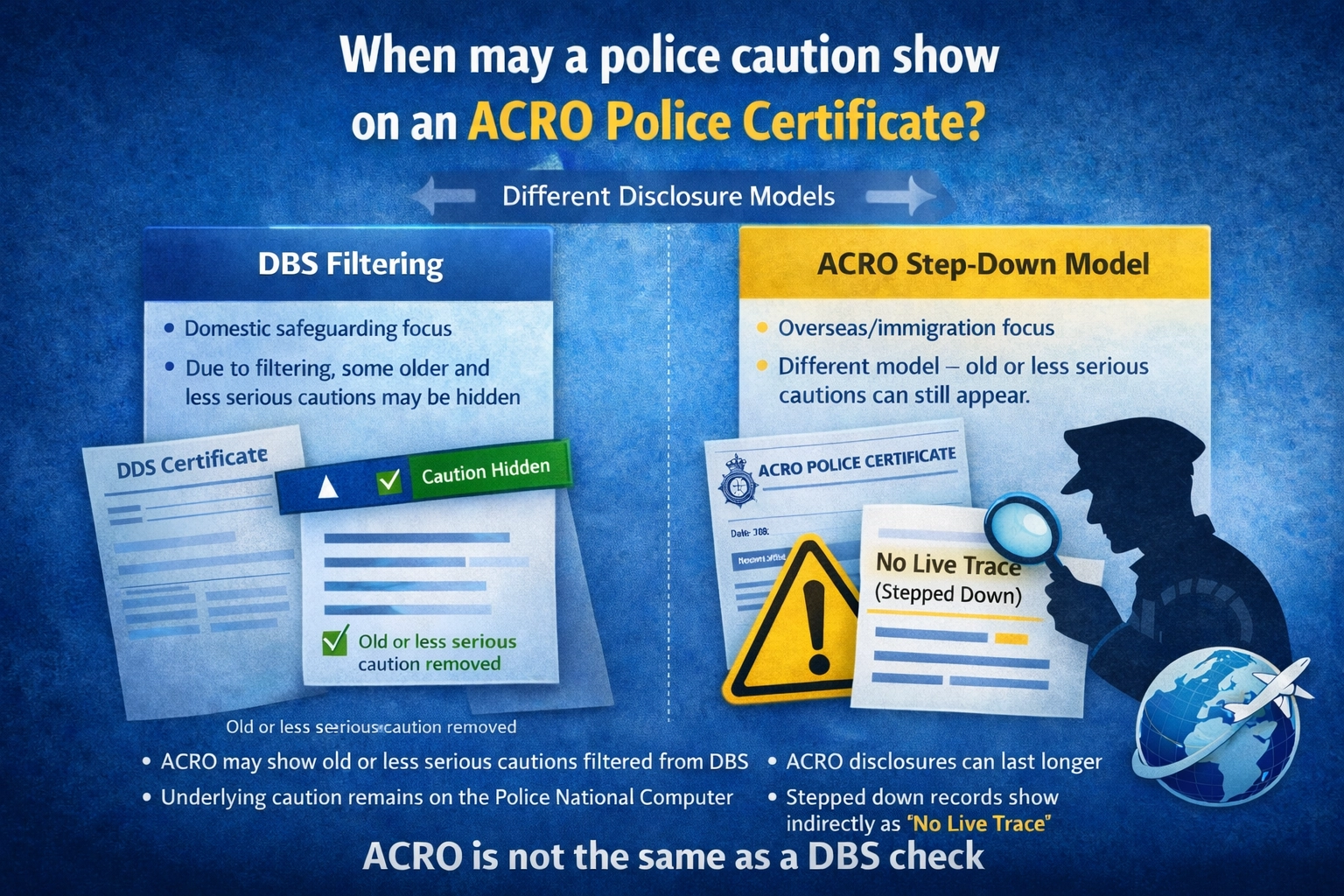
An ACRO Police Certificate uses its own disclosure framework, including the ACRO step-down model. That means a caution may still appear on the certificate even where it is spent or no longer automatically disclosed on a DBS certificate.
Yes, a police caution can show on an ACRO Police Certificate. For adult cautions, some lower-level cautions step down after 5 years, while more serious cautions can take 10 years. After step-down, the certificate may show No Live Trace rather than No Trace.
If your concern is specifically an overseas safeguarding certificate, read our guides on ICPC cautions and disclosure and ICPC vs ACRO Police Certificate. If your concern is domestic employment disclosure, see Do Police Cautions Show on an Enhanced DBS Check?.
Will a Police Caution Show on an ACRO Police Certificate?
Yes, potentially. A police caution can show on an ACRO Police Certificate if it is still applicable under ACRO’s step-down rules.
That is the critical point. ACRO Police Certificates do not simply follow DBS filtering rules. So a caution that no longer appears automatically on a DBS certificate may still be relevant for ACRO purposes.
The Short Answer
For adult cautions, ACRO applies different step-down periods depending on the seriousness category of the offence.
- Category C caution – steps down after 5 years.
- Category B caution – steps down after 5 years.
- Category A caution – steps down after 10 years.
In practical terms, that means a lower-level adult caution such as a minor assault may step down after 5 years, whereas a more serious category A caution – for example some Class A drug matters – may take 10 years before it steps down on an ACRO Police Certificate. If your concern is specifically a drug caution, see our guide on whether a drug possession caution will show on an ACRO Police Certificate. ACRO’s current step-down model sets out those adult caution periods at 5 years for categories B and C, and 10 years for category A cautions.
But step-down is not the same as deletion. A stepped-down caution can still leave you with a No Live Trace certificate rather than a clean No Trace result.
What Do No Trace and No Live Trace Mean?
This is one of the most important practical issues with ACRO Police Certificates.
No Trace generally means there is no conviction, caution, reprimand or warning recorded on the PNC that is relevant for the Police Certificate. By contrast, No Live Trace usually means there is recordable history on police systems, but it has stepped down under the ACRO model and is no longer being listed in full on the certificate. Where certain offences have stepped down, this may be identified on the certificate by the wording No Live Trace.
That distinction matters because many overseas authorities, employers, embassies and immigration decision-makers treat No Live Trace differently from No Trace. That issue arises frequently, including in our old ABH caution removed before a China visa application case study and our case study on a finance professional who deleted a drug caution before a U.S. move. In practice, a No Live Trace certificate often prompts follow-up questions, requests for explanation, or wider scrutiny of the background.
So even where a caution has stepped down, the problem may not be fully resolved. For many people, the issue is not just whether the caution is printed in full, but whether the certificate still signals that police record history exists.
Why ACRO Is Different From DBS
Many people assume that if a caution no longer appears on a DBS certificate, it will also stop appearing for ACRO purposes. That is not how the systems work.
DBS certificates use domestic disclosure rules and filtering. ACRO Police Certificates use the step-down model, which is a different framework used for overseas certificates.
This means you can have a caution that is spent, or even filtered from automatic DBS disclosure, and still face an ACRO issue. If your concern is domestic safeguarding disclosure, see Do Police Cautions Show on an Enhanced DBS Check?. If your concern is broader record retention, see How Long Does a Police Caution Stay on the PNC?.
When a Caution May Step Down
The ACRO step-down model uses offence categories and clear periods. For adult cautions, the broad rule is simple:
- Category B and C adult cautions – 5-year clear period.
- Category A adult cautions – 10-year clear period.
The step-down model uses a clear period from offending. If a person reoffends within the relevant clear period, the clock resets and a fresh clear period begins. Where the person has more than one disposal on the record, the longest applicable retention period prevails.
That is why step-down is not always as simple as counting 5 or 10 years from the date of the caution. Reoffending, multiple disposals, or more serious linked matters can keep the overall history live for longer.
It is also important to understand what step-down does not do. When offences are stepped down they are not removed from the PNC, and disclosure can still take place through other means outside the ACRO certificate process.
See ACRO’s official Police Certificate guidance for the certificate purpose and ACRO’s published step-down model for the disclosure framework.
What If the Caution Should Not Still Be There?
Sometimes the real issue is not just whether the caution will appear on the ACRO Police Certificate. It is whether the caution should still exist on police systems at all. If you need the wider context on police cautions, disclosure and deletion, see our guide to police cautions, DBS checks and police records.
If the caution was wrongly issued, accepted without a proper informed admission, or unfair to retain, the stronger long-term solution may be to seek deletion of the underlying record from the PNC. That is often strategically more powerful than waiting for step-down, particularly where No Live Trace would still cause immigration or overseas-employment problems.
We cover that in more detail in our related guides:
- Can a Police Caution Be Removed From the PNC?
- When Can a Police Caution Be Deleted?
- Delete a Police Caution Before an ICPC Application
How Legisia Can Help
At Legisia, we advise on the wider problem rather than only the certificate in front of you. Sometimes the key question is whether the caution is still applicable under the ACRO step-down model. In other cases, the real issue is that even a stepped-down caution may still leave you with a No Live Trace outcome that causes overseas difficulty.
That is why we advise on both police caution removal and the disclosure consequences that arise on overseas certificates. Where proper grounds exist, deleting the caution before an overseas application is often the more durable solution.
Concerned that a police caution may appear on an ACRO Police Certificate?
If a police caution could affect a visa, residency application, overseas job or immigration process, it may be possible to address the problem before the certificate is issued.
Legisia advises clients on police caution removal, ACRO-related disclosure concerns, and the wider overseas consequences of cautions that remain on the PNC.
Frequently Asked Questions
Does a spent police caution show on an ACRO Police Certificate?
Potentially, yes. “Spent” status does not decide ACRO disclosure in the same way it affects domestic DBS contexts. ACRO Police Certificates use the step-down model instead.
What is the difference between No Trace and No Live Trace on an ACRO Police Certificate?
No Trace generally means there is no relevant caution or conviction history recorded for the certificate. No Live Trace usually means there is police record history, but it has stepped down and is no longer being listed in full on the certificate.
Can a caution show on ACRO even if it no longer appears on DBS?
Yes. A caution may no longer be automatically disclosed on a DBS certificate and still remain applicable for ACRO purposes because ACRO uses a different disclosure framework.
How long does it take for an adult caution to step down on ACRO?
For adult cautions, category B and C cautions step down after 5 years, while category A cautions step down after 10 years, assuming the relevant clear period is not reset by further offending.
Does step-down remove the caution from the PNC?
No. Step-down affects disclosure on the ACRO Police Certificate. It does not itself delete the underlying police record from the PNC.
Can you remove a caution before applying for an ACRO Police Certificate?
Potentially, yes. If there are proper grounds to challenge the caution itself, deletion from the PNC may be possible through the Record Deletion Process. That is often the stronger long-term solution where available.
Share this Post, Choose your platform!

Matt is a Solicitor Advocate and Director of Legisia Legal Services. He specialises exclusively in police record deletion, DBS appeals, and regulatory defence. With over 20 years of experience, he has advised hundreds of professionals and individuals on high-stakes matters affecting careers, reputations, and legal standing. His work focuses on challenging unlawful data retention, safeguarding thresholds, and procedural breaches across UK policing and disclosure systems.
Matt is a Solicitor Advocate and Director of Legisia Legal Services. He specialises exclusively in police record deletion, DBS appeals, and regulatory defence. With over 20 years of experience, he has advised hundreds of professionals and individuals on high-stakes matters affecting careers, reputations, and legal standing. His work focuses on challenging unlawful data retention, safeguarding thresholds, and procedural breaches across UK policing and disclosure systems.
Disclosure & DBS: the complete CPD course for professionals
Written by a solicitor who handles these cases every day. For HR, compliance, safeguarding and legal professionals who make decisions about police records and DBS disclosures.
- Eleven modules covering disclosure, DBS checks, barring, regulatory interface and employment decisions
- The only UK course that also covers how UK records affect work, travel and employment abroad
- CPD-accredited, with written feedback on a final applied-scenario exercise
- Waitlist members get 20% off and a sample module ahead of launch
We'll email you the checklist and news about the course launch – nothing else. See the full course →




Do Police Cautions Show on an Enhanced DBS Check?
Mar 12, 2026

How Long Does a Police Caution Stay on the PNC?
Mar 9, 2026

When Can a Police Caution Be Deleted?
Mar 9, 2026
