


- Police Caution Deletion
-

 10 min read





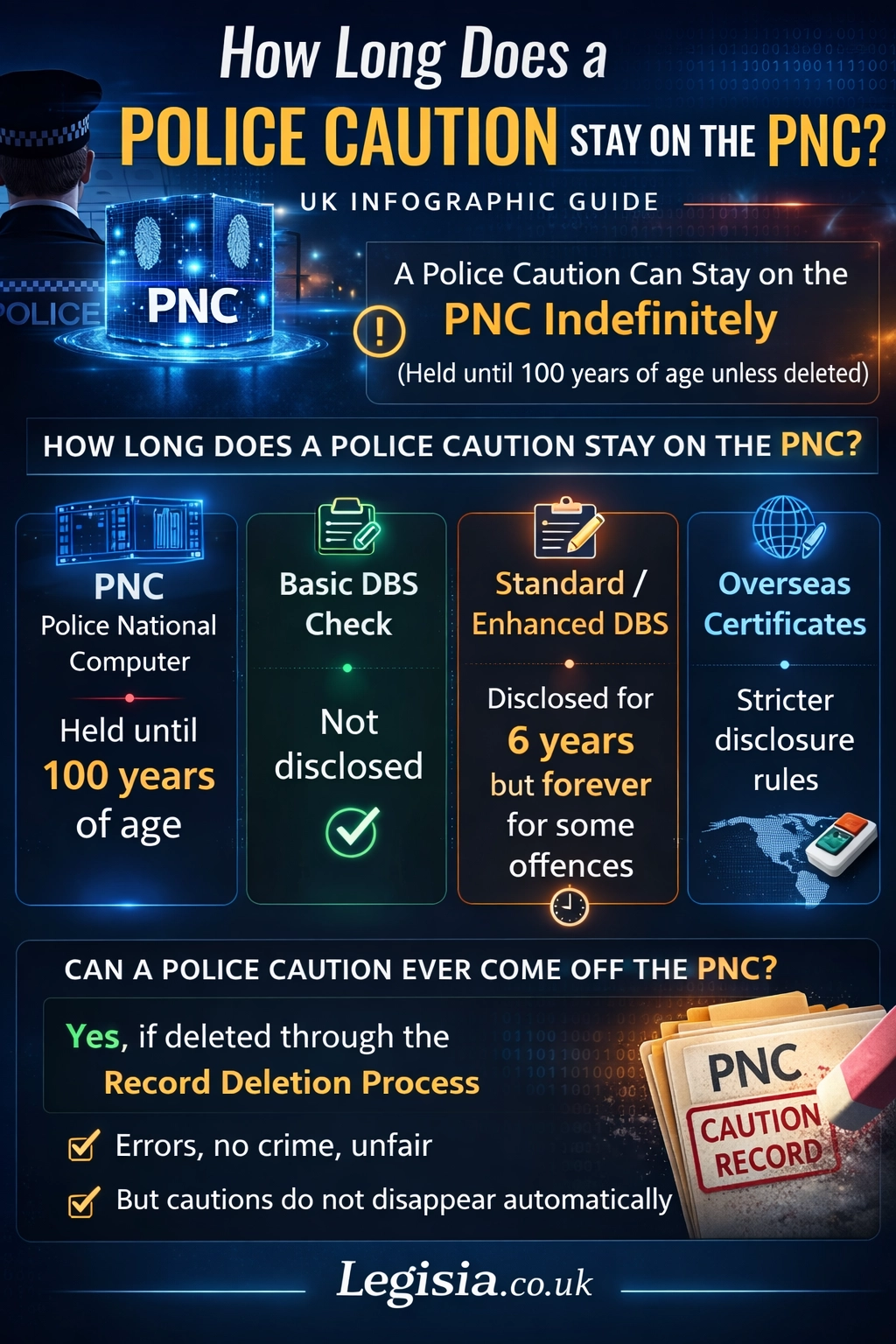
If you are asking how long a police caution stays on the PNC, the key point is that a caution can remain on the Police National Computer (PNC) indefinitely unless it is removed through the Record Deletion Process. That is different from when a caution becomes spent, and different again from when it may stop appearing automatically on some DBS checks.
This is where many people get caught out. They are told that a caution is spent straight away, or that some cautions are filtered from DBS disclosure after a period of time, and assume the record itself has disappeared. Usually it has not. The police record can still remain on the PNC unless a deletion application is made and accepted.
That distinction matters when an old caution starts affecting employment, professional registration, an ACRO Police Certificate, an International Child Protection Certificate (ICPC), or other forms of vetting.
For healthcare professionals registered with the NMC or GMC, whether a caution is protected is also critical to your disclosure obligations — see our guide: police cautions and the NMC or GMC.
Key point: a police caution can stay on the PNC indefinitely even after it is spent, and even after it stops appearing automatically on some DBS certificates.
For the broader overview, see our guide on whether a police caution can be removed from the PNC. For the question of eligibility, see when a police caution can be deleted. This article focuses on time: how long the caution remains in different systems, and why the answer changes depending on what you are actually asking.
How Long Does a Police Caution Stay on the PNC?
A police caution can remain on the PNC indefinitely unless it is deleted. That applies even where the caution is already spent for Rehabilitation of Offenders Act purposes, and even where it may no longer show automatically on some DBS certificates because of filtering rules.
So the practical answer is often this: a caution may stop mattering for one purpose, but still remain recorded for another. That is why people are often surprised when an old caution reappears years later in a new context.
Why People Get Confused About How Long a Caution Lasts
When people ask how long a caution stays on their record, they are usually mixing together several different legal questions.
- PNC retention – whether the caution still exists on the Police National Computer.
- Spent status – whether the caution is spent under the Rehabilitation of Offenders Act.
- DBS filtering – whether it still appears automatically on a Standard or Enhanced DBS certificate.
- ACRO or ICPC disclosure – whether it may still appear on overseas or safeguarding certificates.
Those are not the same thing. A caution can be spent immediately, stop appearing automatically on one type of certificate later on, and still remain on the PNC unless it is formally deleted.
That is also why the answer depends on the system you are asking about. The police record itself is one issue. Disclosure on a particular certificate is another.
How Long Does a Caution Stay on the PNC Itself?
As a general rule, a police caution stays on the PNC indefinitely unless it is removed through the Record Deletion Process. It does not normally disappear just because time has passed.
This is true whether the caution is old or recent. It is also why a person may receive no recent criminal justice outcome at all, but still discover years later that a caution is sitting on national police systems.
Both simple cautions and conditional cautions can remain recorded in this way. Youth cautions also raise their own retention and disclosure issues. Time on its own does not usually erase the underlying PNC entry.
Where a caution is successfully deleted, that is a different outcome altogether. Deletion removes the underlying PNC-based record rather than simply changing how it is disclosed in one particular context. Our earlier article explains whether a police caution can be removed from the PNC, while our second article explains when a police caution can be deleted.
How Long Does a Caution Show on a Basic DBS Check?
A Basic DBS check is much narrower than the PNC itself. It is concerned with unspent matters rather than everything recorded on police systems.
In practice, that means a simple caution will not normally appear on a Basic DBS check because it becomes spent immediately. A conditional caution is different. It can still appear while it remains unspent (usually 3 months), and only falls away from a Basic DBS once it becomes spent.
This is one of the main reasons people become confused. A person may obtain a clear Basic DBS and assume the caution no longer exists. But a clean Basic DBS does not mean the PNC entry has gone.
How Long Can a Caution Show on a Standard or Enhanced DBS Check?
Standard and Enhanced DBS checks work differently again. They can disclose both spent and unspent records from the PNC unless the relevant record has become protected under the filtering rules.
For adult cautions, the broad position is as follows:
- Adult caution for a non-specified offence – this will usually stop appearing automatically on a Standard or Enhanced DBS certificate after 6 years, but can continue to be revealed on a discretionary basis.
- Adult caution for a specified offence – this will continue to appear automatically.
- Youth cautions – these are treated differently and do not automatically appear under the current filtering rules.
That does not mean the underlying police record has been removed. It only means the caution has become protected for the purposes of automatic DBS disclosure.
There is also one important extra point on Enhanced DBS checks. Even where a caution is protected, relevant local police information can sometimes still be disclosed separately if the police consider it relevant and proportionate for the role. That is a different disclosure route from the automatic PNC disclosure rules.If your concern is specifically Enhanced DBS disclosure rather than record retention, see our guide on whether a police caution will show on an Enhanced DBS check.
If you are unsure how the filtering rules may apply to your own caution, Legisia’s Police Caution Calculator is a useful starting point.
What About ACRO Certificates and ICPCs?
Overseas and safeguarding certificates create another layer of confusion. An ACRO Police Certificate is not the same as a DBS certificate, and an ICPC is different again.
Police Certificates use ACRO’s own disclosure framework, rather than the domestic DBS filtering model. So even where a caution no longer appears automatically on a Standard or Enhanced DBS certificate, that does not necessarily mean it is irrelevant for overseas purposes.
For the specific ACRO position, including step-down and No Live Trace outcomes, see our guide on police caution disclosure on an ACRO Police Certificate. If the caution is for drug possession, see our more specific guide on drug possession cautions and ACRO Police Certificates.
An ICPC is stricter still. It does not mirror DBS filtering. If a caution remains recorded and is applicable for ICPC purposes, it may still be disclosed. That is why timing can matter so much in overseas safeguarding cases. See our articles on deleting a police caution before an ICPC application and ICPC cautions and disclosure.
If you are applying for a visa to Australia or Canada, an ACRO Police Certificate — not a DBS certificate — is what matters. See our guide on police cautions and travel to Australia or Canada.
Can an Old Caution Ever Come Off the PNC?
Yes, potentially – but not automatically. If a caution is still on the PNC, it usually stays there unless an application is made under the Record Deletion Process and the police accept proper grounds for deletion.
That is the real difference between waiting and deleting. Waiting may change whether the caution is spent or filtered for certain purposes. It does not usually remove the caution itself from police records.
Whether deletion is realistic depends on the facts. Grounds may include incorrect disposal, no proper informed admission, no crime, procedural unfairness, or other reasons showing that the caution should not have been issued or retained. We deal with that in more detail in our guide on when a police caution can be deleted.
Where the caution is a conditional caution and the conditions are still live, deletion is not usually considered until those conditions have ended.
For the wider process covering national police systems beyond caution cases alone, see our guide on deletion of records from national police systems.
How Legisia Can Help
Legisia’s Police Caution Removal work is focused on the practical problem that many people only discover years later: the caution has not really gone away. It may still be affecting DBS disclosure, professional registration, overseas work, or vetting because the underlying record remains on the PNC.
We assess whether there are proper grounds to challenge the retention of the caution, how the current disclosure rules apply, and whether the better strategy is deletion, disclosure challenge, or both.
Concerned that an old police caution is still on your record?
If a police caution is still affecting your DBS position, an ACRO Police Certificate, an ICPC application, or professional registration, it may be possible to seek removal through the Record Deletion Process.
Legisia advises clients on police caution removal, when a police caution can be deleted, and the wider record-retention issues that continue long after a caution becomes spent.
Frequently Asked Questions
Does a simple caution ever disappear automatically from the PNC?
No. A simple caution may become spent immediately, but that does not usually remove it from the Police National Computer. It will normally remain there unless it is deleted through the Record Deletion Process.
How long can a conditional caution show on a Basic DBS check?
A conditional caution can appear on a Basic DBS check while it remains unspent. It usually becomes spent after 3 months, or earlier if it ceases to have effect before then.
When does an adult caution stop appearing on a Standard or Enhanced DBS certificate?
An adult caution for a non-specified offence will usually stop appearing automatically after 6 years. An adult caution for a specified offence can continue to be disclosed. Filtering does not remove the underlying PNC record.
Do youth cautions stay on the PNC even if they are filtered from DBS?
Yes they do. Youth cautions are treated differently for DBS filtering, but filtering and PNC retention are not the same thing. A filtered youth caution is not the same as a deleted youth caution.
Will an old police caution still show on an ACRO Police Certificate or ICPC?
Yes. All cautions and convictions are disclosable on an ICPC. On an ACRO Police Certificate, they will be disclosed either directly or indirectly, including by means of a “no live trace” entry after step-down. A “no live trace” certificate is still a form of disclosure, because it indicates the existence of a previous caution or conviction, whereas “no trace” indicates that there is no disclosable record.
Is waiting enough, or do you have to apply for deletion?
Waiting may change whether the caution is spent or filtered for certain purposes, but it does not remove the PNC entry itself. If the goal is to have the caution removed from police records, a deletion application is normally required.
Share this Post, Choose your platform!

Matt is a Solicitor Advocate and Director of Legisia Legal Services. He specialises exclusively in police record deletion, DBS appeals, and regulatory defence. With over 20 years of experience, he has advised hundreds of professionals and individuals on high-stakes matters affecting careers, reputations, and legal standing. His work focuses on challenging unlawful data retention, safeguarding thresholds, and procedural breaches across UK policing and disclosure systems.
Matt is a Solicitor Advocate and Director of Legisia Legal Services. He specialises exclusively in police record deletion, DBS appeals, and regulatory defence. With over 20 years of experience, he has advised hundreds of professionals and individuals on high-stakes matters affecting careers, reputations, and legal standing. His work focuses on challenging unlawful data retention, safeguarding thresholds, and procedural breaches across UK policing and disclosure systems.
Disclosure & DBS: the complete CPD course for professionals
Written by a solicitor who handles these cases every day. For HR, compliance, safeguarding and legal professionals who make decisions about police records and DBS disclosures.
- Eleven modules covering disclosure, DBS checks, barring, regulatory interface and employment decisions
- The only UK course that also covers how UK records affect work, travel and employment abroad
- CPD-accredited, with written feedback on a final applied-scenario exercise
- Waitlist members get 20% off and a sample module ahead of launch
We'll email you the checklist and news about the course launch – nothing else. See the full course →





Do Police Cautions Show on an Enhanced DBS Check?
Mar 12, 2026

When Can a Police Caution Be Deleted?
Mar 9, 2026
