


- Police Caution Deletion
-

 11 min read





If your question is when can a police caution be deleted, the answer is narrower than the broader question of whether a caution can ever be removed at all. Some cautions are realistic candidates for deletion. Many are not. The real issue is whether there are proper grounds to say the caution should never have been administered, or should not continue to remain on police systems.
Deletion usually happens through the Record Deletion Process. That means the police are not simply asking whether the caution is old or inconvenient. They are asking whether there is a convincing legal and factual basis for removing it from the Police National Computer (PNC).
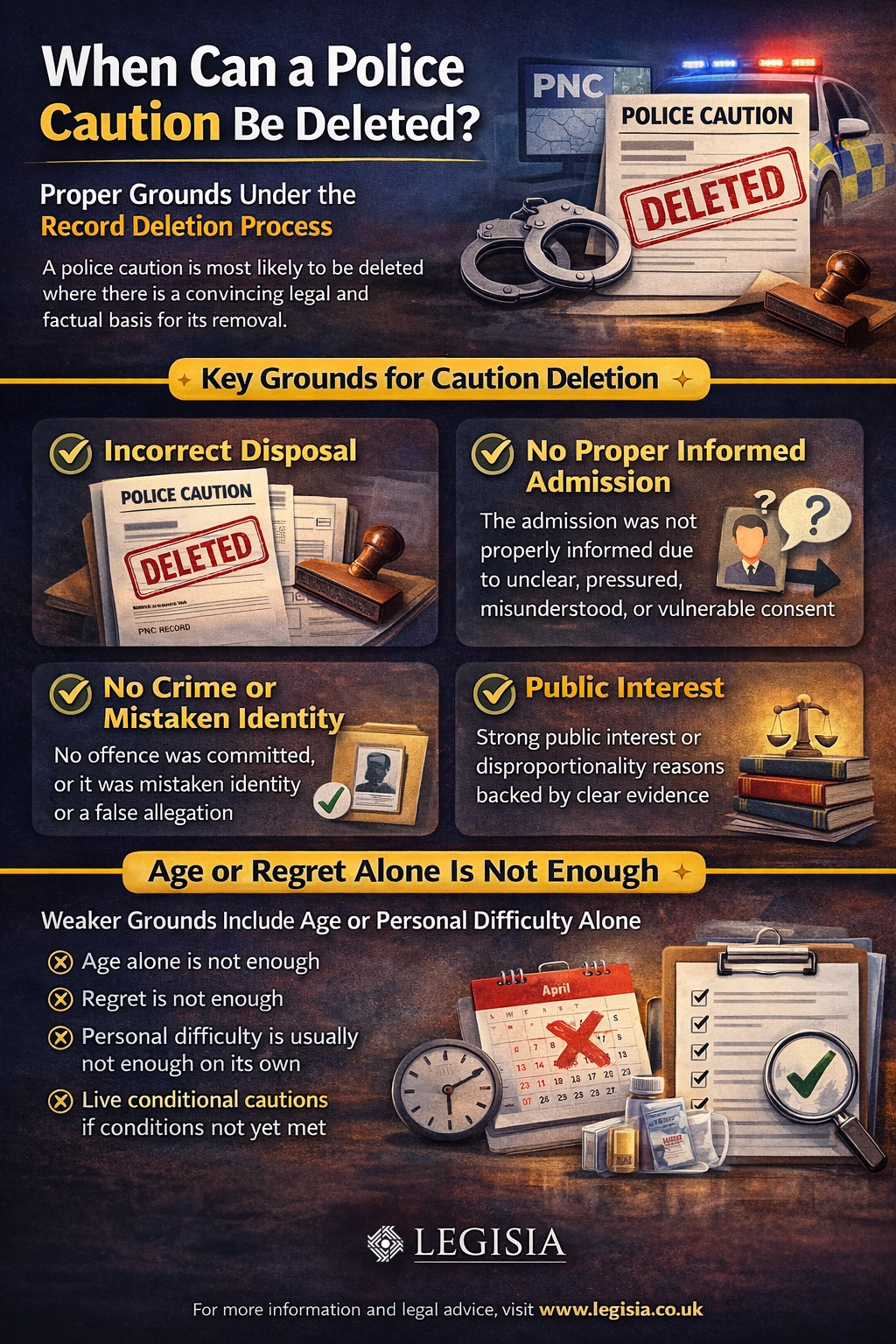
A police caution is most likely to be deleted where there is a substantive flaw in the caution itself – for example, incorrect disposal, no proper informed admission, no crime, mistaken identity, or strong public interest reasons backed by evidence.
If you want the broader overview first, see our guide on whether a police caution can be removed from the PNC. This article is narrower. It focuses on the circumstances in which deletion is realistically possible.
When Can a Police Caution Be Deleted?
A police caution can be deleted where there are proper grounds under the Record Deletion Process and those grounds are accepted by the police force that owns the record. That includes adult cautions and, in the right case, youth cautions and other out-of-court disposals.
But caution cases are different from ordinary arrest record cases. A caution normally involves an admission. So the strongest applications are usually not built around a simple claim of innocence. They are built around showing that the caution was the wrong disposal, was not properly administered, or should not fairly be retained.
That is why the real question is not just “can it be deleted?” but “why should it be deleted?” If the answer is only that the caution is now causing problems, the case is usually weak. If the answer is that the caution was fundamentally flawed, the position is very different.
What Grounds Can Justify Deletion?
The police do not delete cautions simply because they are old or embarrassing. In practice, deletion depends on identifying a recognised ground and supporting it properly. The most important grounds in caution cases usually include the following.
Incorrect disposal
One of the strongest grounds is that the caution was the wrong disposal from the start. That may be because the wrong offence was used, the legal preconditions for a caution were not satisfied, or the police used a caution in circumstances where it should not have been offered at all.
In some cases, the problem only becomes obvious later, once the file is reviewed properly. Where the disposal was wrong, the argument is not merely that the caution is inconvenient. It is that the caution should not have been on the record in the first place.
No proper informed admission
A caution should only be administered where the person understands what is being accepted and makes a clear admission. If the admission was unclear, rushed, pressured, misunderstood, or affected by vulnerability, mental health, language difficulty or lack of proper explanation, that can be a serious ground for deletion.
This is one reason it is so important to think carefully before accepting a caution. If you are at that earlier stage, see Should I Accept a Police Caution? If the caution has already been accepted, the issue becomes whether the admission and process were actually safe.
No crime, mistaken identity or false allegation
Some cases turn on the underlying facts. If no recordable offence was actually committed, the wrong person was cautioned, or there is corroborative evidence of a malicious or false allegation, deletion may be justified.
These cases can be harder in caution matters because a signed caution creates an obvious obstacle. Even so, they can still succeed where the police record is shown to be factually wrong, the alleged conduct did not amount to an offence, or the caution was accepted in circumstances that make the outcome unreliable.
Public interest and disproportionality
Public interest arguments can matter, but they are often misunderstood. The police do not usually delete cautions simply because the consequences feel harsh. Public interest becomes more persuasive where it sits alongside a real underlying flaw in the caution, low seriousness, vulnerability, youth, or a disclosure outcome that is plainly disproportionate. We see that in practice in cases such as our wrongful police caution removed after a tweet investigation and our adult caution removed before a healthcare career was blocked case study .
That is why the strongest cases often combine both substance and consequence. In Legisia’s case study of a single mother wrongly cautioned for child neglect, the career impact mattered because it was coupled with the lack of a clear admission and wider vulnerability.
If you want the wider procedural picture beyond caution-specific grounds, see our guide on how the Record Deletion Process works.
Which Caution Cases Tend to Be Stronger?
Although every case turns on its own facts, police caution deletion is usually more realistic where one or more of the following features can be shown clearly:
- there is a clear defect in how the caution was explained or recorded;
- the interview, caution form or case papers do not show a proper informed admission;
- the conduct was wrongly categorised as a recordable offence or the wrong disposal was used;
- medical, vulnerability or language evidence helps explain why the caution process was unsafe;
- the ongoing impact on DBS disclosure, professional registration, ACRO certificates or ICPC applications supports a wider proportionality argument.
That last point matters most where it reinforces an existing ground. For example, the practical impact on teaching, overseas work, or professional registration may help show why deletion is the fair outcome, but it rarely replaces the need for a proper ground on its own.
If your main concern is overseas safeguarding work, our article on deleting a police caution before an ICPC application explains why timing and disclosure strategy can be just as important as the deletion request itself.
When Is Deletion Usually Unlikely?
Deletion is usually less likely where the caution appears to have been properly administered, the person clearly understood it, there is no obvious problem with the offence or disposal, and the only complaint is that the record has become inconvenient.
- Age alone is not enough – an old caution does not become deletable just because time has passed. If your main concern is how long the caution will stay on record, rather than whether there are grounds to delete it, see our guide on how long a police caution stays on the PNC.
- Regret is not enough – many people wish they had not accepted a caution, but that is not the same as showing that the caution was flawed.
- Hardship alone is not usually enough – difficulty with jobs, visas or reputation can support a case, but usually not without a stronger underlying ground.
- Live conditional cautions are a problem – if the conditions are still running, the application will not usually be considered yet.
- Court convictions are different – the Record Deletion Process is not a route for deleting a conviction imposed by a court.
That does not mean nobody should seek advice in a difficult case. It means expectations need to be realistic from the start. A strong deletion application is not built on hope alone.
Why the Ground Matters More Than the Consequence
Many people only start looking at deletion because something concrete is at stake: a DBS check, a regulator, an ACRO Police Certificate, an ICPC, or a professional role. Those consequences are very real. But in police caution cases, the police will usually focus first on the ground for deletion, not simply on the seriousness of the fallout.
In practice, the best applications combine both. The ground explains why the record is unjustified. The consequence evidence explains why the issue now matters so much. That is often the difference between a general complaint and a well-structured deletion case.
You can see that pattern across Legisia’s caution case studies. In the finance professional’s drug caution case, the overseas impact was severe. In the teacher-training case, the DBS consequences were potentially lifelong because the offence was specified. In each type of case, the real-world consequence is powerful, but it works best when tied to a proper deletion ground.
If your concern is professional regulation rather than overseas work, see our guide on the HCPC and police cautions.
If the issue is when an old drug caution may still show on an overseas certificate, see our guide on whether a drug possession caution will show on an ACRO Police Certificate.
What Evidence Makes an Application Stronger?
Even a good ground can fail if it is poorly evidenced. The police will normally review what they already hold locally, but a well-prepared application helps frame the issues clearly and gives the force something concrete to assess.
Useful material may include:
- the date, location and offence details of the caution;
- the caution paperwork, interview notes, custody record, or body-worn video references if available;
- a clear chronology of what happened and why the caution was wrong or unsafe;
- medical, psychiatric, vulnerability, language or learning-difficulty evidence where relevant;
- documents showing the real-world effect on a DBS check, ACRO Police Certificate, ICPC application, employer or professional regulator;
- any other corroborative documents that support the ground being relied on.
For a fuller explanation of the national procedure itself, see our guide to the Record Deletion Process. The key point for this article is that evidence should support the ground, not simply describe the stress the caution is causing.
How Legisia Can Help
Legisia’s Police Caution Removal work focuses on identifying whether a caution is genuinely deletable and, if so, presenting the case properly. That means reviewing how the caution was administered, whether there is a viable ground for deletion, and how the wider DBS, ACRO, ICPC or regulatory impact should be explained.
Not every caution can be removed. But where the caution was wrongly issued, unfairly administered or disproportionate to retain, early specialist advice can make a real difference to the quality of the application and the strategy around it.
You can also read our police caution removal and disclosure guide for the main caution articles and case studies in one place.
Not sure whether your police caution is actually deletable?
If a police caution is affecting your DBS position, professional registration, ACRO Police Certificate, ICPC application, or overseas plans, the key question is not just whether it causes difficulty – it is whether there are proper grounds to remove it.
Legisia advises clients on police caution removal, the Record Deletion Process, and the wider disclosure issues that often arise once a caution remains on the PNC.
Frequently Asked Questions
What are the strongest grounds for deleting a police caution?
The strongest grounds are usually incorrect disposal, no proper informed admission, no crime, mistaken identity, malicious or false allegation, or public interest factors backed by clear evidence. In caution cases, the police will usually want to see more than bare assertion.
Can a police caution be deleted if I signed the caution form?
Potentially, yes. Signing the form does not make deletion impossible. But it does mean the case normally has to explain why the admission was not properly informed, why the process was unfair, or why the caution was the wrong disposal despite what was signed at the time.
Can an old police caution be deleted just because it is old?
No. Age alone is not enough. The passage of time can help with proportionality and public interest, but an old caution still usually needs a proper deletion ground.
Does a specified offence caution make deletion more important?
Often, yes. A caution for a specified offence can continue to create long-term DBS problems, which makes deletion strategically more important. But importance is not the same as entitlement. You still need a valid ground.
Can a youth caution be deleted under the Record Deletion Process?
Potentially, yes. Youth out-of-court disposals can be eligible for record deletion, although youth disclosure rules are different from adult cautions. For disclosure issues specifically, see our article on youth cautions, warnings and reprimands.
Is job loss, visa trouble or regulator concern enough on its own?
Usually not. Those consequences can be very important and may strengthen a public interest or proportionality argument, but they do not usually replace the need for a genuine legal or factual ground for deletion.
Share this Post, Choose your platform!

Matt is a Solicitor Advocate and Director of Legisia Legal Services. He specialises exclusively in police record deletion, DBS appeals, and regulatory defence. With over 20 years of experience, he has advised hundreds of professionals and individuals on high-stakes matters affecting careers, reputations, and legal standing. His work focuses on challenging unlawful data retention, safeguarding thresholds, and procedural breaches across UK policing and disclosure systems.
Matt is a Solicitor Advocate and Director of Legisia Legal Services. He specialises exclusively in police record deletion, DBS appeals, and regulatory defence. With over 20 years of experience, he has advised hundreds of professionals and individuals on high-stakes matters affecting careers, reputations, and legal standing. His work focuses on challenging unlawful data retention, safeguarding thresholds, and procedural breaches across UK policing and disclosure systems.
Disclosure & DBS: the complete CPD course for professionals
Written by a solicitor who handles these cases every day. For HR, compliance, safeguarding and legal professionals who make decisions about police records and DBS disclosures.
- Eleven modules covering disclosure, DBS checks, barring, regulatory interface and employment decisions
- The only UK course that also covers how UK records affect work, travel and employment abroad
- CPD-accredited, with written feedback on a final applied-scenario exercise
- Waitlist members get 20% off and a sample module ahead of launch
We'll email you the checklist and news about the course launch – nothing else. See the full course →





Do Police Cautions Show on an Enhanced DBS Check?
Mar 12, 2026

How Long Does a Police Caution Stay on the PNC?
Mar 9, 2026
