


- Police Caution Deletion
-

 9 min read





If you are asking whether a police caution can be removed from the PNC, the short answer is that it can be possible – but only in the right case, and usually only through a formal application under the police Record Deletion Process.
This issue often comes up years after the caution was accepted. Someone applies for work, professional registration, an overseas role, an ACRO Police Certificate, an ICPC, or a DBS check, and only then discovers that the caution is still sitting on the Police National Computer (PNC).
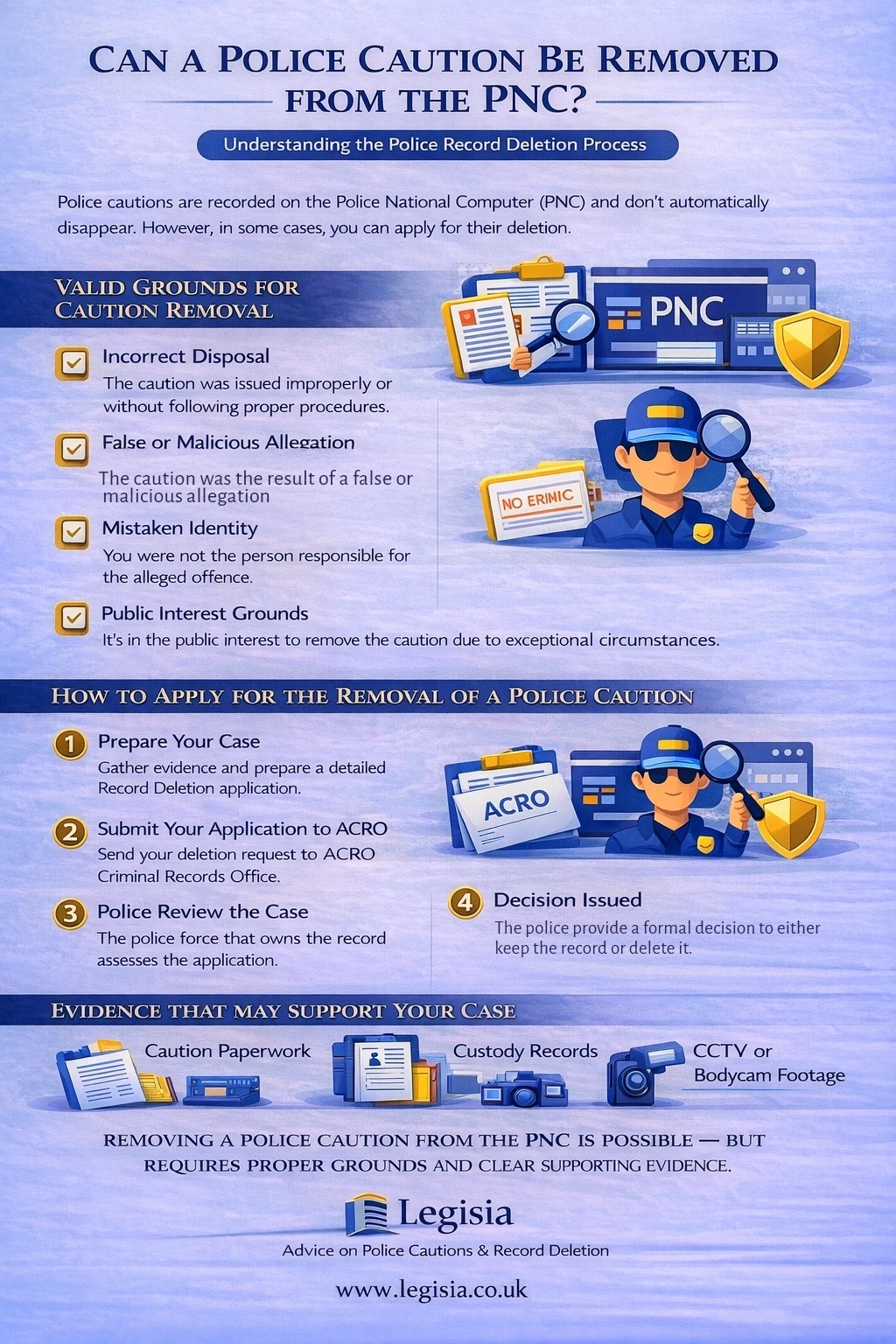
Yes. A police caution can sometimes be removed from the Police National Computer (PNC) through the Record Deletion Process if there are valid grounds such as incorrect disposal, procedural unfairness, or a caution that should never have been issued.
In this article, we explain when a police caution may be removed from the PNC, why deletion is different from a caution becoming spent or filtered, and what evidence usually matters most. If you are being offered a caution now rather than trying to remove an old one, start with our guide Should I Accept a Police Caution?.
Can a Police Caution Be Removed From the PNC?
Yes, potentially. A police caution can sometimes be removed from the PNC through the national Record Deletion Process. That applies to adult cautions and, in the right circumstances, to youth cautions and related out-of-court disposals as well.
What matters, however, is that deletion is not automatic. The police do not remove a caution just because it is old, embarrassing, or causing problems. The application has to show proper grounds and be supported by evidence.
If you need advice on whether your own caution is a realistic candidate for deletion, Legisia’s Police Caution Removal service explains how these cases are approached in practice.
Why Does a Police Caution Stay on the PNC?
A police caution is a formal disposal, not an informal warning. Once it is recorded, it becomes part of the person’s PNC record and can continue to affect criminal record disclosure, safeguarding checks, police vetting, overseas certificates, and professional regulation.
This is why people often first discover the problem when applying for an International Child Protection Certificate (ICPC), checking the likely outcome of an Enhanced DBS certificate, or dealing with a professional regulator such as in Legisia’s article on the HCPC and police cautions. We explain the DBS side in more detail in our guide on police cautions and Enhanced DBS checks. We also explain the overseas ACRO Police Certificate position in more detail in our guide on cautions on ACRO Police Certificates.
You can also see the practical impact in Legisia’s case studies, including a finance professional whose caution affected overseas plans and a single mother whose caution blocked teacher training.
When Can a Police Caution Be Deleted?
This is the key question. In caution cases, deletion is sometimes harder than in a no-further-action arrest case because a caution normally involves an admission. In other words, the police will not usually treat the application as a simple claim that you were never a suspect at all.
Instead, police caution deletion usually turns on whether the caution was the wrong disposal, whether the process was unfair, or whether continued retention is no longer justified. Common themes in viable caution cases include:
- Incorrect disposal – the caution should not have been used at all, the wrong offence or disposal was applied, or the legal preconditions for a caution were not properly met.
- No proper admission or understanding – the admission was unsafe because the person was pressured, confused, vulnerable, or did not properly understand what accepting the caution meant.
- No crime or mistaken identity – the facts did not amount to a recordable offence, or the wrong person was dealt with.
- Public interest arguments – there are wider factors showing that keeping the caution on the PNC is no longer justified, although this is not a general hardship test and still needs proper evidence.
Not every caution that causes problems is removable. But if the caution was wrongly administered, improperly explained, or disproportionate to retain, there may be a basis to seek deletion.
In practice, the police will expect a properly evidenced explanation of why the caution should not stay on the PNC. General regret, or the mere fact that the caution is now causing professional difficulty, is not usually enough on its own.
For a fuller explanation of the grounds the police will actually assess, see our guide on when a police caution can be deleted.
How Do You Apply to Remove a Caution From the PNC?
The usual route is a Record Deletion Process application. In practice, the application is handled through ACRO and considered by the police force that owns the record. A good application does more than say the caution is causing damage. It should identify the legal basis for deletion and explain the evidence clearly.
Useful material may include:
- proof of identity and current address;
- the date, location and details of the caution;
- the caution paperwork, custody record, interview notes, or body-worn video references if available;
- medical, vulnerability, language, or procedural evidence where relevant;
- evidence showing the real-world effect on DBS disclosure, ACRO certificates, ICPC applications, professional registration, or vetting.
There is no fee for the ACRO or Chief Officer part of the Record Deletion Process itself. But the quality of the application matters. A weak or poorly evidenced request is much easier for the police to refuse.
If the caution is a conditional caution and the conditions are still live, the application will not usually be considered until those conditions have ended.
Spent, Filtered or Deleted – What Is the Difference?
These terms are often mixed up, but they do not mean the same thing.
Spent
A simple caution becomes spent straight away. A conditional caution becomes spent when the conditions end, or after three months if the conditions have no end date. That affects what you usually have to disclose for most ordinary purposes.
For a fuller breakdown of how long a caution can stay on the PNC, Basic DBS, Standard and Enhanced DBS, and overseas certificates, see our guide on how long a police caution stays on the PNC.
Filtered
Filtering is a DBS disclosure rule, not PNC deletion. Some adult cautions for non-specified offences stop appearing automatically on standard and enhanced DBS certificates after the relevant period, while cautions for specified offences can continue to be disclosed. If you are unsure, Legisia’s Police Caution Calculator is a useful starting point.
Deleted
Deletion means the record itself is removed from the PNC through the Record Deletion Process. That is a stronger outcome because it addresses the underlying police record rather than only one disclosure rule.
This distinction is especially important for overseas and safeguarding cases. A caution may be spent or filtered for one domestic purpose and still create problems on certificates or vetting systems that depend on the underlying police record.
If you want to understand the broader national-systems position beyond cautions alone, see our guide to the police Record Deletion Process.
What Happens If the Police Refuse?
A refusal is not always the end of the matter. The Record Deletion Process includes an internal appeal stage, and the appeal should be reviewed by someone other than the original decision-maker.
Depending on the case, there may also be scope for a complaint to the force, the force’s data protection officer, or the Information Commissioner’s Office. In some cases, judicial review may need to be considered. The right next step depends on why the request was refused and whether better evidence or a stronger legal argument is available.
How Legisia Can Help
Legisia’s Police Caution Removal work focuses on whether a caution was wrongly issued, improperly explained, or disproportionate to retain. That includes linked issues such as DBS disclosure, ICPC applications, professional registration, overseas certificates, and related police data problems.
If your caution is affecting work, travel, registration, or vetting, Legisia can review the background and tell you honestly whether there appears to be a realistic basis for a Record Deletion Process application.
Need help removing a police caution from the PNC?
If a police caution is affecting your career, professional registration, DBS disclosure, or overseas work opportunities, it may be possible to apply for deletion through the Record Deletion Process.
Legisia advises individuals on whether a caution may qualify for removal and prepares detailed applications to the police where appropriate.
For a wider overview of removal, disclosure and real examples, see our police cautions guide.
Is a police caution affecting your DBS check or career?
If a police caution is appearing on a DBS check, ACRO Police Certificate, ICPC, or professional registration application, it may be possible to apply for removal through the Record Deletion Process.
Legisia advises clients on police caution removal, the Record Deletion Process, and addressing police records that may appear on criminal record checks.
Frequently Asked Questions
Can any police caution be removed from the PNC?
No. The police do not delete cautions automatically or simply because they are old. Removal usually depends on showing proper grounds under the Record Deletion Process, such as incorrect disposal, procedural unfairness, or strong public interest factors.
Does a spent caution still stay on the PNC?
Yes. A caution can be spent for Rehabilitation of Offenders Act purposes and still remain recorded on the PNC. Spent status and PNC deletion are different things.
Can a conditional caution be removed before the conditions end?
Usually not. If the conditions are still live, the application will normally not be considered under the Record Deletion Process until those conditions have been completed.
Will deleting a caution from the PNC stop it showing on a DBS or ACRO certificate?
That is generally the aim. If the caution is deleted from the PNC, it should no longer appear as a PNC-based record on checks or certificates that depend on that record. However, separately held local police information can raise different issues in some cases.
How long does police caution removal take?
There is no single fixed timescale. The national guidance expects a written decision within about a calendar month, but complex cases, additional evidence requests, and force delays can make the process significantly longer.
What if I accepted the caution because I was pressured or did not understand it?
That can be important. A caution should only be used where the legal and procedural requirements were properly met. If the caution was not properly explained, the admission was unsafe, or you were vulnerable at the time, those points may support an argument that the caution was wrongly administered and should be deleted.
Share this Post, Choose your platform!

Matt is a Solicitor Advocate and Director of Legisia Legal Services. He specialises exclusively in police record deletion, DBS appeals, and regulatory defence. With over 20 years of experience, he has advised hundreds of professionals and individuals on high-stakes matters affecting careers, reputations, and legal standing. His work focuses on challenging unlawful data retention, safeguarding thresholds, and procedural breaches across UK policing and disclosure systems.
Matt is a Solicitor Advocate and Director of Legisia Legal Services. He specialises exclusively in police record deletion, DBS appeals, and regulatory defence. With over 20 years of experience, he has advised hundreds of professionals and individuals on high-stakes matters affecting careers, reputations, and legal standing. His work focuses on challenging unlawful data retention, safeguarding thresholds, and procedural breaches across UK policing and disclosure systems.
Disclosure & DBS: the complete CPD course for professionals
Written by a solicitor who handles these cases every day. For HR, compliance, safeguarding and legal professionals who make decisions about police records and DBS disclosures.
- Eleven modules covering disclosure, DBS checks, barring, regulatory interface and employment decisions
- The only UK course that also covers how UK records affect work, travel and employment abroad
- CPD-accredited, with written feedback on a final applied-scenario exercise
- Waitlist members get 20% off and a sample module ahead of launch
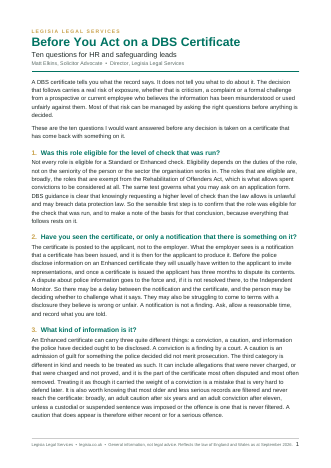
We'll email you the checklist and news about the course launch – nothing else. See the full course →





Do Police Cautions Show on an Enhanced DBS Check?
Mar 12, 2026

How Long Does a Police Caution Stay on the PNC?
Mar 9, 2026
