- Kent Police
-

 6 min read





On November 2023, six Kent Police officers arrived at the Gillingham home of retired special constable Julian Foulkes after a brief reply he posted on X was misinterpreted as a hate-related comment. The post had been viewed only 26 times, yet officers handcuffed the 71-year-old, detained him for eight hours and issued a police caution at the end of the interview.
Mr Foulkes later described accepting the caution while still in shock.
“I didn’t agree, but I felt I had no choice.”
What began as a short online exchange resulted in a formal police record that would remain on the Police National Computer unless successfully challenged.
The case drew national attention after Kent Police later admitted the caution was “not appropriate in the circumstances” and confirmed it had been deleted. The incident raised wider concerns about how online speech is assessed, the use of police powers in low-level digital expression cases and the lasting impact of cautions that are accepted under pressure.
It also placed a spotlight on the broader issue of police data retention, with the deletion achieved only after Mr Foulkes instructed Legisia Legal Services to challenge the record.
The events leading to Mr Foulkes’s arrest began with a brief reply he posted on X in response to an online discussion about rising anti-Semitism. Referencing reports of an anti-Jewish mob storming an airport in Dagestan, he wrote a short comment comparing the situation abroad with the tone of domestic protests. The post had attracted just 26 views, and no members of the public had complained.
However, the Metropolitan Police Intelligence Command flagged the post to Kent Police, raising concerns about its content. Officers interpreted it as hostile rather than cautionary, a reading that conflicted with both the context of the thread and Mr Foulkes’s stated intention. He later said he repeatedly told officers during his interview that his meaning had been misunderstood.
“Kent Police decided to interpret my post as anti-Jewish, but it was the exact opposite,” he said.
Despite denying any intent to cause distress, Mr Foulkes was arrested at his home, booked into custody and held for eight hours before receiving the caution. He recalled trying to explain that his comment had been part of a wider exchange.
“If they’d looked at the full thread, they’d have understood,” he said.
The caution issued at the end of Mr Foulkes’s detention carried lasting consequences. Despite being presented as a minor outcome, a police caution is a formal admission of guilt and remains on the Police National Computer until the age of 100 unless removed. Such records routinely affect employment checks, professional registrations and international travel.
Mr Foulkes said he accepted the caution while still unsettled by the events of the day.
“I wasn’t thinking logically at the time,” he said.
He later described the lingering psychological impact of the incident.
“It’s like PTSD. You push it to the back of your mind, but it comes back and you relive it.”
He explained that he was particularly worried the caution might interfere with visiting his daughter in Australia, a concern that influenced his decision during the interview.
The handling of the case drew wider public attention once Kent Police acknowledged that the caution “was not appropriate in the circumstances” and confirmed it had been deleted. Following publication of the incident, the force amended its public statement to include an apology and later issued a direct personal apology to Mr Foulkes through Chief Constable Tim Smith.
Mr Foulkes said he had heard nothing from the force since 2023 until the apology was made.
“Up to that point I had had no direct apology,” he said.
The case prompted comments from senior political figures, including Suella Braverman and Chris Philp, who both raised concerns about the use of police powers in matters involving lawful expression. The Free Speech Union also offered to support legal action, with the incident becoming part of a broader discussion about the boundaries of digital policing and the assessment of online speech.
The caution was deleted only after Mr Foulkes instructed Legisia Legal Services to challenge the record. He said he was looking for a solicitor with a proven track record in removing cautions and described the submission prepared on his behalf as “excellent.”
For a more detailed, case-focused account of how the caution was challenged and removed, read our case study on wrongful police caution removal after a tweet investigation.
Legisia’s representations led Kent Police to confirm that the caution had been issued in error and should not have remained on the Police National Computer. The decision was followed by a direct apology from Chief Constable Tim Smith and a review of how the case had been handled.
Matt Elkins, director of Legisia Legal Services, said the incident raised wider concerns about how online expression is assessed.
“Our freedoms won’t be taken from us suddenly, but by the quiet and gradual criminalisation of our conscience.”
The case also highlighted wider concerns about how police information is recorded and used. Cautions and related entries can remain on national systems for many years and may appear on background checks even where no charge or prosecution followed.
Matt Elkins said increasing numbers of individuals are seeking advice after discovering how long such records remain active and how they may be interpreted by employers or authorities. He noted that greater clarity is needed around how online communication is assessed within policing decisions.
Mr Foulkes said he hoped his experience would encourage others to be aware of the current environment surrounding digital expression.
“People need to know what’s going on… you might think you’re safe posting something a little edgy from home, but that’s not the climate right now.”
The removal of the caution marked the end of a case that raised broader questions about the handling of online communication and the recording of non-conviction information.
Kent Police’s decision to reassess the incident acknowledged the need for closer scrutiny in such matters. It also demonstrated the value of a well-founded challenge, with Legisia Legal Services securing the deletion that corrected the record and finalised the outcome.
Share this Post, Choose your platform!

Matt is a Solicitor Advocate and Director of Legisia Legal Services. He specialises exclusively in police record deletion, DBS appeals, and regulatory defence. With over 20 years of experience, he has advised hundreds of professionals and individuals on high-stakes matters affecting careers, reputations, and legal standing. His work focuses on challenging unlawful data retention, safeguarding thresholds, and procedural breaches across UK policing and disclosure systems.
Matt is a Solicitor Advocate and Director of Legisia Legal Services. He specialises exclusively in police record deletion, DBS appeals, and regulatory defence. With over 20 years of experience, he has advised hundreds of professionals and individuals on high-stakes matters affecting careers, reputations, and legal standing. His work focuses on challenging unlawful data retention, safeguarding thresholds, and procedural breaches across UK policing and disclosure systems.
Disclosure & DBS: the complete CPD course for professionals
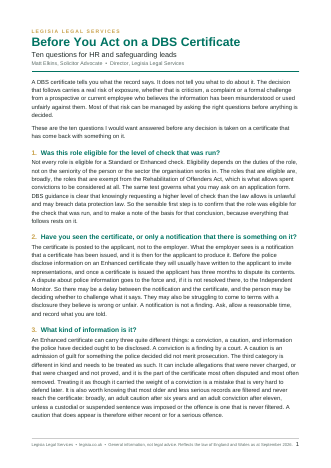
Written by a solicitor who handles these cases every day. For HR, compliance, safeguarding and legal professionals who make decisions about police records and DBS disclosures.
- Eleven modules covering disclosure, DBS checks, barring, regulatory interface and employment decisions
- The only UK course that also covers how UK records affect work, travel and employment abroad
- CPD-accredited, with written feedback on a final applied-scenario exercise
- Waitlist members get 20% off and a sample module ahead of launch
We'll email you the checklist and news about the course launch – nothing else. See the full course →