


- Police Caution Deletion
-

 7 min read





If you are looking for a police caution removal solicitor, the main question is usually not just whether a caution can be removed, but whether your case has the right legal and evidential basis to persuade the police to delete it.
Some caution removal cases are straightforward. Others are much more technical. The difference often comes down to how the caution was issued, whether there was a proper informed admission, what the paperwork shows, and whether the case is really about the underlying PNC record, DBS disclosure, ACRO disclosure, or local police information.
This article focuses on when a solicitor can add real value in a police caution removal case, what specialist legal work usually involves, and why the strategy matters. If you want the broader overview first, read Can a Police Caution Be Removed From the PNC?.
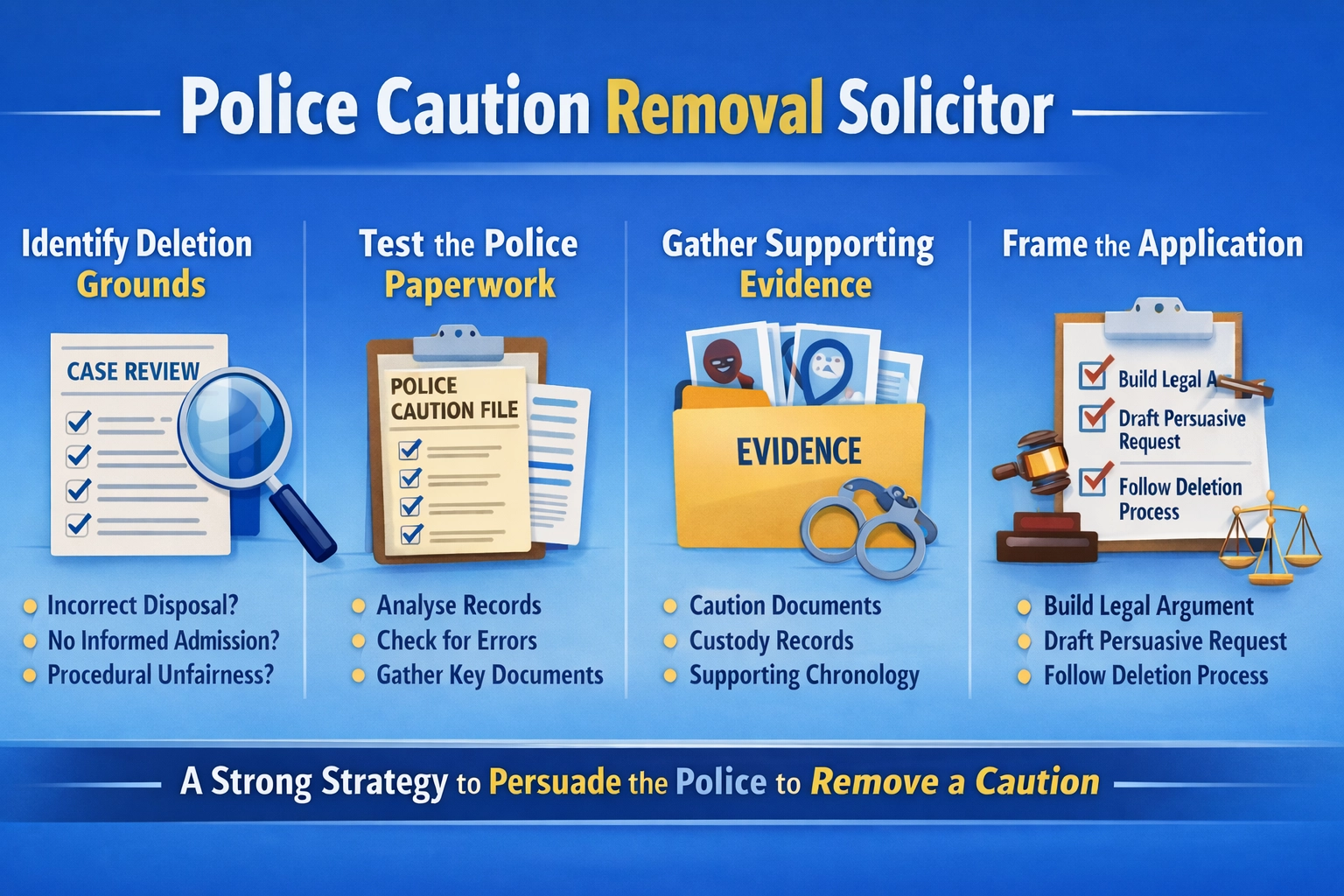
A specialist police caution removal solicitor helps by identifying the right deletion ground, testing the police paperwork, gathering supporting evidence, and framing the application in a way that gives the police a proper basis to remove the caution.
Police Caution Removal Solicitor
A police caution can have lasting consequences even where it is spent immediately for some purposes. It may still remain on the Police National Computer (PNC), affect an Enhanced DBS check, appear on an ACRO Police Certificate, or create problems for professional regulation, overseas work, or security vetting.
That is why many people only seek help years later, when the caution starts to interfere with a job, visa, regulator, safeguarding role or overseas application. At that point, the issue is no longer simply whether the caution feels unfair. The issue is whether there are proper legal grounds to challenge its retention.
When Should You Speak to a Solicitor?
You should consider specialist advice where the caution is causing a serious practical problem, or where the way it was administered was questionable.
Common examples include:
- you were pressured into accepting the caution or it was not properly explained;
- you did not fully understand the legal consequences at the time;
- the wrong disposal may have been used;
- the caution is affecting a DBS certificate, overseas certificate, regulator or job offer;
- the police have already refused a request to remove it.
If your question is mainly whether the caution is even deletable in principle, see our guide on when a police caution can be deleted.
What a Solicitor Actually Does in a Caution Removal Case
The value of legal advice is not just writing a letter saying the caution is causing problems. A strong caution removal case usually needs a solicitor to test the legal ground, organise the facts properly, and present the evidence in a coherent way.
That often includes:
- reviewing how the caution was administered and whether there was a proper informed admission;
- identifying whether the case is really about incorrect disposal, procedural unfairness, no crime, disproportionality, or another recognised ground;
- obtaining and analysing the caution paperwork, custody material, chronology or supporting records where possible;
- showing the practical impact on employment, DBS disclosure, ACRO certificates, professional registration or overseas plans;
- drafting the application in a way that aligns with the Record Deletion Process.
That legal framing matters because the police do not delete cautions just because they are old or inconvenient. They need a proper basis for doing so.
Why Some Caution Removal Cases Are More Complex Than They Look
At first sight, some cases look simple: the caution seems unfair, the consequences are harsh, and the person has moved on. But those factors do not automatically mean the police will delete the record.
The difficulty is that caution cases usually involve an apparent admission. That means the case often turns on more technical questions such as whether the admission was actually informed, whether the disposal was wrong, whether vulnerability or pressure affected the process, or whether the caution should never have been issued in that form at all.
It is also important to understand what kind of problem you are trying to solve. If the issue is retention on the PNC, our guide on how long a police caution stays on the PNC explains the record-retention side. If the issue is disclosure on an Enhanced DBS certificate, read Do Police Cautions Show on an Enhanced DBS Check?. If the problem is overseas disclosure, see Will a Police Caution Show on an ACRO Police Certificate?.
What Happens If the Police Refuse to Delete the Caution?
A refusal is not always the end of the matter. Depending on the circumstances, there may be scope for an internal appeal, a complaint, or in the right case a judicial review challenge.
This is another stage where legal advice can matter. Sometimes the original application failed because the wrong ground was advanced, the evidence was incomplete, or the police response needs to be challenged more carefully. In other cases, the refusal makes clear that the problem lies elsewhere – for example in local police information rather than the caution itself.
If you are already at the refusal stage, a solicitor can help assess whether the better next step is appeal, complaint, judicial review, or a different disclosure strategy altogether.
How Legisia Can Help
Legisia’s Police Caution Removal work is focused on identifying whether a caution is genuinely deletable and, if so, presenting the strongest possible case to the police. That includes caution cases affecting DBS disclosure, ACRO Police Certificates, overseas work, security vetting and professional regulation.
We have acted in hundreds of police record matters and understand that caution cases often sit at the intersection of record retention, disclosure law, data protection and professional regulation. The right approach is not always obvious at first glance, which is why careful case assessment matters.
Need advice from a police caution removal solicitor?
If a police caution is affecting your job, DBS position, overseas application, professional registration or long-term plans, specialist legal advice may make the difference between a weak request and a properly prepared deletion case. Taking legal advice is often advisable where a caution threatens a professional future, as in our case study on a nurse who deleted a police caution before her NMC registration.
Legisia advises clients on police caution removal, the Record Deletion Process, and related disclosure problems where cautions continue to cause difficulty.
Frequently Asked Questions
Do I need a solicitor to remove a police caution?
Not in every case, but specialist legal advice can be very useful where the caution is causing serious consequences, the police are likely to dispute the ground, or the paperwork and factual history need careful analysis.
Can a solicitor guarantee that a police caution will be removed?
No. No solicitor can honestly guarantee deletion. What matters is whether there are proper grounds, good evidence, and a strong strategy for presenting the case.
What makes a police caution removal case stronger?
Strong cases often involve incorrect disposal, no proper informed admission, procedural unfairness, vulnerability, no crime, compelling personal circumstances or a caution that should not have been issued in the way it was.
Can a solicitor help after the police refuse to delete the caution?
Yes. A solicitor can review the refusal, assess whether appeal or judicial review is realistic, and consider whether the real issue lies in the caution itself or another type of police record or disclosure.
Is a caution removal case the same as a DBS challenge?
No. Sometimes the problem is the underlying caution on the PNC. Sometimes it is local police information or DBS disclosure. The correct strategy depends on the source of the issue.
Will removing a caution from the PNC help with ACRO or overseas problems?
Often, yes. If the underlying caution is successfully deleted from the PNC, that is usually a stronger long-term solution than relying only on step-down or certificate-specific disclosure rules.
Share this Post, Choose your platform!

Matt is a Solicitor Advocate and Director of Legisia Legal Services. He specialises exclusively in police record deletion, DBS appeals, and regulatory defence. With over 20 years of experience, he has advised hundreds of professionals and individuals on high-stakes matters affecting careers, reputations, and legal standing. His work focuses on challenging unlawful data retention, safeguarding thresholds, and procedural breaches across UK policing and disclosure systems.
Matt is a Solicitor Advocate and Director of Legisia Legal Services. He specialises exclusively in police record deletion, DBS appeals, and regulatory defence. With over 20 years of experience, he has advised hundreds of professionals and individuals on high-stakes matters affecting careers, reputations, and legal standing. His work focuses on challenging unlawful data retention, safeguarding thresholds, and procedural breaches across UK policing and disclosure systems.
Disclosure & DBS: the complete CPD course for professionals
Written by a solicitor who handles these cases every day. For HR, compliance, safeguarding and legal professionals who make decisions about police records and DBS disclosures.
- Eleven modules covering disclosure, DBS checks, barring, regulatory interface and employment decisions
- The only UK course that also covers how UK records affect work, travel and employment abroad
- CPD-accredited, with written feedback on a final applied-scenario exercise
- Waitlist members get 20% off and a sample module ahead of launch
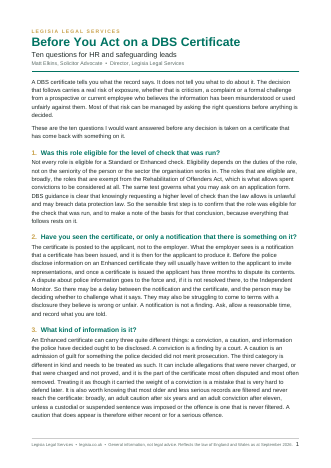
We'll email you the checklist and news about the course launch – nothing else. See the full course →





Do Police Cautions Show on an Enhanced DBS Check?
Mar 12, 2026

How Long Does a Police Caution Stay on the PNC?
Mar 9, 2026
